van Assen Marcel A L M, van Aert Robbie C M, Nuijten Michèle B, Wicherts Jelte M
Department of Methodology and Statistics, Tilburg School of Behavioral Sciences, Tilburg University, Tilburg, The Netherlands.
PLoS One. 2014 Jan 17;9(1):e84896. doi: 10.1371/journal.pone.0084896. eCollection 2014.
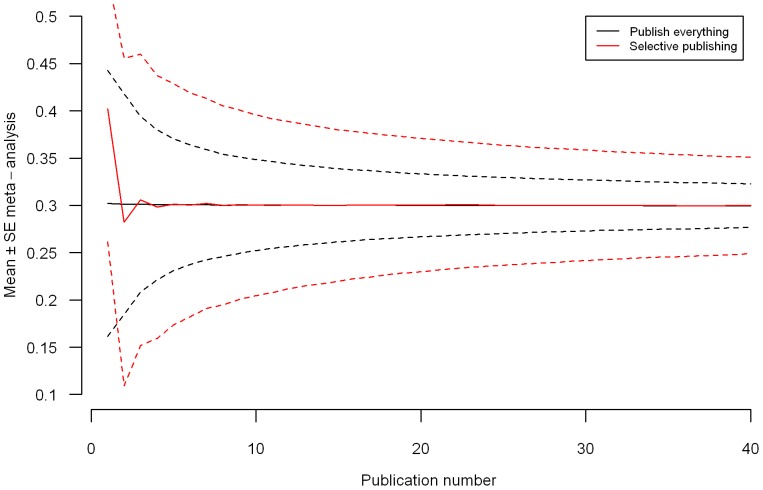
De Winter and Happee examined whether science based on selective publishing of significant results may be effective in accurate estimation of population effects, and whether this is even more effective than a science in which all results are published (i.e., a science without publication bias). Based on their simulation study they concluded that "selective publishing yields a more accurate meta-analytic estimation of the true effect than publishing everything, (and that) publishing nonreplicable results while placing null results in the file drawer can be beneficial for the scientific collective" (p.4).
Using their scenario with a small to medium population effect size, we show that publishing everything is more effective for the scientific collective than selective publishing of significant results. Additionally, we examined a scenario with a null effect, which provides a more dramatic illustration of the superiority of publishing everything over selective publishing.
Publishing everything is more effective than only reporting significant outcomes.
德温特和哈佩研究了基于选择性发表显著结果的科学是否能有效准确估计总体效应,以及这是否比发表所有结果的科学(即无发表偏倚的科学)更有效。基于他们的模拟研究,他们得出结论:“与发表所有结果相比,选择性发表能对真实效应进行更准确的荟萃分析估计,(并且)发表不可重复的结果同时将无效结果放入文件抽屉对科学共同体可能是有益的”(第4页)。
使用他们设定的中小总体效应量情景,我们表明对科学共同体而言,发表所有结果比选择性发表显著结果更有效。此外,我们研究了零效应情景,这更有力地说明了发表所有结果优于选择性发表。
发表所有结果比仅报告显著结果更有效。