Thorolfsdottir Rosa Björk, Aspelund Thor, Capewell Simon, Critchley Julia, Gudnason Vilmundur, Andersen Karl
Icelandic Heart Association, Kopavogur, Iceland ; University of Iceland, Reykjavik, Iceland.
Division of Public Health, University of Liverpool, Liverpool, United Kingdom.
PLoS One. 2014 Jan 21;9(1):e85800. doi: 10.1371/journal.pone.0085800. eCollection 2014.
Coronary heart disease (CHD) mortality rates have been decreasing in Iceland since the 1980s, largely reflecting improvements in cardiovascular risk factors. The purpose of this study was to predict future CHD mortality in Iceland based on potential risk factor trends.
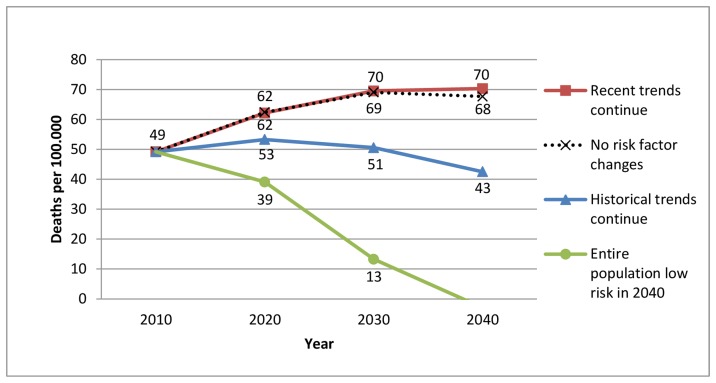
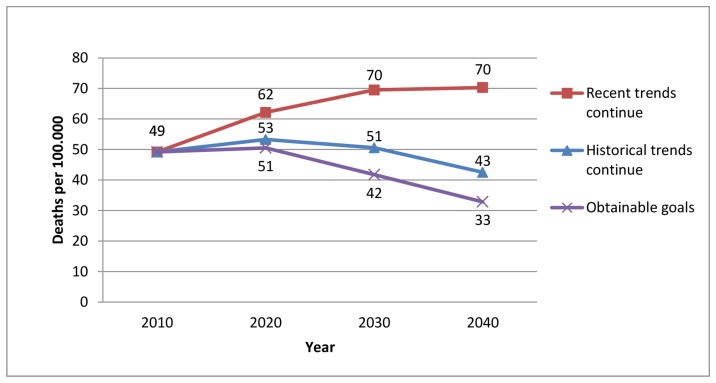
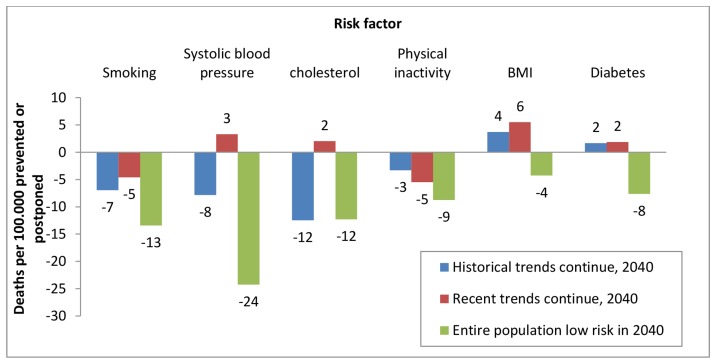
The previously validated IMPACT model was used to predict changes in CHD mortality between 2010 and 2040 among the projected population of Iceland aged 25-74. Calculations were based on combining: i) data on population numbers and projections (Statistics Iceland), ii) population risk factor levels and projections (Refine Reykjavik study), and iii) effectiveness of specific risk factor reductions (published meta-analyses). Projections for three contrasting scenarios were compared: (1) If the historical risk factor trends of past 30 years were to continue, the declining death rates of past decades would level off, reflecting population ageing. (2) If recent trends in risk factors (past 5 years) continue, this would result in a death rate increasing from 49 to 70 per 100,000. This would reflect a recent plateau in previously falling cholesterol levels and recent rapid increases in obesity and diabetes prevalence. 3) Assuming that in 2040 the entire population enjoys optimal risk factor levels observed in low risk cohorts, this would prevent almost all premature CHD deaths before 2040.
The potential increase in CHD deaths with recent trends in risk factor levels is alarming both for Iceland and probably for comparable Western populations. However, our results show considerable room for reducing CHD mortality. Achieving the best case scenario could eradicate premature CHD deaths by 2040. Public health policy interventions based on these predictions may provide a cost effective means of reducing CHD mortality in the future.
自20世纪80年代以来,冰岛的冠心病(CHD)死亡率一直在下降,这在很大程度上反映了心血管危险因素方面的改善。本研究的目的是根据潜在危险因素趋势预测冰岛未来的冠心病死亡率。
使用先前验证过的IMPACT模型来预测2010年至2040年冰岛25 - 74岁预计人口中的冠心病死亡率变化。计算基于以下数据的结合:i)人口数量和预测数据(冰岛统计局),ii)人群危险因素水平和预测数据(雷克雅未克精细化研究),以及iii)特定危险因素降低的有效性(已发表的荟萃分析)。比较了三种不同情景的预测结果:(1)如果过去30年的历史危险因素趋势继续下去,过去几十年下降的死亡率将趋于平稳,这反映了人口老龄化。(2)如果危险因素的近期趋势(过去5年)持续下去,这将导致死亡率从每10万人49例增加到70例。这将反映出此前下降的胆固醇水平近期出现平稳期,以及肥胖和糖尿病患病率近期迅速上升。(3)假设到2040年整个人口都达到低风险队列中观察到的最佳危险因素水平,这将预防2040年前几乎所有的冠心病过早死亡。
危险因素水平的近期趋势可能导致的冠心病死亡增加,这对冰岛以及可能对类似的西方人群来说都令人担忧。然而,我们的结果表明降低冠心病死亡率仍有很大空间。实现最佳情景可能在2040年前消除冠心病过早死亡。基于这些预测的公共卫生政策干预措施可能为未来降低冠心病死亡率提供一种具有成本效益的手段。