Department of Applied Health Research, University College London, London, United Kingdom.
PLoS One. 2013 Jul 25;8(7):e69935. doi: 10.1371/journal.pone.0069935. Print 2013.
To estimate the number of coronary heart disease (CHD) deaths potentially preventable in England in 2020 comparing four risk factor change scenarios.
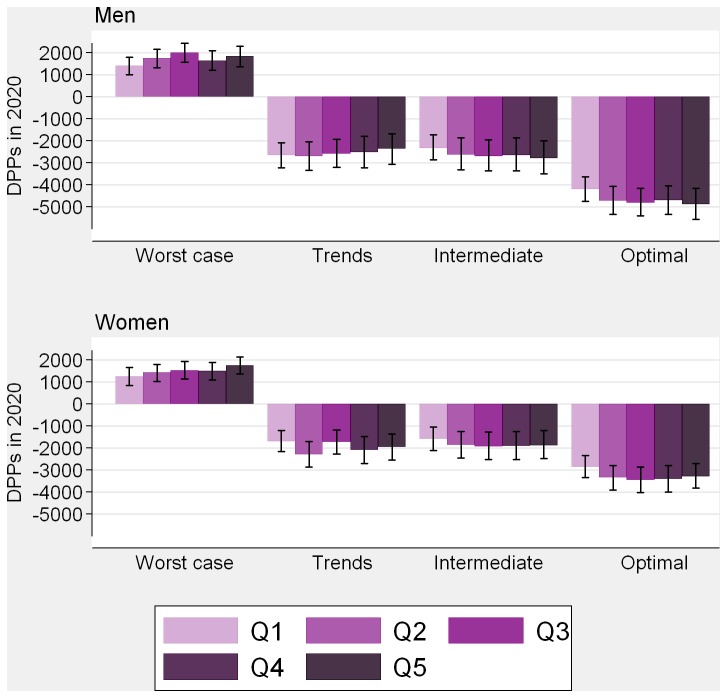
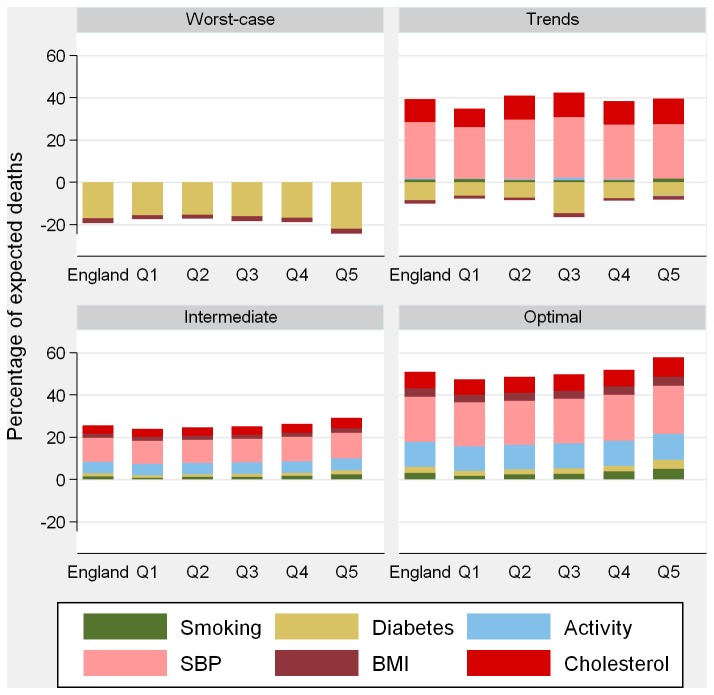
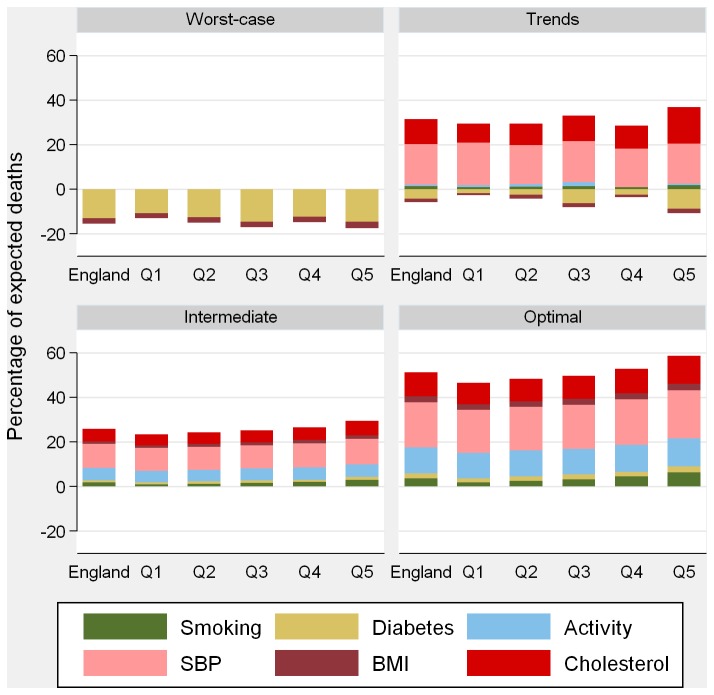
Using 2007 as baseline, the IMPACTSEC model was extended to estimate the potential number of CHD deaths preventable in England in 2020 by age, gender and Index of Multiple Deprivation 2007 quintiles given four risk factor change scenarios: (a) assuming recent trends will continue; (b) assuming optimal but feasible levels already achieved elsewhere; (c) an intermediate point, halfway between current and optimal levels; and (d) assuming plateauing or worsening levels, the worst case scenario. These four scenarios were compared to the baseline scenario with both risk factors and CHD mortality rates remaining at 2007 levels. This would result in approximately 97,000 CHD deaths in 2020. Assuming recent trends will continue would avert approximately 22,640 deaths (95% uncertainty interval: 20,390-24,980). There would be some 39,720 (37,120-41,900) fewer deaths in 2020 with optimal risk factor levels and 22,330 fewer (19,850-24,300) in the intermediate scenario. In the worst case scenario, 16,170 additional deaths (13,880-18,420) would occur. If optimal risk factor levels were achieved, the gap in CHD rates between the most and least deprived areas would halve with falls in systolic blood pressure, physical inactivity and total cholesterol providing the largest contributions to mortality gains.
CHD mortality reductions of up to 45%, accompanied by significant reductions in area deprivation mortality disparities, would be possible by implementing optimal preventive policies.
通过比较四种风险因素变化情景,估计 2020 年英格兰可能预防的冠心病(CHD)死亡人数。
以 2007 年为基线,IMPACTSEC 模型扩展到 2020 年,按年龄、性别和 2007 年多因素剥夺指数五分位数估计英格兰 CHD 死亡人数,基于四种风险因素变化情景:(a)假设近期趋势将继续;(b)假设已经达到其他地方的最佳但可行水平;(c)中间点,介于当前和最佳水平之间;(d)假设水平稳定或恶化,最坏情况。将这四种情景与基线情景进行比较,即两种风险因素和 CHD 死亡率保持在 2007 年的水平。这将导致 2020 年约有 97000 例 CHD 死亡。假设近期趋势将继续,将避免约 22640 例死亡(95%置信区间:20390-24980)。如果采用最佳风险因素水平,2020 年将减少约 39720 例死亡(37120-41900),而中间情景将减少 22330 例死亡(19850-24300)。在最坏情况下,将额外增加 16170 例死亡(13880-18420)。如果达到最佳风险因素水平,最贫困和最富裕地区之间的 CHD 发病率差距将缩小一半,收缩压、身体活动不足和总胆固醇下降将对死亡率的提高做出最大贡献。
通过实施最佳预防政策,CHD 死亡率可降低 45%,同时大幅减少地区贫困相关死亡率差异。