Mi Yang, Wang Lijuan, Zong Lu, Pei Meili, Lu Qingyang, Huang Pu
Obstetrical department, Maternal and Child Health Hospital of Shaanxi Province, Xi'an, ShaanXi, Peoples' Republic of China.
Department of Obstetrics and Gynecology, The First Affiliated Hospital of Xi'an Jiaotong University College of Medicine, Xi'an, ShaanXi, Peoples' Republic of China.
PLoS One. 2014 Jan 22;9(1):e86061. doi: 10.1371/journal.pone.0086061. eCollection 2014.
Single nucleotide polymorphisms (SNPs) in putative microRNA binding sites (miRSNPs) modulate cancer susceptibility via affecting miRNA binding. Here, we sought to investigate the association between miRSNPs and cervical cancer risk.
We first genotyped 41 miRSNPs of 37 cancer-related genes in 338 patients and 334 controls (Study 1), and replicated the significant associations in 502 patients and 600 controls (Study 2). We tested the effects of miRSNPs on microRNA-mRNA interaction by luciferase reporter assay.
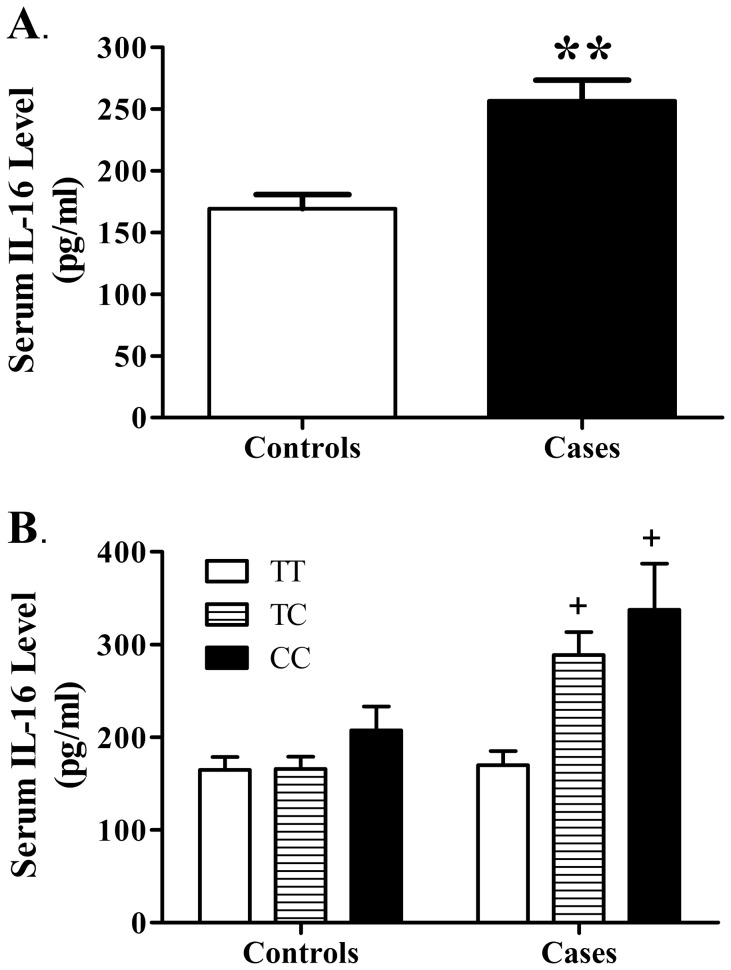
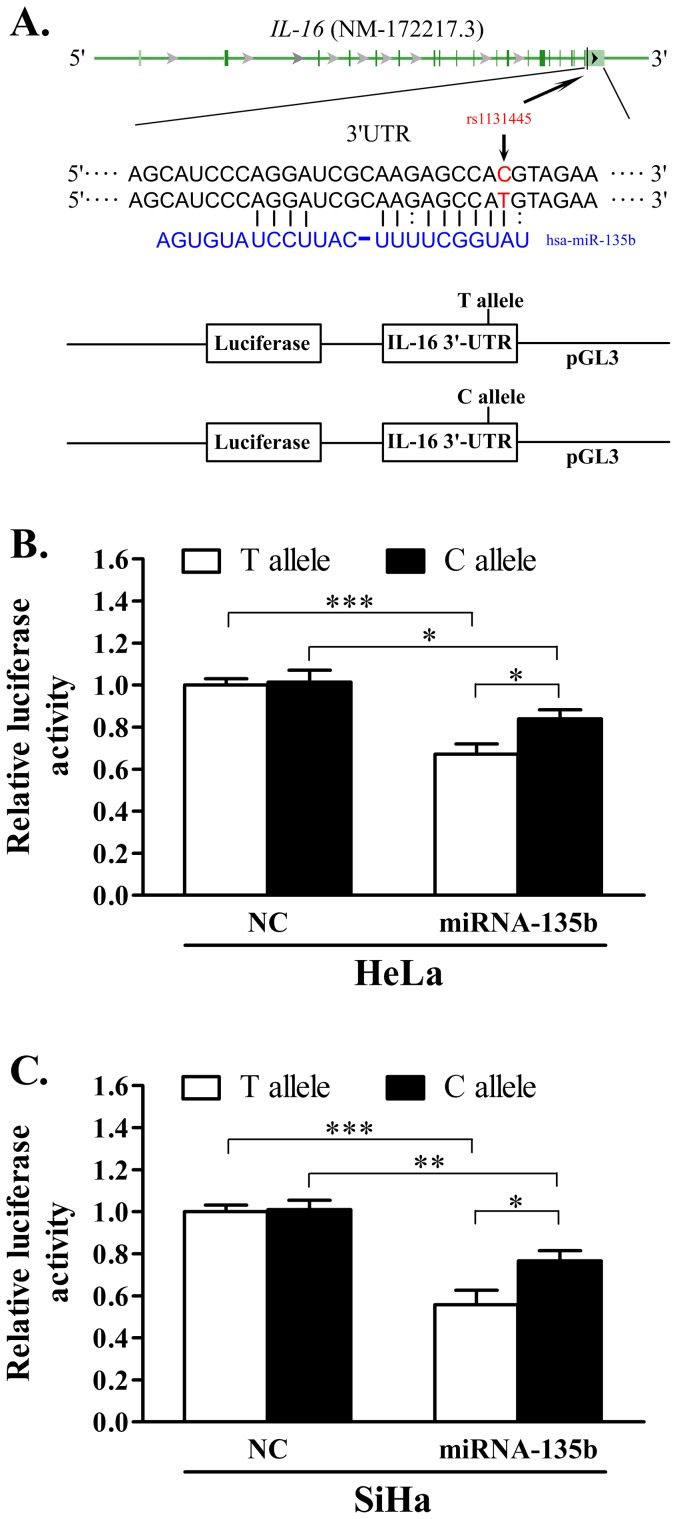
Five SNPs displayed notable association with cervical cancer risk in Study 1. Only IL-16 rs1131445 maintained a significant association with cervical cancer (CT/CC vs. TT, adjusted OR = 1.51, P = 0.001) in Study 2. This association was more evident in the combined data of two studies (adjusted OR = 1.49, P = 0.00007). We also found that miR-135b mimics interacted with IL-16 3'-UTR to reduce gene expression and that the rs1131445 T to C substitution within the putative binding site impaired the interaction of miR-135b with IL-16 3'-UTR. An ELISA indicated that the serum IL-16 of patients with cervical cancer was elevated (vs. controls, P = 0.001) and correlated with the rs1131445 genotype. Patients who carried the rs1131445 C allele had higher serum IL-16 than non-carriers (P<0.001).
These results support our hypothesis that miRSNPs constitute a susceptibility factor for cervical cancers. rs1131445 affects IL-16 expression by interfering with the suppressive function of miR135b and this variant is significantly associated with cervical cancer risk.
假定的微小RNA结合位点中的单核苷酸多态性(miRSNPs)通过影响微小RNA结合来调节癌症易感性。在此,我们试图研究miRSNPs与宫颈癌风险之间的关联。
我们首先对338例患者和334例对照(研究1)中37个癌症相关基因的41个miRSNPs进行基因分型,并在502例患者和600例对照(研究2)中重复显著关联。我们通过荧光素酶报告基因检测来测试miRSNPs对微小RNA-信使核糖核酸相互作用的影响。
在研究1中,5个单核苷酸多态性与宫颈癌风险呈现显著关联。在研究2中,只有白细胞介素-16 rs1131445与宫颈癌保持显著关联(CT/CC与TT相比,校正比值比=1.51,P=0.001)。这种关联在两项研究的合并数据中更为明显(校正比值比=1.49,P=0.00007)。我们还发现,微小RNA-135b模拟物与白细胞介素-16 3'-非翻译区相互作用以降低基因表达,并且假定结合位点内的rs1131445从T到C的替换损害了微小RNA-135b与白细胞介素-16 3'-非翻译区的相互作用。酶联免疫吸附测定表明,宫颈癌患者的血清白细胞介素-16升高(与对照相比,P=0.001),并且与rs1131445基因型相关。携带rs1131445 C等位基因的患者血清白细胞介素-16高于非携带者(P<0.001)。
这些结果支持我们的假设,即miRSNPs构成宫颈癌的一个易感性因素。rs1131445通过干扰微小RNA-135b的抑制功能影响白细胞介素-16表达,并且该变异与宫颈癌风险显著相关。