Rodríguez-Carrio Javier, de Paz Banesa, López Patricia, Prado Catuxa, Alperi-López Mercedes, Ballina-García Francisco Javier, Suárez Ana
Area Of Immunology, Department Of Functional Biology, Faculty Of Medicine, University Of Oviedo, Oviedo, Spain.
Department Of Rheumatology, Hospital Universitario Central De Asturias, Oviedo, Spain.
PLoS One. 2014 Jan 21;9(1):e86069. doi: 10.1371/journal.pone.0086069. eCollection 2014.
IFNα has been largely implicated in the ethiopathogenesis of autoimmune diseases but only recently it has been linked to endothelial damage and accelerated atherosclerosis in autoimmunity. In addition, proinflammatory conditions are supposed to be implicated in the cardiovascular status of these patients. Since a role for IFNα in endothelial damage and impaired Endothelial Progenitor Cell (EPC) number and function has been reported in other diseases, we aimed to evaluate the potential associations of IFNα serum levels on EPC populations and cytokine profiles in Rheumatoid Arthritis (RA) patients.
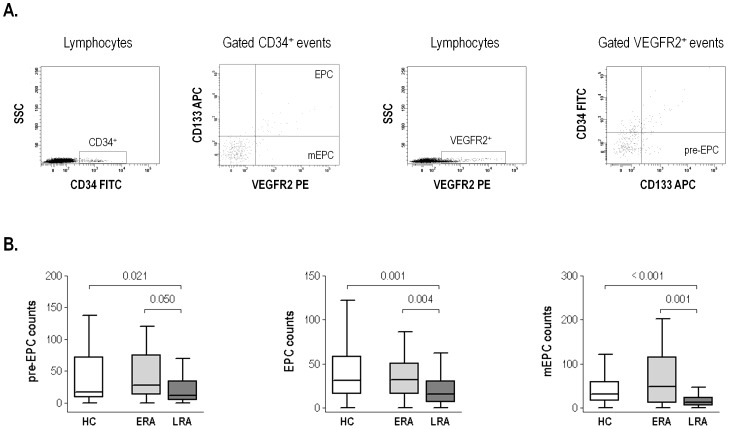
pre-EPC, EPC and mature EPC (mEPC) populations were quantified by flow cytometry analyzing their differential CD34, CD133 and VEGFR2 expression in blood samples from 120 RA patients, 52 healthy controls (HC), and 83 systemic lupus erythematosus (SLE) patients as disease control. Cytokine serum levels were measured by immunoassays and clinical and immunological data, including cardiovascular (CV) events and CV risk factors, were retrospectively obtained by reviewing clinical records.
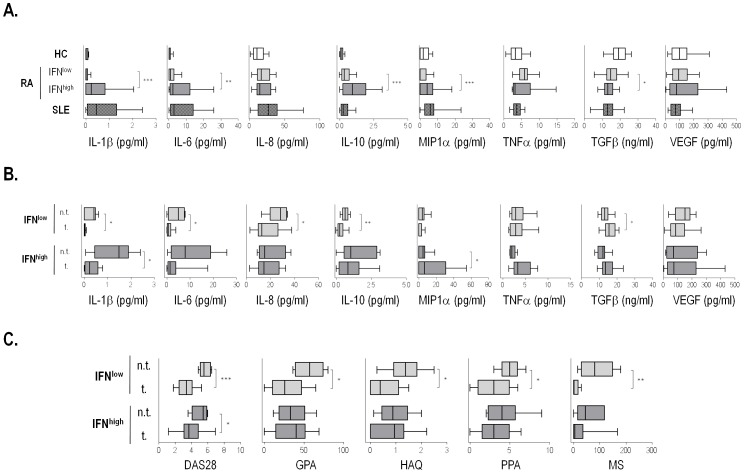
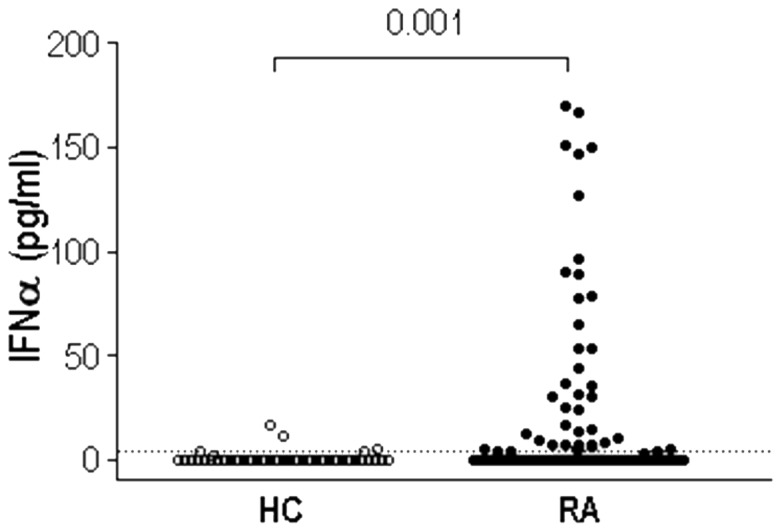
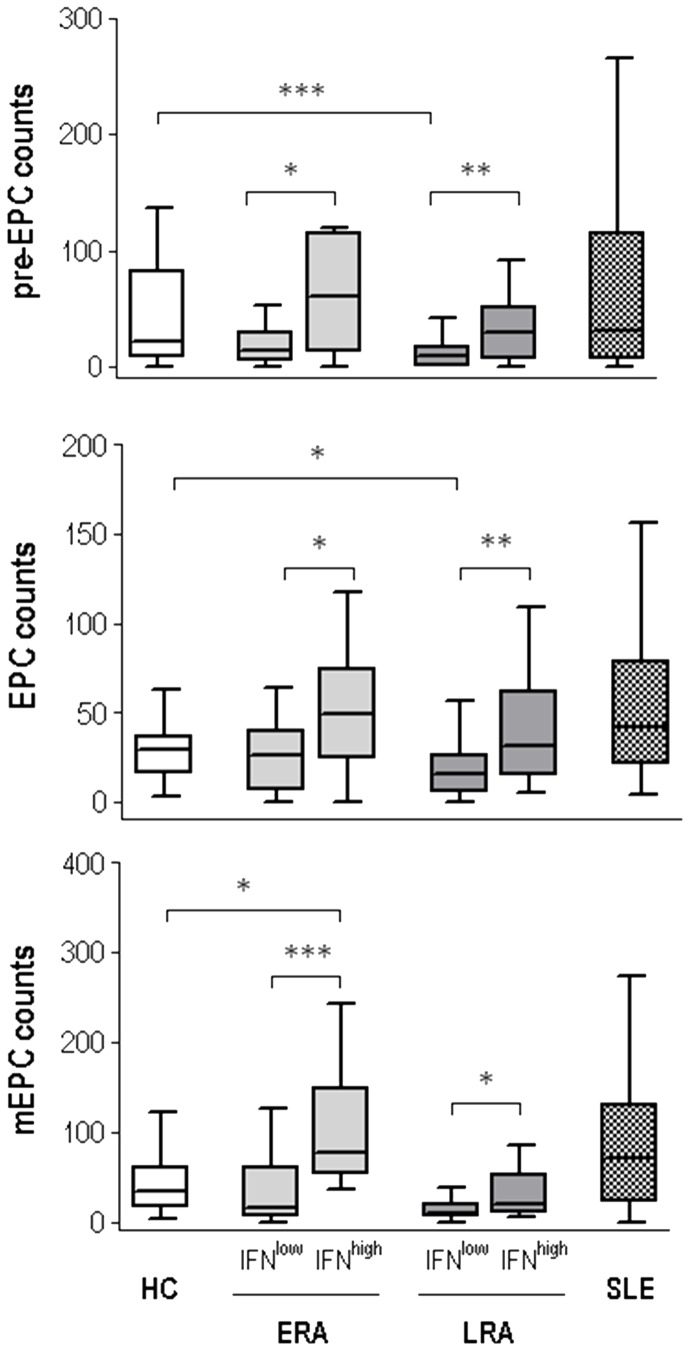
Long-standing, but not recent onset RA patients displayed a significant depletion of all endothelial progenitor populations, unless high IFNα levels were present. In fact, the IFN(high) RA patient group (n = 40, 33%), showed increased EPC levels, comparable to SLE patients. In addition, high IFNα serum levels were associated with higher disease activity (DAS28), presence of autoantibodies, higher levels of IL-1β, IL-6, IL-10 and MIP-1α, lower amounts of TGF-β, and increased mEPC/EPC ratio, thus suggesting higher rates of endothelial damage and an endothelial repair failure. Finally, the relationship between high IFNα levels and occurrence of CV events observed in RA patients seems to support this hypothesis.
IFNα serum marker could be used to identify a group of RA patients with increased disease activity, EPC imbalance, enhanced proinflammatory profile and higher cardiovascular risk, probably due, at least in part, to an impaired endothelial repair.
干扰素α(IFNα)在自身免疫性疾病的发病机制中起着重要作用,但直到最近它才与自身免疫中的内皮损伤和动脉粥样硬化加速相关联。此外,促炎状态被认为与这些患者的心血管状况有关。由于IFNα在其他疾病中对内皮损伤以及内皮祖细胞(EPC)数量和功能受损所起的作用已有报道,我们旨在评估类风湿关节炎(RA)患者中IFNα血清水平与EPC群体及细胞因子谱之间的潜在关联。
通过流式细胞术对120例RA患者、52例健康对照(HC)以及83例系统性红斑狼疮(SLE)患者(作为疾病对照)的血液样本中前EPC、EPC和成熟EPC(mEPC)群体进行定量分析,分析其CD34、CD133和VEGFR2的差异表达。通过免疫测定法测量细胞因子血清水平,并通过查阅临床记录回顾性获取临床和免疫学数据,包括心血管(CV)事件和CV危险因素。
病程较长而非近期发病的RA患者,除非存在高IFNα水平,否则所有内皮祖细胞群体均显著减少。实际上,IFN(高)RA患者组(n = 40,33%)的EPC水平升高,与SLE患者相当。此外,高IFNα血清水平与更高的疾病活动度(DAS28)、自身抗体的存在、更高水平的IL-1β、IL-6、IL-10和MIP-1α、更低水平的TGF-β以及更高的mEPC/EPC比值相关,这表明内皮损伤率更高且内皮修复失败。最后,RA患者中高IFNα水平与CV事件发生之间的关系似乎支持这一假设。
IFNα血清标志物可用于识别一组疾病活动度增加(EPC失衡、促炎谱增强且心血管风险更高)的RA患者,这可能至少部分归因于内皮修复受损。