
意义中心团体心理疗法在癌症幸存者中的效果和成本效益:一项随机对照试验方案。
Effectiveness and cost-effectiveness of meaning-centered group psychotherapy in cancer survivors: protocol of a randomized controlled trial.
机构信息
Department of Clinical Psychology, VU University, VdBoechorststraat 1, room 2B-64, Amsterdam 1081 BT, The Netherlands.
出版信息
BMC Psychiatry. 2014 Jan 28;14:22. doi: 10.1186/1471-244X-14-22.
BACKGROUND
Meaning-focused coping may be at the core of adequate adjustment to life after cancer. Cancer survivors who experience their life as meaningful are better adjusted, have better quality of life and psychological functioning. Meaning-Centered Group Psychotherapy for Cancer Survivors (MCGP-CS) was designed to help patients to sustain or enhance a sense of meaning and purpose in their lives. The aim of the proposed study is to evaluate the effectiveness and cost-effectiveness of MCGP-CS.
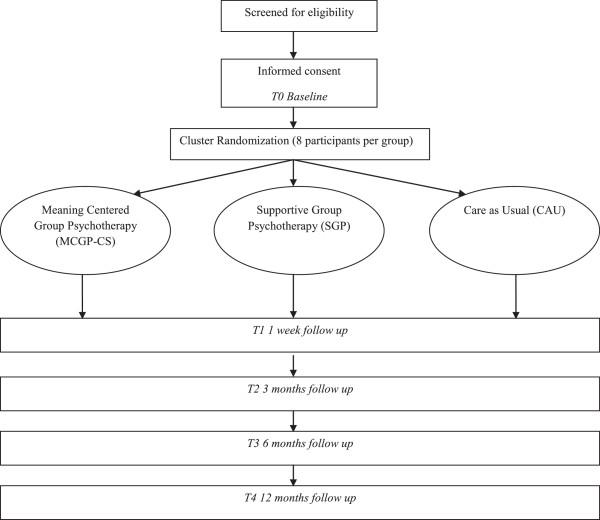
METHODS/DESIGN: Survivors diagnosed with cancer in the last 5 years and treated with curative intent, are recruited via several hospitals in the Netherlands. After screening, 168 survivors are randomly assigned to one of the three study arms: 1. Meaning-Centered Group Psychotherapy (MCGP-CS) 2. Supportive group psychotherapy (SGP) 3. Care as usual (CAU). Baseline assessment takes place before randomisation, with follow up assessments post-intervention and at 3, 6 and 12 months follow-up. Primary outcome is meaning making (PMP, PTGI, SPWB). Secondary outcome measures address quality of life (EORTC-30), anxiety and depression (HADS), hopelessness (BHS), optimism (LOT-R), adjustment to cancer (MAC), and costs (TIC-P, EQ-5D, PRODISQ).
DISCUSSION
Meaning-focused coping is key to adjustment to life after cancer, however, there is a lack of evidence based psychological interventions in this area. Many cancer survivors experience feelings of loneliness and alienation, and have a need for peer support, therefore a group method in particular, can be beneficial for sustaining or enhancing a sense of meaning. If this MCGP-CS is effective for cancer survivors, it can be implemented in the practice of psycho-oncology care.
TRIAL REGISTRATION
Netherlands Trial Register, NTR3571.
背景
以意义为中心的应对方式可能是癌症后适当调整的核心。体验到生活有意义的癌症幸存者适应能力更好,生活质量和心理功能更好。为了帮助患者在生活中保持或增强意义感和目标感,设计了癌症幸存者以意义为中心的团体心理治疗(MCGP-CS)。本研究旨在评估 MCGP-CS 的有效性和成本效益。
方法/设计:通过荷兰多家医院招募过去 5 年内被诊断患有癌症且接受根治性治疗的幸存者。筛选后,168 名幸存者被随机分配到三个研究组之一:1. 以意义为中心的团体心理治疗(MCGP-CS)2. 支持性团体心理治疗(SGP)3. 常规护理(CAU)。基线评估在随机分组前进行,干预后和 3、6、12 个月随访时进行随访评估。主要结局是意义建构(PMP、PTGI、SPWB)。次要结局指标包括生活质量(EORTC-30)、焦虑和抑郁(HADS)、绝望感(BHS)、乐观度(LOT-R)、癌症适应(MAC)和成本(TIC-P、EQ-5D、PRODISQ)。
讨论
以意义为中心的应对方式是适应癌症后生活的关键,但在这一领域缺乏基于证据的心理干预措施。许多癌症幸存者感到孤独和疏远,需要同伴支持,因此,特别是团体方法,可能有助于维持或增强意义感。如果这种 MCGP-CS 对癌症幸存者有效,它可以在心理肿瘤学护理实践中实施。
试验注册
荷兰试验注册处,NTR3571。
 Zotero 插件