Institute of Ageing and Chronic Disease, Faculty of Health and Life Sciences, University of Liverpool, Leahurst CH64 7TE, UK.
Acta Vet Scand. 2014 Jan 27;56(1):8. doi: 10.1186/1751-0147-56-8.
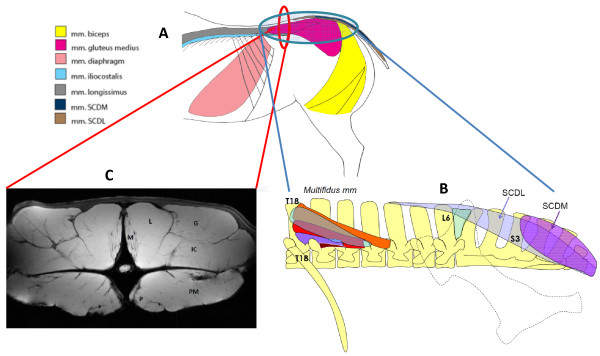
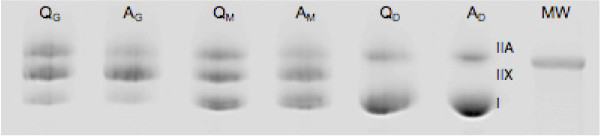
Although the majority of equine muscles have a mixed fibre type distribution indicative of diverse functional roles, the predominance of a fibre type can indicate the primary function of a muscle. The deep epaxial musculature has an important role in core spinal stability in humans, reflected as a predominantly muscle fibre type (MFT) I or postural fibre type. The fibre type of the deep epaxial musculature has not been determined in horses. The objective of the study was to determine the MFT distribution in selected muscles of thoracolumbar and hindlimb region of horses. This included deep epaxial and hypaxial muscles that were hypothesised to have a postural stabilising role. A second objective was to examine differences in MFT distribution between horses bred for endurance (Arabian) and sprinting (Quarter horse). Muscle biopsy samples were obtained from selected thoracolumbar and hind limb muscles of 5 Quarter horses, 4 Arabians, and 2 Thoroughbreds. The myosin heavy chain distribution was determined by gel electrophoresis. Mann-Whitney rank test was used to compare the proportional MFT and differences between breeds.
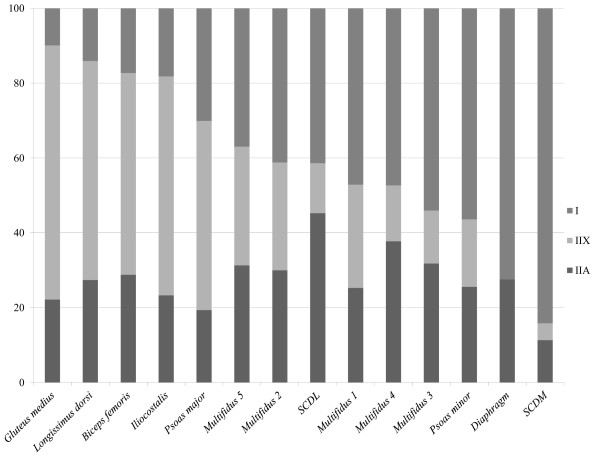
Mm. sacrocaudalis dorsalis medialis and diaphragm had the highest proportion of MFT-I. The remaining deep epaxial muscles and the hypaxial muscle m. psoas minor had approximately equal MFT I and II proportions. Mm. psoas major, iliocostalis, longissimus dorsi and the hind limb muscles contained mostly MFT-IIX. The fibre type distribution was similar between Arabians and Quarter horses, although Quarter horses had more MFT-IIX fibres in psoas major (P = 0.02) while Arabians had more MFT-I fibres in m. longissimus dorsi (P = 0.03).
The fibre type distribution of the deep epaxial muscles, mm psoas minor and diaphragm varied from approximately equal MFT-I and II proportions to predominantly MFT-I suggesting a postural stabilising role possibly important in core spinal stability. In contrast the fibre type proportions of mm psoas major, iliocostalis, longissimus dorsi and the hind limb muscles were mainly MFT-II suggesting a locomotory role. Knowledge of fibre type distribution in such a clinically important area can direct diagnosis, prevention and treatment of muscular or neuromotor dysfunction.
尽管大多数马的肌肉都具有混合纤维类型分布,表明其具有多种功能,但主要纤维类型可以指示肌肉的主要功能。人类的深部轴旁肌在核心脊柱稳定性中起着重要作用,表现为主要纤维类型(MFT)I 或姿势纤维类型。马的深部轴旁肌的纤维类型尚未确定。本研究的目的是确定胸腰椎和后肢区域选定肌肉的 MFT 分布。这包括深部轴旁肌和腹侧轴旁肌,这些肌肉被假设具有姿势稳定作用。第二个目的是检查用于耐力(阿拉伯马)和短跑(夸特马)的马的 MFT 分布之间的差异。从 5 匹夸特马、4 匹阿拉伯马和 2 匹纯血马的选定胸腰椎和后肢肌肉中获得肌肉活检样本。通过凝胶电泳确定肌球蛋白重链分布。使用曼-惠特尼秩检验比较品种间的比例 MFT 和差异。
背最长肌背侧内侧和横膈膜的 Mm. sacrocaudalis dorsalis medialis 具有最高比例的 MFT-I。其余深部轴旁肌和腹侧肌 m. psoas minor 具有相等的 MFT I 和 II 比例。M. psoas major、iliocostalis、longissimus dorsi 和后肢肌肉主要含有 MFT-IIX。阿拉伯马和夸特马的纤维类型分布相似,尽管夸特马的 psoas major 中含有更多的 MFT-IIX 纤维(P=0.02),而阿拉伯马的 longissimus dorsi 中含有更多的 MFT-I 纤维(P=0.03)。
深部轴旁肌、mm psoas minor 和横膈膜的纤维类型分布从大约相等的 MFT-I 和 II 比例到主要的 MFT-I 不等,表明具有姿势稳定作用,可能对核心脊柱稳定性很重要。相比之下,m. psoas major、iliocostalis、longissimus dorsi 和后肢肌肉的纤维类型比例主要是 MFT-II,表明具有运动作用。了解如此重要的临床区域的纤维类型分布可以指导肌肉或神经肌肉功能障碍的诊断、预防和治疗。