
在阿巴拉契亚的一大群人中,结直肠癌患病率与血清全氟辛烷磺酸(PFOS)和全氟辛酸(PFOA)水平呈负相关。
Inverse association of colorectal cancer prevalence to serum levels of perfluorooctane sulfonate (PFOS) and perfluorooctanoate (PFOA) in a large Appalachian population.
作者信息
Innes Kim E, Wimsatt Jeffrey H, Frisbee Stephanie, Ducatman Alan M
机构信息
Department of Epidemiology, West Virginia University School of Public Health, PO Box 9190, Morgantown, WV 26506-9190, USA.
出版信息
BMC Cancer. 2014 Jan 27;14:45. doi: 10.1186/1471-2407-14-45.
BACKGROUND
Perfluorooctanoate (PFOA) and perfluorooctane sulfonate (PFOS) are persistent environmental contaminants that affect metabolic regulation, inflammation, and other factors implicated in the development and progression of colorectal cancer (CRC). However, the link between these compounds and CRC remains unknown. In this cross-sectional study, we investigated the association of CRC diagnosis to PFOA and PFOS blood levels in a large Appalachian population.
METHODS
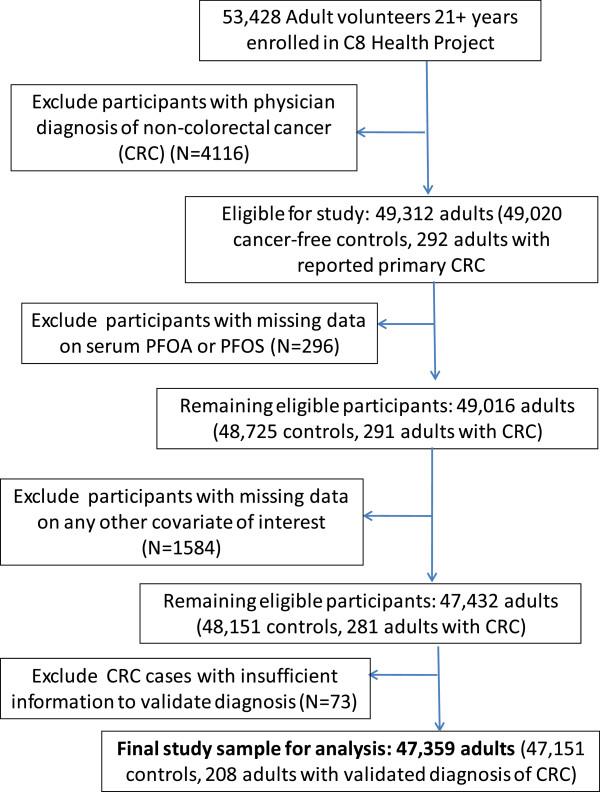
Participants were 47,359 adults ≥ 21 years of age and residing in six PFOA-contaminated water districts in the mid-Ohio Valley (N = 47,151 cancer-free adults, 208 cases of primary CRC). All participants completed a comprehensive health survey between 2005 and 2006; serum levels of PFOA, PFOS, and a range of other blood markers were also measured. Medical history was assessed via self report and cancer diagnosis confirmed via chart review.
RESULTS
CRC showed a strong inverse, dose-response association with PFOS serum levels (odds ratio (OR) adjusted for potential confounders = 0.2, 95% confidence interval (CI) 0.2,0.3) for highest vs. lowest quartile of PFOS, P-trend < 0.00001) and a significant, but more modest inverse association with PFOA (adjusted OR = 0.6 (CI 0.4, 0.9) for highest vs. lowest quartile, P-trend = 0.001). These inverse associations were stronger in those diagnosed within the previous 6 years and resident in the same water district for a minimum of 10-15 years preceding assessment. The relationship between PFOA and CRC was also more pronounced in men and leaner adults, and showed a stronger linear trend at lower exposure levels.
CONCLUSIONS
In this large cross-sectional study, we found a strong, inverse association between PFOS and likelihood of CRC diagnosis and a significant, although more modest inverse association between PFOA and CRC. If confirmed in prospective investigations, these findings may aid in identifying new strategies for CRC prevention and treatment and inform future studies regarding mechanisms underlying CRC pathogenesis.
背景
全氟辛酸(PFOA)和全氟辛烷磺酸(PFOS)是持久性环境污染物,会影响代谢调节、炎症以及与结直肠癌(CRC)发生和发展相关的其他因素。然而,这些化合物与CRC之间的联系仍不清楚。在这项横断面研究中,我们调查了俄亥俄州中部山谷六个受PFOA污染的水区中大量阿巴拉契亚人群的CRC诊断与PFOA和PFOS血液水平之间的关联。
方法
参与者为47359名年龄≥21岁且居住在俄亥俄州中部山谷六个受PFOA污染的水区的成年人(47151名无癌成年人,208例原发性CRC)。所有参与者在2005年至2006年期间完成了一项全面的健康调查;还测量了PFOA、PFOS以及一系列其他血液标志物的血清水平。通过自我报告评估病史,并通过病历审查确认癌症诊断。
结果
CRC与PFOS血清水平呈强负相关且存在剂量反应关系(调整潜在混杂因素后的优势比(OR)=0.2,95%置信区间(CI)0.2,0.3),最高四分位数与最低四分位数的PFOS相比,P趋势<0.00001),与PFOA呈显著但更适度的负相关(最高四分位数与最低四分位数的调整后OR = 0.6(CI 0.4, 0.9),P趋势 = 0.001)。这些负相关在过去6年内确诊且在评估前至少在同一水区居住10 - 15年的人群中更强。PFOA与CRC之间的关系在男性和较瘦的成年人中也更明显,并且在较低暴露水平下呈现出更强的线性趋势。
结论
在这项大型横断面研究中,我们发现PFOS与CRC诊断可能性之间存在强负相关,PFOA与CRC之间存在显著但更适度的负相关。如果在前瞻性研究中得到证实,这些发现可能有助于确定CRC预防和治疗的新策略,并为未来关于CRC发病机制的研究提供信息。

 Zotero 插件