
欧洲药品管理局药品许可中的分层医学:预测性生物标志物的系统评价
Stratified medicine in European Medicines Agency licensing: a systematic review of predictive biomarkers.
作者信息
Malottki Kinga, Biswas Mousumi, Deeks Jonathan J, Riley Richard D, Craddock Charles, Johnson Philip, Billingham Lucinda
机构信息
MRC Midland Hub for Trials Methodology Research, University of Birmingham, Birmingham, UK.
出版信息
BMJ Open. 2014 Jan 27;4(1):e004188. doi: 10.1136/bmjopen-2013-004188.
OBJECTIVES
Stratified medicine is often heralded as the future of clinical practice. Key part of stratified medicine is the use of predictive biomarkers, which identify patient subgroups most likely to benefit (or least likely to experience harm) from an intervention. We investigated how many and what predictive biomarkers are currently included in European Medicines Agency (EMA) licensing.
SETTING
EMA licensing.
PARTICIPANTS
Indications and contraindications of all drugs considered by the EMA and published in 883 European Public Assessment Reports and Pending Decisions.
PRIMARY AND SECONDARY OUTCOME MEASURES
Data were collected on: the type of the biomarker, whether it selected a subgroup of patients based on efficacy or toxicity, therapeutic area, marketing status, date of licensing decision, date of inclusion of the biomarker in the indication or contraindication and on orphan designation.
RESULTS
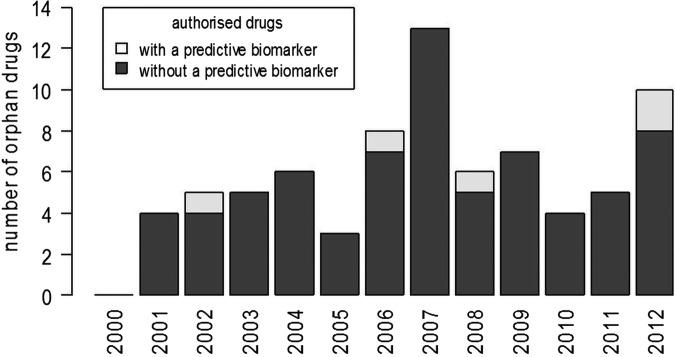
49 biomarker-indication-drug (B-I-D) combinations were identified over 16 years, which included 37 biomarkers and 41 different drugs. All identified biomarkers were molecular. Six drugs (relating to 10 B-I-D combinations) had an orphan designation at the time of licensing. The identified B-I-D combinations were mainly used in cancer and HIV treatment, and also in hepatitis C and three other indications (cystic fibrosis, hyperlipoproteinaemia type I and methemoglobinaemia). In 45 B-I-D combinations, biomarkers were used as predictive of drug efficacy and in four of drug toxicity. It appeared that there was an increase in the number of B-I-D combinations introduced each year; however, the numbers were too small to identify any trends.
CONCLUSIONS
Given the large body of literature documenting research into potential predictive biomarkers and extensive investment into stratified medicine, we identified relatively few predictive biomarkers included in licensing. These were also limited to a small number of clinical areas. This might suggest a need for improvement in methods of translation from laboratory findings to clinical practice.
目的
分层医学常被誉为临床实践的未来。分层医学的关键部分是使用预测性生物标志物,其可识别出最有可能从干预措施中获益(或最不可能受到伤害)的患者亚组。我们调查了目前欧洲药品管理局(EMA)药品许可中纳入了多少种以及哪些预测性生物标志物。
背景
EMA药品许可。
参与者
EMA审议并发表在883份欧洲公共评估报告和待决决定中的所有药物的适应症和禁忌症。
主要和次要结局指标
收集的数据包括:生物标志物的类型、其是否基于疗效或毒性选择患者亚组、治疗领域、上市状态、许可决定日期、生物标志物在适应症或禁忌症中纳入的日期以及孤儿药指定情况。
结果
在16年期间共识别出49种生物标志物-适应症-药物(B-I-D)组合,其中包括37种生物标志物和41种不同药物。所有识别出的生物标志物均为分子类。六种药物(涉及10种B-I-D组合)在许可时被指定为孤儿药。识别出的B-I-D组合主要用于癌症和HIV治疗,也用于丙型肝炎及其他三种适应症(囊性纤维化、I型高脂蛋白血症和高铁血红蛋白血症)。在45种B-I-D组合中,生物标志物用于预测药物疗效,4种用于预测药物毒性。每年引入的B-I-D组合数量似乎有所增加;然而,数量过少,无法确定任何趋势。
结论
鉴于有大量文献记录了对潜在预测性生物标志物的研究以及对分层医学的大量投资,我们发现许可中纳入的预测性生物标志物相对较少。这些生物标志物也仅限于少数临床领域。这可能表明需要改进从实验室研究结果转化为临床实践的方法。


 Zotero 插件