Lu Lu, Liu Qi, Zhu Yun, Chan Kwok-Hung, Qin Lili, Li Yuan, Wang Qian, Chan Jasper Fuk-Woo, Du Lanying, Yu Fei, Ma Cuiqing, Ye Sheng, Yuen Kwok-Yung, Zhang Rongguang, Jiang Shibo
1] Key Laboratory of Medical Molecular Virology of Ministries of Education and Health, Shanghai Medical College and Institute of Medical Microbiology, Fudan University, Shanghai 200032, China [2].
1] National Laboratory of Biomacromolecules, Institute of Biophysics, Chinese Academy of Sciences, Beijing 100101, China [2].
Nat Commun. 2014;5:3067. doi: 10.1038/ncomms4067.
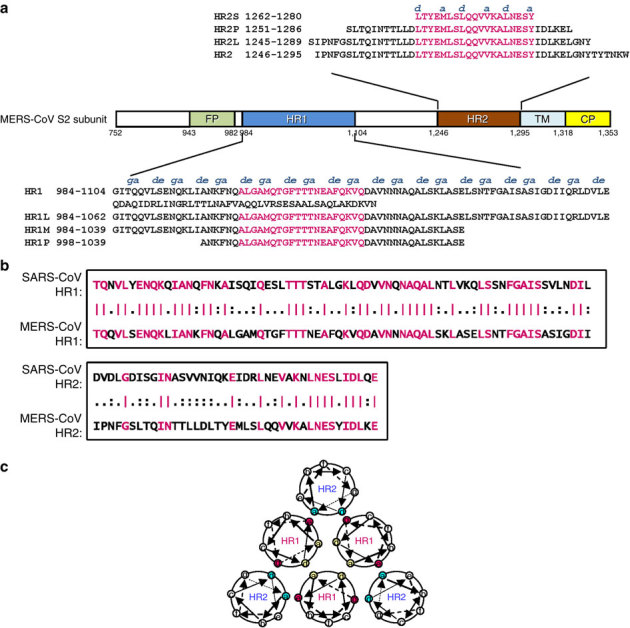
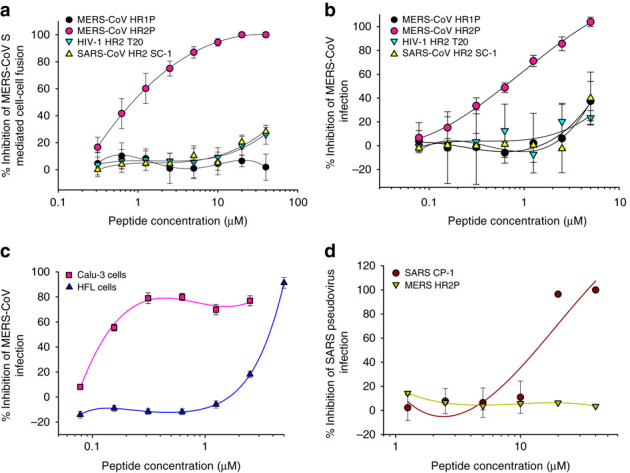
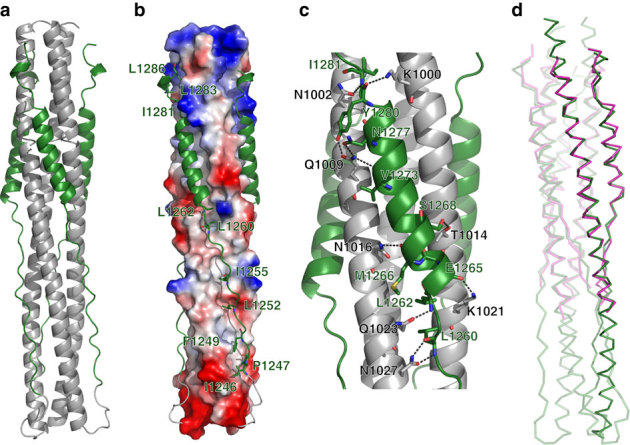
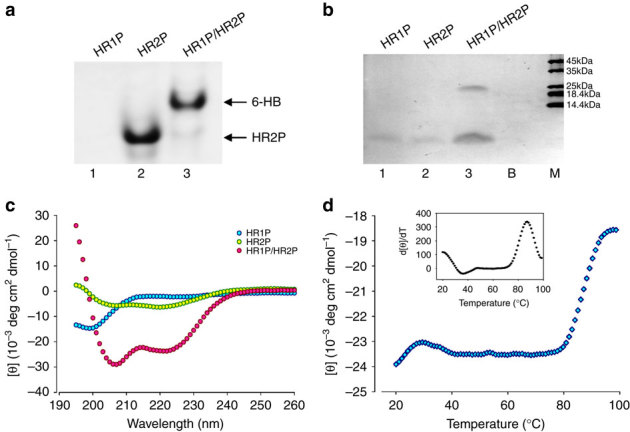
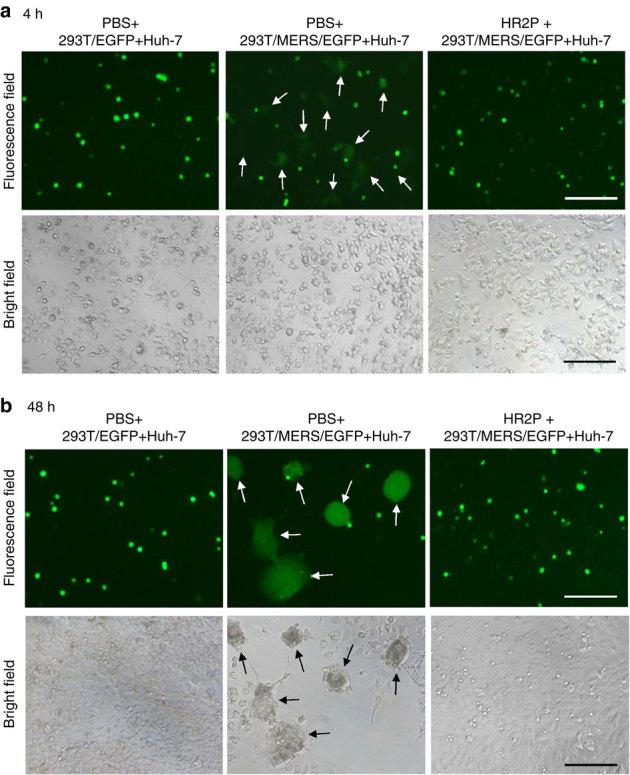
A novel human coronavirus, Middle East respiratory syndrome coronavirus (MERS-CoV), has caused outbreaks of a SARS-like illness with high case fatality rate. The reports of its person-to-person transmission through close contacts have raised a global concern about its pandemic potential. Here we characterize the six-helix bundle fusion core structure of MERS-CoV spike protein S2 subunit by X-ray crystallography and biophysical analysis. We find that two peptides, HR1P and HR2P, spanning residues 998-1039 in HR1 and 1251-1286 in HR2 domains, respectively, can form a stable six-helix bundle fusion core structure, suggesting that MERS-CoV enters into the host cell mainly through membrane fusion mechanism. HR2P can effectively inhibit MERS-CoV replication and its spike protein-mediated cell-cell fusion. Introduction of hydrophilic residues into HR2P results in significant improvement of its stability, solubility and antiviral activity. Therefore, the HR2P analogues have good potential to be further developed into effective viral fusion inhibitors for treating MERS-CoV infection.
一种新型人类冠状病毒,中东呼吸综合征冠状病毒(MERS-CoV),已引发了具有高病死率的类似严重急性呼吸综合征(SARS)疾病的疫情爆发。其通过密切接触进行人际传播的报道引发了全球对其大流行潜力的关注。在此,我们通过X射线晶体学和生物物理分析对MERS-CoV刺突蛋白S2亚基的六螺旋束融合核心结构进行了表征。我们发现,分别跨越HR1结构域中998 - 1039位残基和HR2结构域中1251 - 1286位残基的两条肽段HR1P和HR2P,能够形成稳定的六螺旋束融合核心结构,这表明MERS-CoV主要通过膜融合机制进入宿主细胞。HR2P能够有效抑制MERS-CoV复制及其刺突蛋白介导的细胞 - 细胞融合。将亲水性残基引入HR2P可显著提高其稳定性、溶解性和抗病毒活性。因此,HR2P类似物具有进一步开发成为治疗MERS-CoV感染的有效病毒融合抑制剂的良好潜力。