Yang Hui, Wang Hongbing
Department of Pharmaceutical Sciences, University of Maryland School of Pharmacy, 20 Penn Street, Baltimore, MD, 21201, USA.
Protein Cell. 2014 Feb;5(2):113-23. doi: 10.1007/s13238-013-0013-0. Epub 2014 Jan 29.
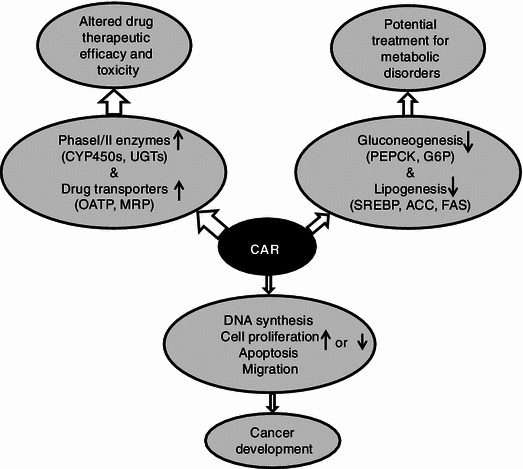
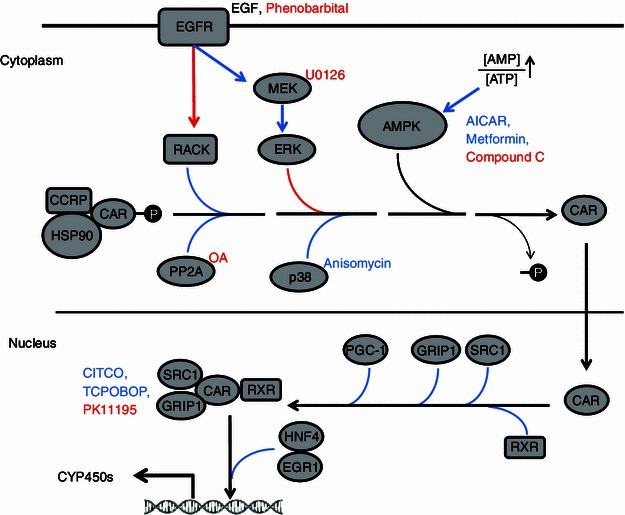
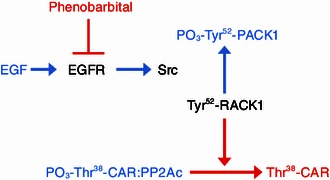
The constitutive androstane receptor (CAR, NR1I3) plays a crucial role in the regulation of drug metabolism, energy homeostasis, and cancer development through modulating the transcription of its numerous target genes. Different from prototypical nuclear receptors, CAR can be activated by either direct ligand binding or ligand-independent (indirect) mechanisms both initiated with nuclear translocation of CAR from the cytoplasm. In comparison to the well-defined ligand-based activation, indirect activation of CAR appears to be exclusively involved in the nuclear translocation through mechanisms yet to be fully understood. Accumulating evidence reveals that without activation, CAR forms a protein complex in the cytoplasm where it can be functionally affected by multiple signaling pathways. In this review, we discuss recent progresses in our understanding of the signaling regulation of CAR nuclear accumulation and activation. We expect that this review will also provide greater insight into the similarity and difference between the mechanisms of direct vs. indirect human CAR activation.
组成型雄烷受体(CAR,NR1I3)通过调节其众多靶基因的转录,在药物代谢、能量稳态和癌症发展的调控中发挥关键作用。与典型的核受体不同,CAR可通过直接配体结合或配体非依赖性(间接)机制激活,这两种机制均始于CAR从细胞质向细胞核的转运。与明确的基于配体的激活相比,CAR的间接激活似乎仅通过尚未完全了解的机制参与核转运。越来越多的证据表明,在未激活的情况下,CAR在细胞质中形成蛋白质复合物,在那里它可受到多种信号通路的功能影响。在本综述中,我们讨论了在理解CAR核积累和激活的信号调控方面的最新进展。我们期望本综述也能更深入地了解人类CAR直接激活与间接激活机制之间的异同。