Department of Neuroscience, University Medical Center Groningen, University of Groningen , Groningen , Netherlands ; Center for Human Movement Sciences, University Medical Center Groningen, University of Groningen , Groningen , Netherlands.
Center for Human Movement Sciences, University Medical Center Groningen, University of Groningen , Groningen , Netherlands ; Faculty of Health and Life Sciences, Northumbria University , Newcastle Upon Tyne , UK.
Front Aging Neurosci. 2014 Jan 24;6:5. doi: 10.3389/fnagi.2014.00005. eCollection 2014.
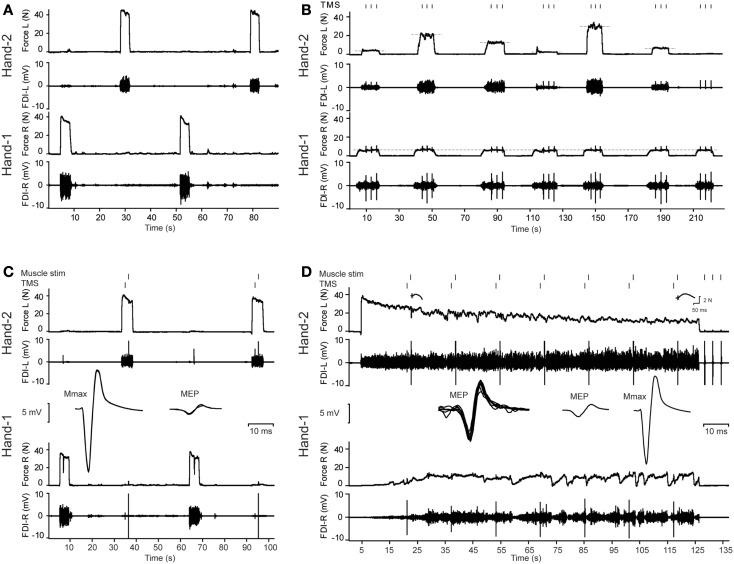
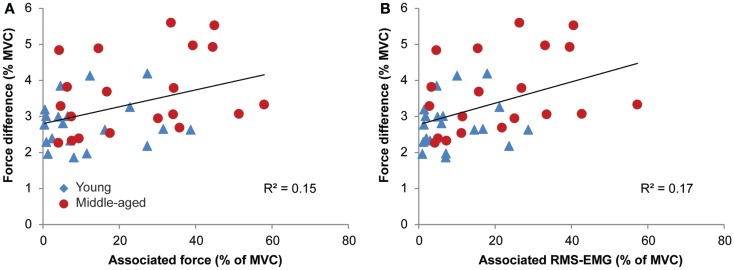
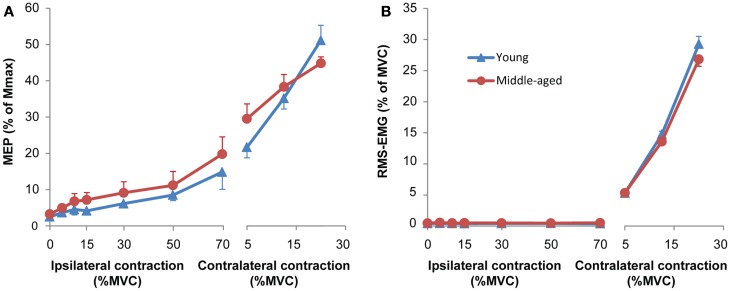
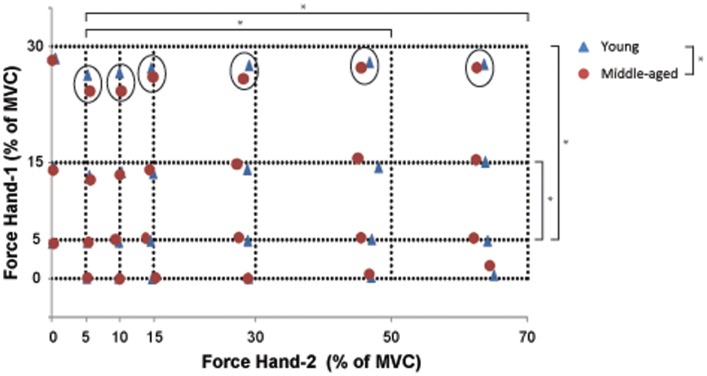
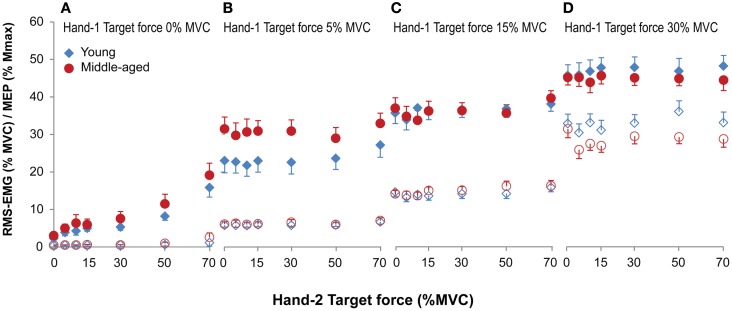
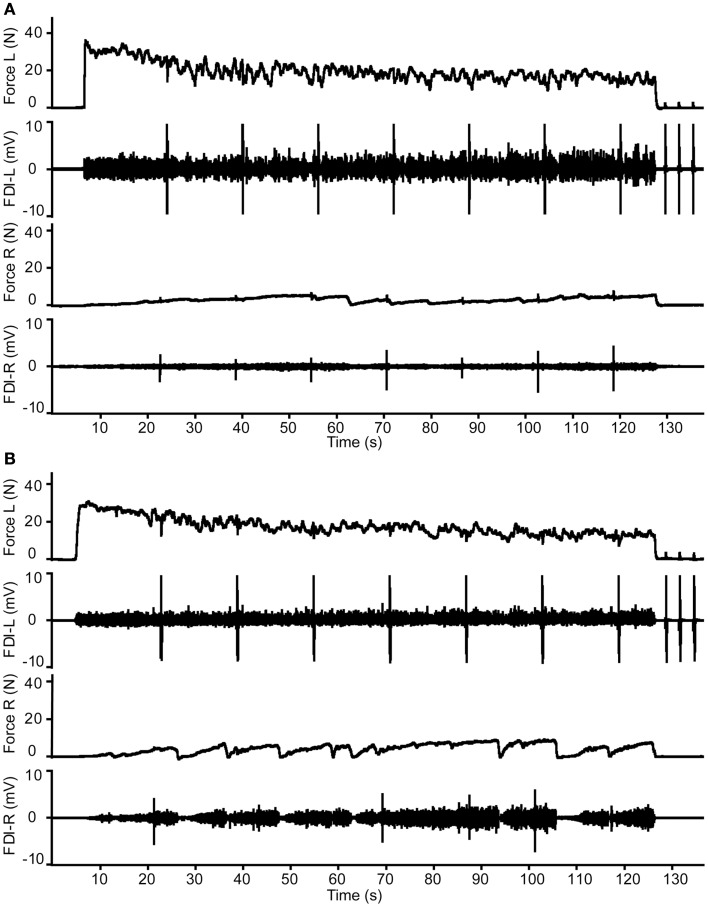
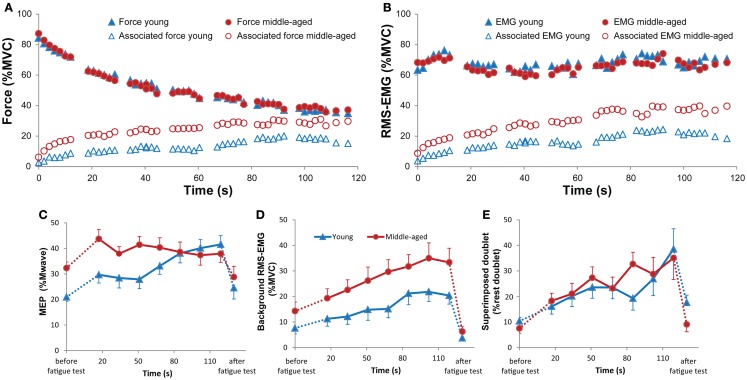
A hallmark of the age-related neural reorganization is that old versus young adults execute typical motor tasks by a more diffuse neural activation pattern including stronger ipsilateral activation during unilateral tasks. Whether such changes in neural activation are present already at middle age and affect bimanual interactions is unknown. We compared the amount of associated activity, i.e., muscle activity and force produced by the non-task hand and motor evoked potentials (MEPs) produced by magnetic brain stimulation between young (mean 24 years, n = 10) and middle-aged (mean 50 years, n = 10) subjects during brief unilateral (seven levels of % maximal voluntary contractions, MVCs) and bilateral contractions (4 × 7 levels of % MVC combinations), and during a 120-s-long MVC of sustained unilateral index finger abduction. During the force production, the excitability of the ipsilateral (iM1) or contralateral primary motor cortex (cM1) was assessed. The associated activity in the "resting" hand was ~2-fold higher in middle-aged (28% of MVC) versus young adults (11% of MVC) during brief unilateral MVCs. After controlling for the background muscle activity, MEPs in iM1 were similar in the two groups during brief unilateral contractions. Only at low (bilateral) forces, MEPs evoked in cM1 were 30% higher in the middle-aged versus young adults. At the start of the sustained contraction, the associated activity was higher in the middle-aged versus young subjects and increased progressively in both groups (30 versus 15% MVC at 120 s, respectively). MEPs were greater at the start of the sustained contraction in middle-aged subjects but increased further during the contraction only in young adults. Under these experimental conditions, the data provide evidence for the reorganization of neural control of unilateral force production as early as age 50. Future studies will determine if the altered neural control of such inter-manual interactions are of functional significance.
与年龄相关的神经重组的一个标志是,老年人和年轻人执行典型的运动任务时,神经激活模式更为分散,包括单侧任务时更强的同侧激活。这种神经激活的变化是否已经出现在中年,并影响双手交互作用尚不清楚。我们比较了相关活动的量,即在短暂的单侧(7 个最大自主收缩百分比水平,MVC)和双侧收缩(4×7%MVC 组合)期间,非任务手的肌肉活动和产生的力,以及在持续 120 秒的单侧食指外展的最大自主收缩期间,年轻人(平均年龄 24 岁,n=10)和中年人(平均年龄 50 岁,n=10)之间产生的运动诱发电位(MEPs)。在产生力的过程中,评估同侧(iM1)或对侧初级运动皮层(cM1)的兴奋性。在短暂的单侧 MVC 期间,中年人(28%的 MVC)的“休息”手的相关活动比年轻人(11%的 MVC)高约 2 倍。在控制背景肌肉活动后,在短暂的单侧收缩期间,两组的 iM1 中的 MEPs 相似。只有在低(双侧)力下,cM1 中诱发的 MEPs 在中年人中比年轻人高 30%。在持续收缩开始时,中年人比年轻人的相关活动更高,两组的活动都逐渐增加(分别为 120 秒时 30%和 15%的 MVC)。在中年人中,MEPs 在持续收缩开始时更大,但仅在年轻人中,MEPs 在收缩过程中进一步增加。在这些实验条件下,数据提供了证据表明,神经对单侧力量产生的控制早在 50 岁就发生了重组。未来的研究将确定这种双手交互作用的神经控制的改变是否具有功能意义。