Department of Endocrinology, University of Groningen, University Medical Center Groningen, HPC AA31, P,O, Box 30001, Groningen RB 9700, The Netherlands.
BMC Endocr Disord. 2014 Feb 1;14:9. doi: 10.1186/1472-6823-14-9.
Not all obese subjects have an adverse metabolic profile predisposing them to developing type 2 diabetes or cardiovascular disease. The BioSHaRE-EU Healthy Obese Project aims to gain insights into the consequences of (healthy) obesity using data on risk factors and phenotypes across several large-scale cohort studies. Aim of this study was to describe the prevalence of obesity, metabolic syndrome (MetS) and metabolically healthy obesity (MHO) in ten participating studies.
Ten different cohorts in seven countries were combined, using data transformed into a harmonized format. All participants were of European origin, with age 18-80 years. They had participated in a clinical examination for anthropometric and blood pressure measurements. Blood samples had been drawn for analysis of lipids and glucose. Presence of MetS was assessed in those with obesity (BMI ≥ 30 kg/m2) based on the 2001 NCEP ATP III criteria, as well as an adapted set of less strict criteria. MHO was defined as obesity, having none of the MetS components, and no previous diagnosis of cardiovascular disease.
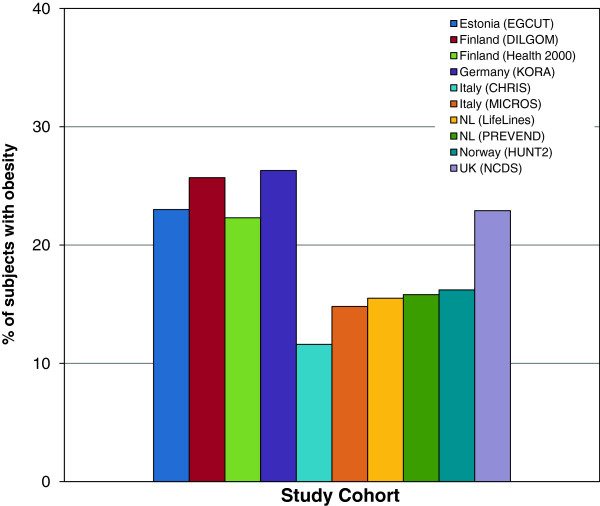
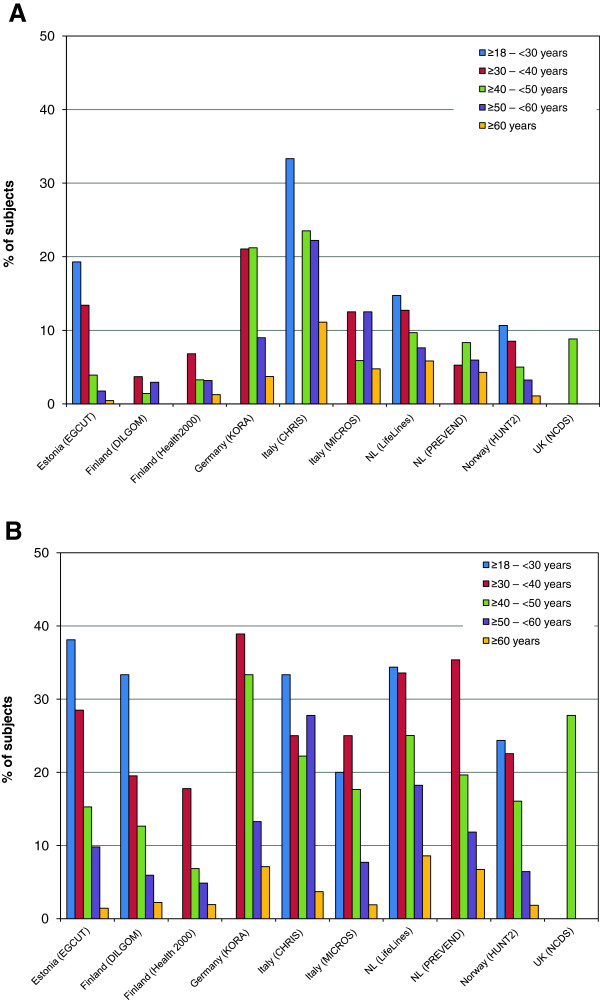
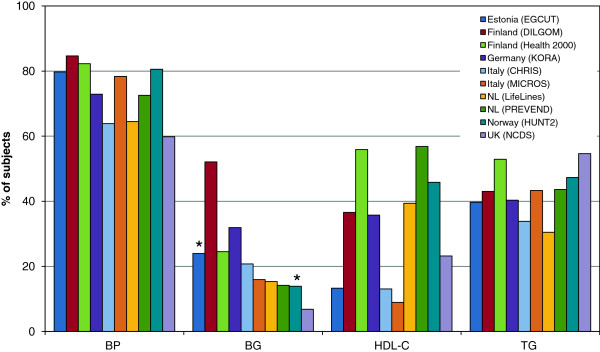
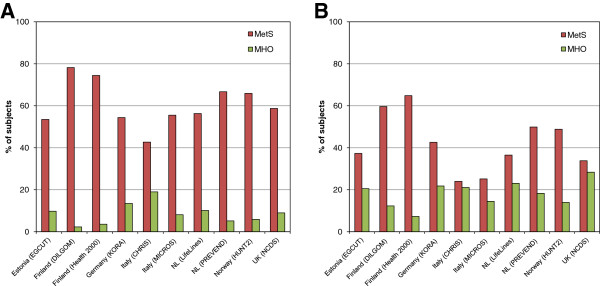
Data for 163,517 individuals were available; 17% were obese (11,465 men and 16,612 women). The prevalence of obesity varied from 11.6% in the Italian CHRIS cohort to 26.3% in the German KORA cohort. The age-standardized percentage of obese subjects with MetS ranged in women from 24% in CHRIS to 65% in the Finnish Health2000 cohort, and in men from 43% in CHRIS to 78% in the Finnish DILGOM cohort, with elevated blood pressure the most frequently occurring factor contributing to the prevalence of the metabolic syndrome. The age-standardized prevalence of MHO varied in women from 7% in Health2000 to 28% in NCDS, and in men from 2% in DILGOM to 19% in CHRIS. MHO was more prevalent in women than in men, and decreased with age in both sexes.
Through a rigorous harmonization process, the BioSHaRE-EU consortium was able to compare key characteristics defining the metabolically healthy obese phenotype across ten cohort studies. There is considerable variability in the prevalence of healthy obesity across the different European populations studied, even when unified criteria were used to classify this phenotype.
并非所有肥胖者都具有导致 2 型糖尿病或心血管疾病的不良代谢特征。BioSHaRE-EU 健康肥胖项目旨在利用多项大型队列研究中的危险因素和表型数据深入了解(健康)肥胖的后果。本研究的目的是描述十个参与研究中肥胖、代谢综合征(MetS)和代谢健康肥胖(MHO)的患病率。
将来自七个国家的十个不同队列合并在一起,使用转化为统一格式的数据。所有参与者均为欧洲血统,年龄在 18-80 岁之间。他们参加了临床检查,进行了人体测量和血压测量。采集了血液样本,用于分析血脂和血糖。根据 2001 年 NCEP ATP III 标准以及一套较为宽松的标准,评估肥胖者(BMI≥30kg/m2)中代谢综合征的存在。MHO 定义为肥胖,没有任何代谢综合征成分,且没有心血管疾病的既往诊断。
共获得 163517 人的数据;17%的人肥胖(男性 11465 人,女性 16612 人)。肥胖的患病率从意大利 CHRIS 队列的 11.6%到德国 KORA 队列的 26.3%不等。女性中,按年龄标准化的代谢综合征肥胖患者比例从 CHRIS 的 24%到芬兰 Health2000 队列的 65%不等,男性从 CHRIS 的 43%到芬兰 DILGOM 队列的 78%不等,其中血压升高是导致代谢综合征患病率升高的最常见因素。女性中,按年龄标准化的 MHO 患病率从 Health2000 的 7%到 NCDS 的 28%不等,男性从 DILGOM 的 2%到 CHRIS 的 19%不等。MHO 在女性中比在男性中更为普遍,并且在两性中都随着年龄的增长而减少。
通过严格的协调过程,BioSHaRE-EU 联盟能够比较十个队列研究中定义代谢健康肥胖表型的关键特征。即使使用统一的标准来分类这种表型,不同欧洲人群中健康肥胖的患病率也存在相当大的差异。