Department of Neurology and Neurotherapeutics, University of Texas Southwestern Medical Center at Dallas, 6000 Harry Hines Blvd, Dallas, TX 75390-8813, USA.
J Neuroinflammation. 2014 Jan 31;11:22. doi: 10.1186/1742-2094-11-22.
Repetitive hypoxic preconditioning (RHP) creates an anti-inflammatory phenotype that protects from stroke-induced injury for months after a 2-week treatment. The mechanisms underlying long-term tolerance are unknown, though one exposure to hypoxia significantly increased peripheral B cell representation. For this study, we sought to determine if RHP specifically recruited B cells into the protected ischemic hemisphere, and whether RHP could phenotypically alter B cells prior to stroke onset.
Adult, male SW/ND4 mice received RHP (nine exposures over 2 weeks; 8 to 11 % O2; 2 to 4 hours) or identical exposures to 21 % O2 as control. Two weeks following RHP, a 60-minute transient middle cerebral artery occlusion was induced. Standard techniques quantified CXCL13 mRNA and protein expression. Two days after stroke, leukocytes were isolated from brain tissue (70:30 discontinuous Percoll gradient) and profiled on a BD-FACS Aria flow cytometer. In a separate cohort without stroke, sorted splenic CD19+ B cells were isolated 2 weeks after RHP and analyzed on an Illumina MouseWG-6 V2 Bead Chip. Final gene pathways were determined using Ingenuity Pathway Analysis. Student's t-test or one-way analysis of variance determined significance (P < 0.05).
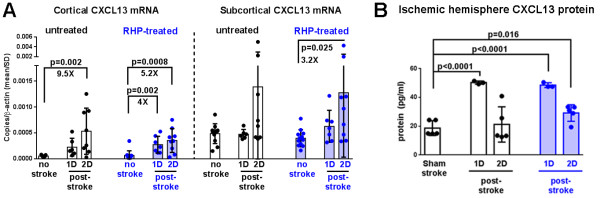
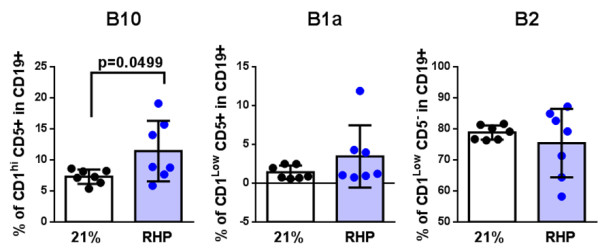
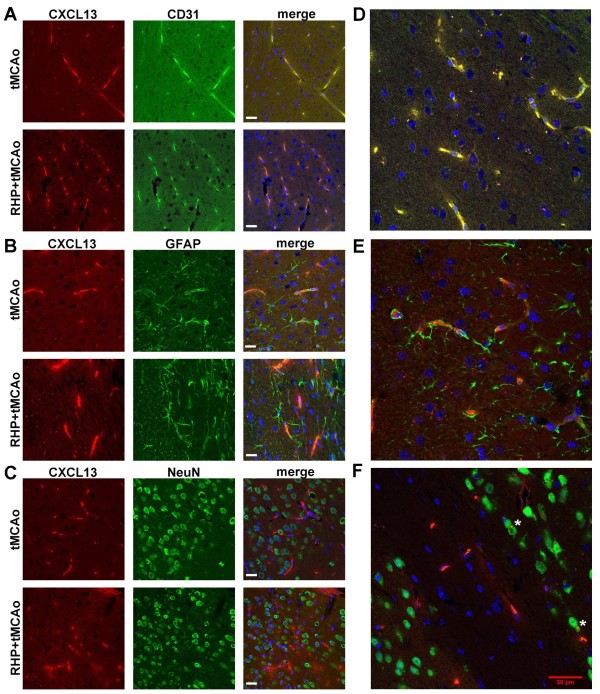
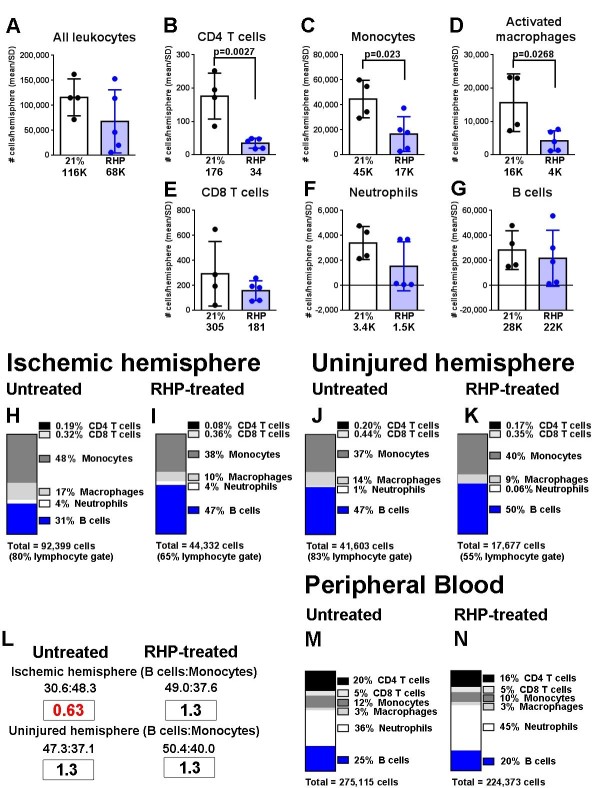
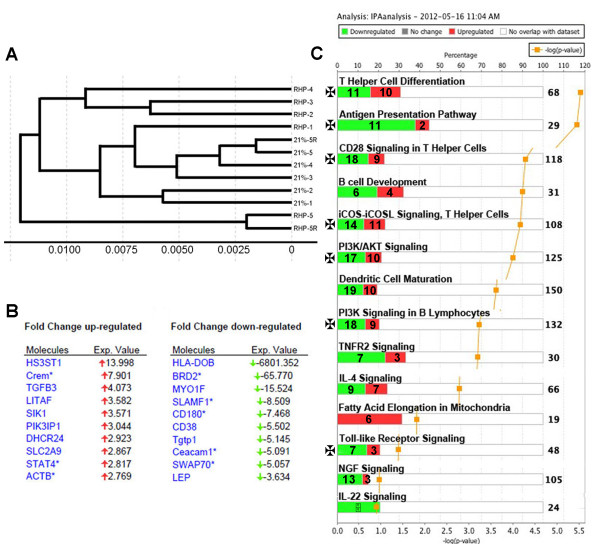
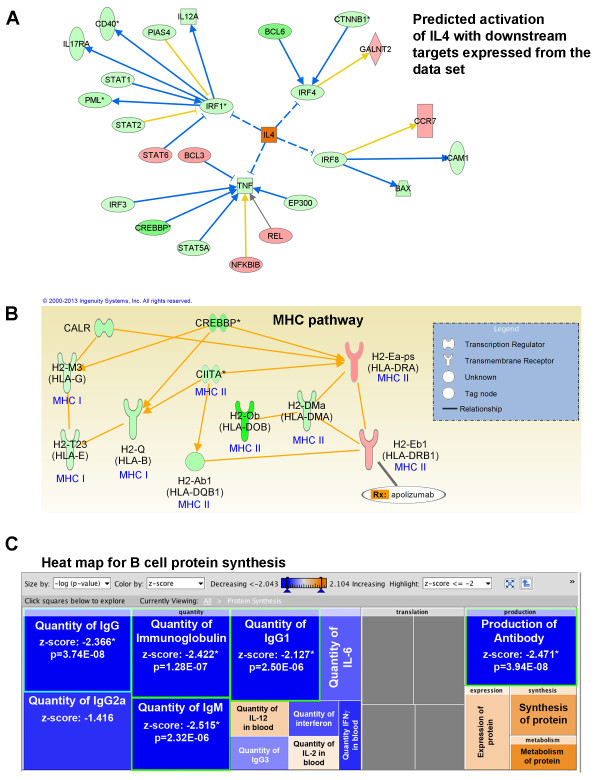
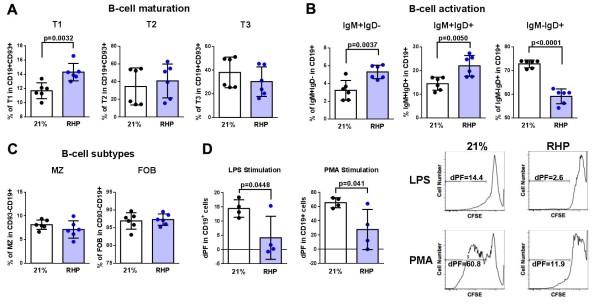
CXCL13, a B cell-specific chemokine, was upregulated in post-stroke cortical vessels of both groups. In the ischemic hemisphere, RHP increased B cell representation by attenuating the diapedesis of monocyte, macrophage, neutrophil and T cells, to quantities indistinguishable from the uninjured, contralateral hemisphere. Pre-stroke splenic B cells isolated from RHP-treated mice had >1,900 genes differentially expressed by microarray analysis. Genes related to B-T cell interactions, including antigen presentation, B cell differentiation and antibody production, were profoundly downregulated. Maturation and activation were arrested in a cohort of B cells from pre-stroke RHP-treated mice while regulatory B cells, a subset implicated in neurovascular protection from stroke, were upregulated.
Collectively, our data characterize an endogenous neuroprotective phenotype that utilizes adaptive immune mechanisms pre-stroke to protect the brain from injury post-stroke. Future studies to validate the role of B cells in minimizing injury and promoting central nervous system recovery, and to determine whether B cells mediate an adaptive immunity to systemic hypoxia that protects from subsequent stroke, are needed.
反复缺氧预处理(RHP)可产生抗炎表型,在 2 周治疗后长达数月对卒中诱导的损伤起到保护作用。尽管单次缺氧暴露可显著增加外周 B 细胞的代表性,但长期耐受的机制尚不清楚。在这项研究中,我们试图确定 RHP 是否专门将 B 细胞募集到受保护的缺血半球,以及 RHP 是否可以在卒中发作前改变 B 细胞的表型。
成年雄性 SW/ND4 小鼠接受 RHP(2 周内 9 次暴露;8-11%O2;2-4 小时)或相同的 21%O2 暴露作为对照。RHP 后 2 周,诱导 60 分钟短暂性大脑中动脉闭塞。采用标准技术定量检测 CXCL13mRNA 和蛋白表达。卒中后 2 天,从脑组织(70:30 不连续 Percoll 梯度)中分离白细胞,并在 BD-FACS Aria 流式细胞仪上进行分析。在没有卒中的另一队列中,在 RHP 后 2 周分离出分选的脾 CD19+B 细胞,并在 Illumina MouseWG-6V2 Bead Chip 上进行分析。最后使用 Ingenuity Pathway Analysis 确定基因途径。采用 Student's t-test 或单因素方差分析确定显著性(P<0.05)。
趋化因子 CXCL13 是一种 B 细胞特异性趋化因子,在两组卒中后皮质血管中均上调。在缺血半球,RHP 通过减轻单核细胞、巨噬细胞、中性粒细胞和 T 细胞的穿出,增加 B 细胞的数量,使其与未损伤的对侧半球无区别。从 RHP 治疗小鼠的卒中前脾 B 细胞中分离出的细胞通过微阵列分析显示有 >1900 个基因表达差异。与 B-T 细胞相互作用相关的基因,包括抗原呈递、B 细胞分化和抗体产生,显著下调。在卒中前 RHP 治疗小鼠的 B 细胞中,成熟和激活被阻滞,而调节性 B 细胞(一种被认为可减轻卒中后神经血管损伤的亚群)上调。
总的来说,我们的数据描述了一种内源性神经保护表型,它在卒中前利用适应性免疫机制来保护大脑免受损伤。需要进一步的研究来验证 B 细胞在减轻损伤和促进中枢神经系统恢复中的作用,以及确定 B 细胞是否介导对全身缺氧的适应性免疫反应,从而预防随后的卒中。