Koningstein Maike, van der Bij Akke K, de Kraker Marlieke E A, Monen Jos C, Muilwijk Jan, de Greeff Sabine C, Geerlings Suzanne E, Leverstein-van Hall Maurine A
Centre for Infectious Disease Control, National Institute for Public Health and the Environment (RIVM), Bilthoven, The Netherlands.
Centre for Infectious Disease Control, National Institute for Public Health and the Environment (RIVM), Bilthoven, The Netherlands ; Department of Medical Microbiology, Reinier de Graaf Groep, Delft, The Netherlands.
PLoS One. 2014 Jan 28;9(1):e86634. doi: 10.1371/journal.pone.0086634. eCollection 2014.
Complicated urinary tract infections (c-UTIs) are among the most common nosocomial infections and a substantial part of the antimicrobial agents used in hospitals is for the treatment of c-UTIs. Data from surveillance can be used to guide the empirical treatment choices of clinicians when treating c-UTIs. We therefore used nation-wide surveillance data to evaluate antimicrobial coverage of agents for the treatment of c-UTI in the Netherlands.
We included the first isolate per patient of urine samples of hospitalised patients collected by the Infectious Disease Surveillance Information System for Antibiotic Resistance (ISIS-AR) in 2012, and determined the probability of inadequate coverage for antimicrobial agents based on species distribution and susceptibility. Analyses were repeated for various patient groups and hospital settings.
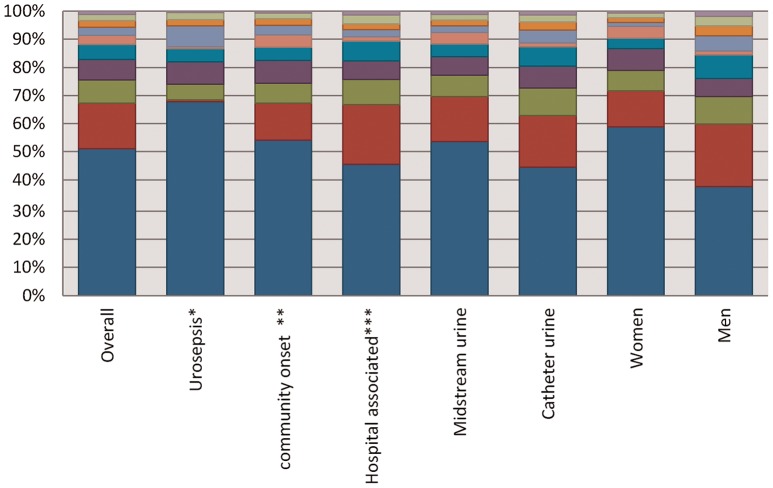
The most prevalent bacteria in 27,922 isolates of 23,357 patients were Escherichia coli (47%), Enterococcus spp. (14%), Proteus mirabilis (8%), and Klebsiella pneumoniae (7%). For all species combined, the probability of inadequate coverage was <5% for amoxicillin or amoxicillin-clavulanic acid combined with gentamicin and the carbapenems. When including gram-negative bacteria only, the probability of inadequate coverage was 4.0%, 2.7%, 2.3% and 1.7%, respectively, for amoxicillin, amoxicillin-clavulanic acid, a second or a third generation cephalosporin in combination with gentamicin, and the carbapenems (0.4%). There were only small variations in results among different patient groups and hospital settings.
When excluding Enterococcus spp., considered as less virulent, and the carbapenems, considered as last-resort drugs, empirical treatment for c-UTI with the best chance of adequate coverage are one of the studied beta-lactam-gentamicin combinations. This study demonstrates the applicability of routine surveillance data for up-to-date clinical practice guidelines on empirical antimicrobial therapy, essential in patient care given the evolving bacterial susceptibility.
复杂性尿路感染(c-UTIs)是最常见的医院感染之一,医院使用的抗菌药物中有很大一部分用于治疗c-UTIs。监测数据可用于指导临床医生在治疗c-UTIs时的经验性治疗选择。因此,我们使用全国性监测数据来评估荷兰治疗c-UTI药物的抗菌覆盖范围。
我们纳入了2012年由传染病监测抗生素耐药性信息系统(ISIS-AR)收集的住院患者尿液样本中每位患者的第一株分离菌,并根据菌种分布和敏感性确定抗菌药物覆盖不足的概率。对不同患者群体和医院环境重复进行分析。
在23357例患者的27922株分离菌中,最常见的细菌是大肠埃希菌(47%)、肠球菌属(14%)、奇异变形杆菌(8%)和肺炎克雷伯菌(7%)。对于所有菌种综合来看,阿莫西林或阿莫西林-克拉维酸联合庆大霉素以及碳青霉烯类药物覆盖不足的概率<5%。仅纳入革兰氏阴性菌时,阿莫西林、阿莫西林-克拉维酸、第二代或第三代头孢菌素联合庆大霉素以及碳青霉烯类药物(0.4%)覆盖不足的概率分别为4.0%、2.7%、2.3%和1.7%。不同患者群体和医院环境之间的结果仅有微小差异。
当排除毒力较低的肠球菌属和作为最后手段药物的碳青霉烯类药物时,对c-UTI进行经验性治疗且覆盖充分可能性最大的是所研究的β-内酰胺类-庆大霉素联合用药之一。本研究证明了常规监测数据在经验性抗菌治疗最新临床实践指南中的适用性,鉴于细菌敏感性不断变化,这在患者护理中至关重要。