Health and Use of Time Group, School of Health Sciences, University of South Australia, GPO Box 2471, Adelaide, South Australia 5001, Australia.
BMC Pediatr. 2014 Feb 3;14:31. doi: 10.1186/1471-2431-14-31.
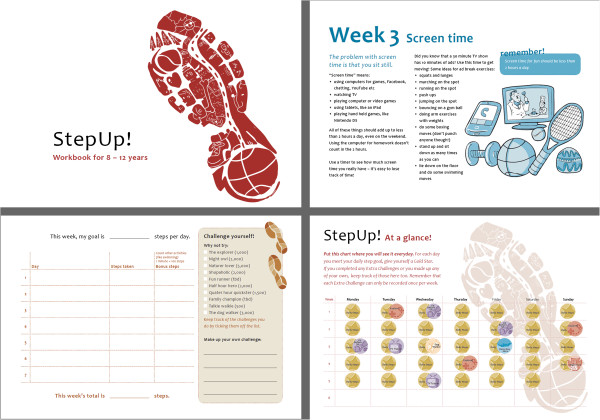
Physical activity affords a wide range of physiological and psychological benefits for children and adolescents, yet many children with physical disabilities are insufficiently active to achieve these benefits. The StepUp program is a newly developed 6-week pedometer-based self-management program for children and adolescents with physical disability. Participants use a pedometer to undertake a 6-week physical activity challenge, with personalised daily step count goals set in consultation with a physiotherapist. The study aims to evaluate the effectiveness of the StepUp program, using a randomised control trial design.
METHODS/DESIGN: A target sample of 70 young people with physical disabilities (aged 8-17 years, ambulant with or without aid, residing in Adelaide) will be recruited. Participants will be randomly allocated to either intervention or control following completion of baseline assessments. Assessments are repeated at 8 weeks (immediately post intervention) and 20 weeks (12 weeks post intervention). The primary outcome is objective physical activity determined from 7 day accelerometry, and the secondary outcomes are exercise intention, physical self-worth, quality of life and fatigue. Analyses will be undertaken on an intention-to-treat basis using random effects mixed modelling.
This study will provide information about the potential of a low-touch and low-cost physical activity intervention for children and adolescents with cerebral palsy.
Australian New Zealand Clinical Trials Registry (ANZCTR): ACTRN12613000023752.
身体活动为儿童和青少年提供了广泛的生理和心理益处,但许多身体残疾的儿童活动不足,无法从中受益。StepUp 计划是一个新开发的基于计步器的 6 周自我管理计划,适用于身体残疾的儿童和青少年。参与者使用计步器完成 6 周的身体活动挑战,根据与物理治疗师的协商设定个性化的每日步数目标。本研究旨在采用随机对照试验设计评估 StepUp 计划的有效性。
方法/设计:将招募 70 名有身体残疾的年轻人(年龄 8-17 岁,可借助或不借助辅助工具行走,居住在阿德莱德)作为目标样本。参与者在完成基线评估后将随机分配到干预组或对照组。在 8 周(干预后立即)和 20 周(干预后 12 周)进行重复评估。主要结局是通过 7 天加速计测量的客观身体活动,次要结局是锻炼意图、身体自我价值感、生活质量和疲劳。分析将基于意向治疗原则,采用随机效应混合模型进行。
本研究将提供有关针对脑瘫儿童和青少年的低接触、低成本身体活动干预措施的潜力的信息。
澳大利亚新西兰临床试验注册中心(ANZCTR):ACTRN12613000023752。