Bhowmick Manishabrata, Fields Gregg B
Torrey Pines Institute for Molecular Studies, 11350 SW Village, Parkway, Port St. Lucie, FL 34987, USA.
Int J Pept Res Ther. 2012 Dec;18(4):335-339. doi: 10.1007/s10989-012-9307-y.
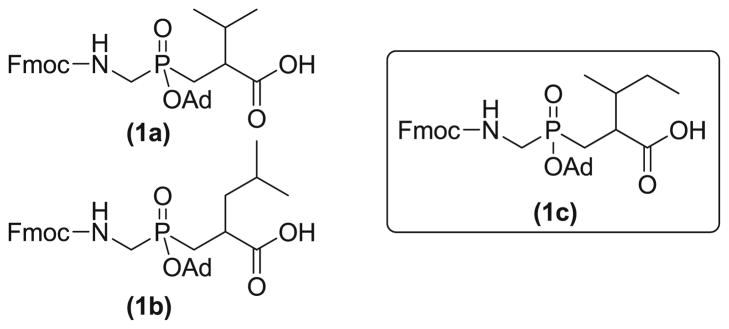
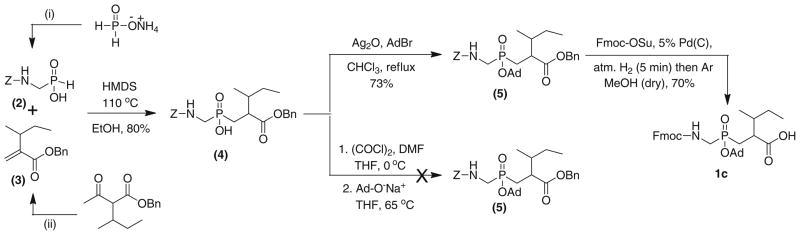
The efficient synthesis of an Fmoc-Gly-Ile phosphinic pseudodipeptide was desired as an eventual building block for construction of matrix metalloproteinase inhibitors. A Michael-type addition reaction of bis(tri-methylsilyl) phosphonite with the appropriate acrylate generated the pseudodipeptide bond. Additional of adamantyl (Ad) protection by our prior route (reaction of in situ generated phosphinic acid chloride with the sodium salt of adamantanol) was surprisingly inefficient. Adamantyl protection was achieved in high yield by refluxing the phosphinic acid, AgO, and 1-AdBr in chloroform. Subsequently a concise one-pot three-step reaction comprising a double deprotection of the N- and C-termini under catalytic hydrogenation conditions followed by selective protection of the N-terminus with an Fmoc group yielded Fmoc-NHCHPO(OAd)CHCH(2-butyl)COH in 41 % overall yield. These results indicate that, as the diversity of phosphinic pseudodipeptides is increased to create selective matrix metalloproteinase inhibitors, different synthetic pathways may be required for efficient building block preparation.
高效合成Fmoc-Gly-Ile次膦酸假二肽是期望作为构建基质金属蛋白酶抑制剂的最终构件。双(三甲基甲硅烷基)亚磷酸酯与适当的丙烯酸酯的迈克尔型加成反应生成了假二肽键。通过我们之前的路线(原位生成的次膦酰氯与金刚烷醇的钠盐反应)进行金刚烷基(Ad)保护的效率出奇地低。通过在氯仿中回流次膦酸、AgO和1-AdBr以高收率实现了金刚烷基保护。随后,一个简洁的一锅三步反应,包括在催化氢化条件下对N-和C-末端进行双重脱保护,然后用Fmoc基团选择性保护N-末端,以41%的总收率得到Fmoc-NHCHPO(OAd)CHCH(2-丁基)COH。这些结果表明,随着用于创建选择性基质金属蛋白酶抑制剂的次膦酸假二肽多样性的增加,可能需要不同的合成途径来高效制备构件。