Ledwoń Patrycja, Papini Anna Maria, Rovero Paolo, Latajka Rafal
Department of Bioorganic Chemistry, Faculty of Chemistry, Wroclaw University of Science and Technology, 50-370 Wroclaw, Poland.
Interdepartmental Research Unit of Peptide and Protein Chemistry and Biology, Department of Neurosciences, Psychology, Drug Research and Child Health-Section of Pharmaceutical Sciences and Nutraceutics, University of Florence, 50019 Sesto Fiorentino, Firenze, Italy.
Materials (Basel). 2021 Jun 10;14(12):3217. doi: 10.3390/ma14123217.
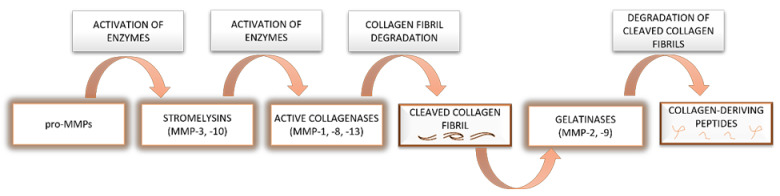
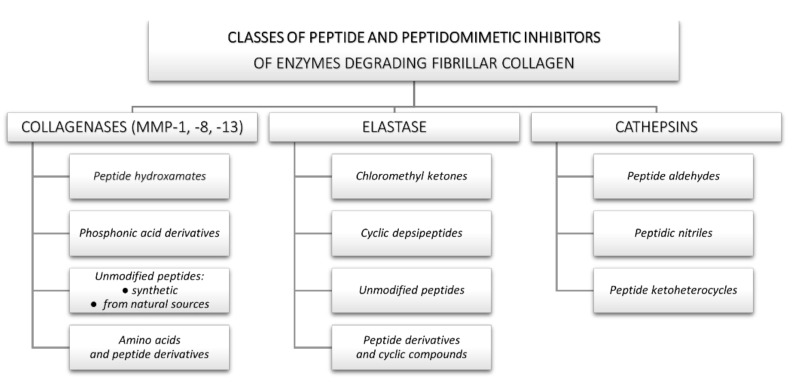
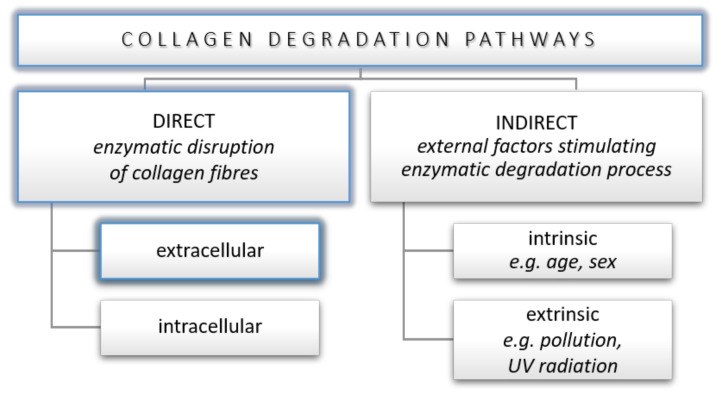
Collagen fibres degradation is a complex process involving a variety of enzymes. Fibrillar collagens, namely type I, II, and III, are the most widely spread collagens in human body, e.g., they are responsible for tissue fibrillar structure and skin elasticity. Nevertheless, the hyperactivity of fibrotic process and collagen accumulation results with joints, bone, heart, lungs, kidneys or liver fibroses. Per contra, dysfunctional collagen turnover and its increased degradation leads to wound healing disruption, skin photoaging, and loss of firmness and elasticity. In this review we described the main enzymes participating in collagen degradation pathway, paying particular attention to enzymes degrading fibrillar collagen. Therefore, collagenases (MMP-1, -8, and -13), elastases, and cathepsins, together with their peptide and peptidomimetic inhibitors, are reviewed. This information, related to the design and synthesis of new inhibitors based on peptide structure, can be relevant for future research in the fields of chemistry, biology, medicine, and cosmeceuticals.
胶原纤维降解是一个涉及多种酶的复杂过程。纤维状胶原蛋白,即I型、II型和III型胶原蛋白,是人体中分布最广泛的胶原蛋白,例如,它们负责组织的纤维状结构和皮肤弹性。然而,纤维化过程的过度活跃和胶原蛋白的积累会导致关节、骨骼、心脏、肺、肾脏或肝脏纤维化。相反,胶原蛋白周转功能失调及其降解增加会导致伤口愈合受阻、皮肤光老化以及紧致度和弹性丧失。在本综述中,我们描述了参与胶原蛋白降解途径的主要酶,特别关注降解纤维状胶原蛋白的酶。因此,对胶原酶(MMP-1、-8和-13)、弹性蛋白酶和组织蛋白酶及其肽和拟肽抑制剂进行了综述。这些与基于肽结构的新型抑制剂的设计和合成相关的信息,可能对化学、生物学、医学和药妆学领域的未来研究具有重要意义。