• 文献检索
  • 文档翻译
  • 深度研究
  • 学术资讯
  • Suppr Zotero 插件Zotero 插件
  • 邀请有礼
  • 套餐&价格
  • 历史记录
应用&插件
Suppr Zotero 插件Zotero 插件浏览器插件Mac 客户端Windows 客户端微信小程序
定价
高级版会员购买积分包购买API积分包
服务
文献检索文档翻译深度研究API 文档MCP 服务
关于我们
关于 Suppr公司介绍联系我们用户协议隐私条款
关注我们

Suppr 超能文献

核心技术专利:CN118964589B侵权必究
粤ICP备2023148730 号-1Suppr @ 2026

文献检索

告别复杂PubMed语法,用中文像聊天一样搜索,搜遍4000万医学文献。AI智能推荐,让科研检索更轻松。

立即免费搜索

文件翻译

保留排版,准确专业,支持PDF/Word/PPT等文件格式,支持 12+语言互译。

免费翻译文档

深度研究

AI帮你快速写综述,25分钟生成高质量综述,智能提取关键信息,辅助科研写作。

立即免费体验

非线性频率压缩对听力损失儿童言语识别的影响。

Effects of nonlinear frequency compression on speech identification in children with hearing loss.

作者信息

Hillock-Dunn Andrea, Buss Emily, Duncan Nicole, Roush Patricia A, Leibold Lori J

机构信息

1Department of Allied Health Sciences, The University of North Carolina at Chapel Hill, School of Medicine, Chapel Hill, North Carolina, USA; 2Department of Otolaryngology/Head and Neck Surgery, The University of North Carolina at Chapel Hill, School of Medicine Chapel Hill, North Carolina, USA.

出版信息

Ear Hear. 2014 May-Jun;35(3):353-65. doi: 10.1097/AUD.0000000000000007.

DOI:10.1097/AUD.0000000000000007
PMID:24496288
原文链接:https://pmc.ncbi.nlm.nih.gov/articles/PMC4301569/
Abstract

OBJECTIVES

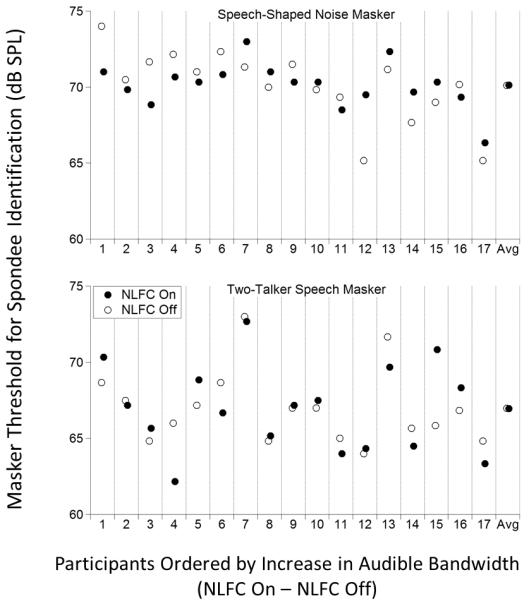
This study evaluated effects of nonlinear frequency compression (NLFC) processing in children with hearing loss for consonant identification in quiet and for spondee identification in competing noise or speech. It was predicted that participants would benefit from NLFC for consonant identification in quiet when access to high-frequency information was critical, but that NLFC would be less beneficial, or even detrimental, when identification relied on mid-frequency cues. Further, it was hypothesized that NLFC could result in greater susceptibility to masking in the spondee task. The rationale for these predictions is that improved access to high-frequency information comes at the cost of decreased spectral resolution.

DESIGN

A repeated-measures design compared speech-perception outcomes in 17 pediatric hearing aid users (9 to 17 years of age) wearing Naida V SP "laboratory" hearing aids with NLFC on and off. Data were also collected in an initial baseline session in which children wore their personal hearing aids. Children with a wide range of audiometric configurations were included, but all participants were full-time users of hearing aids with active NLFC. For each hearing aid condition, speech perception was assessed in the sound field by using a closed-set 12-alternative consonant-vowel identification measure in quiet, and a closed-set four-alternative spondee-identification measure in a speech-shaped noise or in a two-talker speech masker.

RESULTS

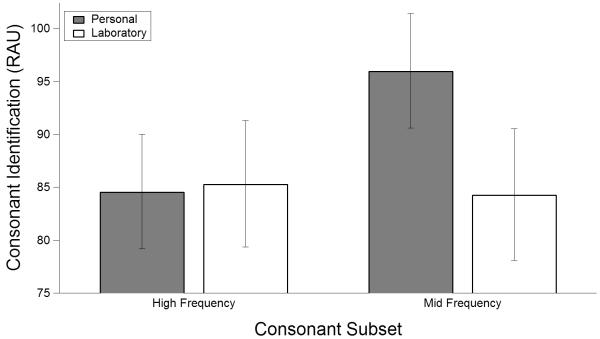
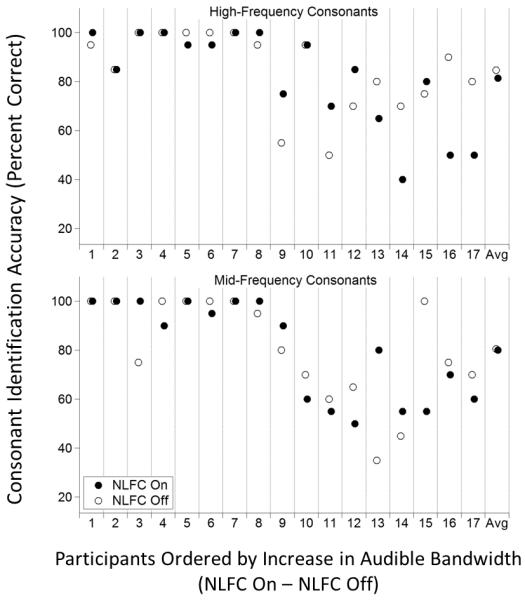
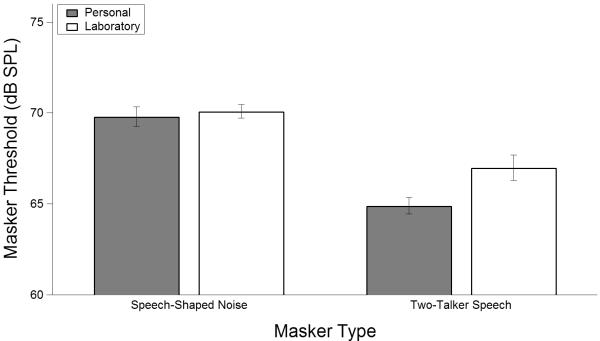
No significant differences in performance were observed between laboratory hearing aid conditions with NLFC activated or deactivated for either speech-perception measure. An unexpected finding was that the majority of participants had no difficulty identifying the high-frequency consonant /s/ even when NLFC was deactivated. Investigation into individual differences revealed that subjects with a greater difference in audible bandwidth with NLFC on versus NLFC off were less likely to demonstrate improvements in high-frequency consonant identification in quiet, but were more likely to demonstrate improvements in spondee identification in speech-shaped noise. Group results observed in the initial baseline assessment using personal aids fitted with more aggressive NLFC settings than used in laboratory aids indicated better consonant identification accuracy in quiet. However, spondee identification in the two-talker masker was poorer with personal compared with laboratory hearing aids. Comparisons across personal and laboratory hearing aids are tempered, however, by the potential of an order effect.

CONCLUSIONS

The observation of comparable performance with NLFC on and NLFC off in the laboratory aids provides evidence that NLFC is neither detrimental nor advantageous when modest in strength. Results with personal hearing aids fitted with stronger compression settings than laboratory aids (NLFC on) highlight the critical need for further research to determine the impact of NLFC processing on speech perception for a wider range of speech-perception measures and compression settings.
https://cdn.ncbi.nlm.nih.gov/pmc/blobs/a6ec/4301569/fa2c5043b5d0/nihms-655691-f0004.jpg
https://cdn.ncbi.nlm.nih.gov/pmc/blobs/a6ec/4301569/a0cd16e81257/nihms-655691-f0001.jpg
https://cdn.ncbi.nlm.nih.gov/pmc/blobs/a6ec/4301569/9bdc37bf06b4/nihms-655691-f0002.jpg
https://cdn.ncbi.nlm.nih.gov/pmc/blobs/a6ec/4301569/4d3e0e103825/nihms-655691-f0003.jpg
https://cdn.ncbi.nlm.nih.gov/pmc/blobs/a6ec/4301569/fa2c5043b5d0/nihms-655691-f0004.jpg
https://cdn.ncbi.nlm.nih.gov/pmc/blobs/a6ec/4301569/a0cd16e81257/nihms-655691-f0001.jpg
https://cdn.ncbi.nlm.nih.gov/pmc/blobs/a6ec/4301569/9bdc37bf06b4/nihms-655691-f0002.jpg
https://cdn.ncbi.nlm.nih.gov/pmc/blobs/a6ec/4301569/4d3e0e103825/nihms-655691-f0003.jpg
https://cdn.ncbi.nlm.nih.gov/pmc/blobs/a6ec/4301569/fa2c5043b5d0/nihms-655691-f0004.jpg
摘要

目的

本研究评估了非线性频率压缩(NLFC)处理对听力损失儿童在安静环境中识别辅音以及在竞争性噪声或言语环境中识别扬扬格词的影响。研究预测,当获取高频信息至关重要时,参与者在安静环境中识别辅音会从NLFC中受益,但当识别依赖中频线索时,NLFC的益处会减少,甚至可能产生不利影响。此外,研究假设NLFC可能会使扬扬格词任务中对掩蔽的敏感性更高。这些预测的依据是,改善高频信息的获取是以降低频谱分辨率为代价的。

设计

采用重复测量设计,比较了17名佩戴奈达V SP“实验室”助听器且NLFC功能开启和关闭的儿科助听器使用者(9至17岁)的言语感知结果。还在初始基线阶段收集了数据,在此阶段儿童佩戴他们自己的助听器。纳入了听力图配置范围广泛的儿童,但所有参与者都是NLFC功能开启的助听器的全职使用者。对于每种助听器条件,通过在安静环境中使用封闭式12选1的辅音 - 元音识别测量方法以及在言语噪声或双说话者言语掩蔽环境中使用封闭式4选1的扬扬格词识别测量方法,在声场中评估言语感知。

结果

对于任何一种言语感知测量方法,NLFC开启或关闭的实验室助听器条件下的表现均未观察到显著差异。一个意外发现是,即使NLFC关闭,大多数参与者在识别高频辅音/s/时也没有困难。对个体差异的调查显示,NLFC开启与关闭时可听带宽差异较大的受试者,在安静环境中高频辅音识别方面不太可能表现出改善,但在言语噪声中扬扬格词识别方面更有可能表现出改善。在初始基线评估中观察到的群体结果表明,使用比实验室助听器设置更强的NLFC功能的个人助听器,在安静环境中辅音识别准确性更高。然而,与实验室助听器相比,个人助听器在双说话者掩蔽环境中的扬扬格词识别较差。不过,由于可能存在顺序效应,个人助听器和实验室助听器之间的比较受到了影响。

结论

在实验室助听器中观察到NLFC开启和关闭时表现相当,这证明当强度适当时,NLFC既无不利影响也无优势。配备比实验室助听器更强压缩设置(NLFC开启)的个人助听器的结果突出表明,迫切需要进一步研究,以确定NLFC处理对于更广泛的言语感知测量方法和压缩设置对言语感知的影响。

相似文献

1
Effects of nonlinear frequency compression on speech identification in children with hearing loss.非线性频率压缩对听力损失儿童言语识别的影响。
Ear Hear. 2014 May-Jun;35(3):353-65. doi: 10.1097/AUD.0000000000000007.
2
Evaluation of wideband frequency responses and nonlinear frequency compression for children with cookie-bite audiometric configurations.对具有饼干咬痕式听力图构型的儿童进行宽带频率响应和非线性频率压缩评估。
J Am Acad Audiol. 2014 Nov-Dec;25(10):1022-33. doi: 10.3766/jaaa.25.10.10.
3
Effects of nonlinear frequency compression on Mandarin speech and sound-quality perception in hearing-aid users.非线性频率压缩对助听器使用者的普通话语音感知和音质感知的影响。
Int J Audiol. 2020 Jul;59(7):524-533. doi: 10.1080/14992027.2020.1761035. Epub 2020 May 22.
4
Evaluation of nonlinear frequency compression for school-age children with moderate to moderately severe hearing loss.对中度至中度重度听力损失学龄儿童的非线性频率压缩评估。
J Am Acad Audiol. 2010 Nov-Dec;21(10):618-28. doi: 10.3766/jaaa.21.10.2.
5
Aided cortical response, speech intelligibility, consonant perception and functional performance of young children using conventional amplification or nonlinear frequency compression.使用传统放大或非线性频率压缩对幼儿的辅助皮层反应、言语可懂度、辅音感知和功能表现。
Int J Pediatr Otorhinolaryngol. 2014 Oct;78(10):1692-700. doi: 10.1016/j.ijporl.2014.07.022. Epub 2014 Jul 23.
6
Benefit from non-linear frequency compression hearing aids in a clinical setting: the effects of duration of experience and severity of high-frequency hearing loss.在临床环境中受益于非线性频率压缩助听器:使用经验时长和高频听力损失严重程度的影响
Int J Audiol. 2014 Apr;53(4):219-28. doi: 10.3109/14992027.2013.873956.
7
Effects of frequency compression hearing aids for unilaterally implanted children with acoustically amplified residual hearing in the nonimplanted ear.单侧植入助听后对非植入耳残余听力行声学放大儿童的频率压缩助听器效果。
Ear Hear. 2012 Jul-Aug;33(4):e1-e12. doi: 10.1097/AUD.0b013e31824a3b97.
8
Evaluation of hearing aid frequency response fittings in pediatric and young adult bimodal recipients.儿童及年轻成人双耳选配者助听器频率响应适配的评估
J Am Acad Audiol. 2015 Apr;26(4):393-407. doi: 10.3766/jaaa.26.4.7.
9
Benefits of Nonlinear Frequency Compression in Adult Hearing Aid Users.成人助听器使用者中非线性频率压缩的益处
J Am Acad Audiol. 2015 Nov-Dec;26(10):838-55. doi: 10.3766/jaaa.15022.
10
Extended bandwidth nonlinear frequency compression in Mandarin-speaking hearing-aid users.汉语使用者的宽带非线性频率压缩扩展。
J Formos Med Assoc. 2018 Feb;117(2):109-116. doi: 10.1016/j.jfma.2017.01.013. Epub 2017 Apr 6.

引用本文的文献

1
Audibility and Spectral-Ripple Discrimination Thresholds as Predictors of Word Recognition with Nonlinear Frequency Compression.可听度和频谱波纹辨别阈作为非线性频率压缩助听后言语识别的预测指标
J Am Acad Audiol. 2021 Oct;32(9):596-605. doi: 10.1055/s-0041-1732333. Epub 2022 Feb 17.
2
Influence of aided audibility on speech recognition performance with frequency composition for children and adults.助听可懂度对儿童和成人频率组成言语识别性能的影响。
Int J Audiol. 2021 Nov;60(11):849-857. doi: 10.1080/14992027.2021.1893839. Epub 2021 Mar 15.
3
Comparison of Frequency Transposition and Frequency Compression for People With Extensive Dead Regions in the Cochlea.

本文引用的文献

1
Influence of hearing loss on children's identification of spondee words in a speech-shaped noise or a two-talker masker.听力损失对儿童在语音噪声或双说话人掩蔽下识别重读词的影响。
Ear Hear. 2013 Sep;34(5):575-84. doi: 10.1097/AUD.0b013e3182857742.
2
The contribution of a frequency-compression hearing aid to contralateral cochlear implant performance.频率压缩助听器对侧人工耳蜗性能的贡献。
J Am Acad Audiol. 2013 Feb;24(2):105-20. doi: 10.3766/jaaa.24.2.4.
3
Maximizing audibility and speech recognition with nonlinear frequency compression by estimating audible bandwidth.
比较广泛耳蜗死区患者的频率移调与频率压缩
Trends Hear. 2019 Jan-Dec;23:2331216518822206. doi: 10.1177/2331216518822206.
4
The Use of Frequency Lowering Technology in the Treatment of Severe-to-Profound Hearing Loss: A Review of the Literature and Candidacy Considerations for Clinical Application.频率降低技术在重度至极重度听力损失治疗中的应用:文献综述及临床应用的候选因素考量
Semin Hear. 2018 Nov;39(4):377-389. doi: 10.1055/s-0038-1670700. Epub 2018 Oct 26.
5
Auditory perceptual efficacy of nonlinear frequency compression used in hearing aids: A review.助听器中使用的非线性频率压缩的听觉感知功效:综述。
J Otol. 2017 Sep;12(3):97-111. doi: 10.1016/j.joto.2017.06.003. Epub 2017 Jul 4.
6
Evaluation of a Frequency-Lowering Algorithm for Adults With High-Frequency Hearing Loss.成人高频听力损失低频算法评估。
Trends Hear. 2017 Jan-Dec;21:2331216517734455. doi: 10.1177/2331216517734455.
7
Listening Effort and Speech Recognition with Frequency Compression Amplification for Children and Adults with Hearing Loss.针对听力损失儿童和成人的频率压缩放大技术下的聆听努力与言语识别
J Am Acad Audiol. 2017 Oct;28(9):823-837. doi: 10.3766/jaaa.16158.
8
Quality ratings of frequency-compressed speech by participants with extensive high-frequency dead regions in the cochlea.耳蜗中存在广泛高频死区的参与者对频率压缩语音的质量评级。
Int J Audiol. 2017 Feb;56(2):106-120. doi: 10.1080/14992027.2016.1234071. Epub 2016 Oct 11.
9
Effects of Nonlinear Frequency Compression on ACC Amplitude and Listener Performance.非线性频率压缩对听神经复合动作电位振幅及听者表现的影响
Ear Hear. 2015 Sep-Oct;36(5):e261-70. doi: 10.1097/AUD.0000000000000177.
10
Aided and unaided speech perception by older hearing impaired listeners.老年听力受损听众的助听和非助听言语感知
PLoS One. 2015 Mar 2;10(3):e0114922. doi: 10.1371/journal.pone.0114922. eCollection 2015.
通过估计可听带宽,利用非线性频率压缩最大化可听度和语音识别。
Ear Hear. 2013 Mar-Apr;34(2):e24-7. doi: 10.1097/AUD.0b013e31826d0beb.
4
Long-term effects of non-linear frequency compression for children with moderate hearing loss.非线性频率压缩对中度听力损失儿童的长期影响。
Int J Audiol. 2011 Jun;50(6):396-404. doi: 10.3109/14992027.2010.551788. Epub 2011 Feb 28.
5
Cochlear dead regions in typical hearing aid candidates: prevalence and implications for use of high-frequency speech cues.典型助听器候选者中的耳蜗死区:流行情况及其对使用高频语音线索的影响。
Ear Hear. 2011 May-Jun;32(3):339-48. doi: 10.1097/AUD.0b013e318202e982.
6
Evaluation of nonlinear frequency compression for school-age children with moderate to moderately severe hearing loss.对中度至中度重度听力损失学龄儿童的非线性频率压缩评估。
J Am Acad Audiol. 2010 Nov-Dec;21(10):618-28. doi: 10.3766/jaaa.21.10.2.
7
Evaluation of nonlinear frequency compression: clinical outcomes.非线性频率压缩评估:临床结果。
Int J Audiol. 2009;48(9):632-44. doi: 10.1080/14992020902971349.
8
Frequency-lowering devices for managing high-frequency hearing loss: a review.用于管理高频听力损失的频率降低装置:综述
Trends Amplif. 2009 Jun;13(2):87-106. doi: 10.1177/1084713809336421.
9
Pitch perception and auditory stream segregation: implications for hearing loss and cochlear implants.音高感知与听觉流分离:对听力损失和人工耳蜗的影响
Trends Amplif. 2008 Dec;12(4):316-31. doi: 10.1177/1084713808325881. Epub 2008 Oct 30.
10
High-frequency amplification and sound quality in listeners with normal through moderate hearing loss.听力正常至中度听力损失者的高频放大与音质
J Speech Lang Hear Res. 2008 Feb;51(1):160-72. doi: 10.1044/1092-4388(2008/012).