Tanaka Kazushi, Shigemura Katsumi, Ishimura Takeshi, Muramaki Mototsugu, Miyake Hideaki, Fujisawa Masato
Division of Urology, Department of Surgery Related, Faculty of Medicine, Kobe University Graduate School of Medicine, Kobe, Japan.
Indian J Urol. 2014 Jan;30(1):13-6. doi: 10.4103/0970-1591.124199.
One of the main benefits of robotic surgery is the surgeon's three-dimensional (3D) vision system. The purpose of this study is to evaluate the efficacy of 3D vision using a flat screen and polarized glasses for surgical skills during robotic surgeries.
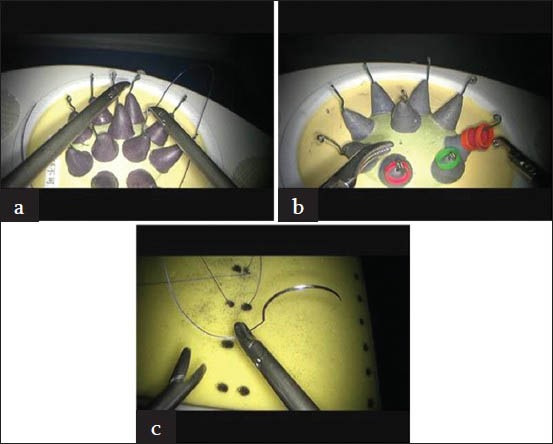
In an experimental model, six surgeons performed three surgical tasks with laparoscopic devices using a standard 2D and a flat-screen 3D model with polarized glasses. Performance times were compared between two-dimensional (2D) and 3D vision for each task. The surgeons also graded the efficiency of the 3D system, on a subjective scale of 0-100.
Performance times for task 1 (seven holes) and 2 (elastic bands) were significantly reduced by 84% and 56% using 3D compared with a 2D system and experienced surgeons performed all three tasks faster in 3D than 2D. The surgeons reported the polarized glasses were comfortable to wear and direct vision was seldom affected.
The use of 3D visualization seems to improve the efficiency of surgical skills during robotic surgery and reduce performance time for characteristic surgical procedure tasks.
机器人手术的主要优势之一是外科医生的三维(3D)视觉系统。本研究的目的是评估使用平板屏幕和偏光眼镜的3D视觉在机器人手术中对手术技能的效果。
在一个实验模型中,六名外科医生使用标准二维(2D)设备以及配备偏光眼镜的平板屏幕3D模型,通过腹腔镜设备执行三项手术任务。比较了每项任务在二维(2D)和3D视觉下的操作时间。外科医生还以0至100的主观评分标准对3D系统的效率进行了评分。
与2D系统相比,使用3D时任务1(七个孔)和任务2(橡皮筋)的操作时间分别显著减少了84%和56%,并且经验丰富的外科医生在3D模式下执行所有三项任务的速度都比2D模式下更快。外科医生报告称,偏光眼镜佩戴舒适,直视很少受到影响。
3D可视化的使用似乎可以提高机器人手术期间的手术技能效率,并减少特定外科手术任务的操作时间。