Pulcu Erdem, Lythe Karen, Elliott Rebecca, Green Sophie, Moll Jorge, Deakin John F W, Zahn Roland
The University of Manchester and Manchester Academic Health Sciences Centre, School of Medicine, Neuroscience and Psychiatry Unit, Manchester, United Kingdom.
The University of Manchester and Manchester Academic Health Sciences Centre, School of Medicine, Neuroscience and Psychiatry Unit, Manchester, United Kingdom ; The University of Manchester and Manchester Academic Health Sciences Centre, School of Psychological Sciences, Neuroscience and Aphasia Research Unit, Manchester, United Kingdom.
PLoS One. 2014 Jan 30;9(1):e86900. doi: 10.1371/journal.pone.0086900. eCollection 2014.
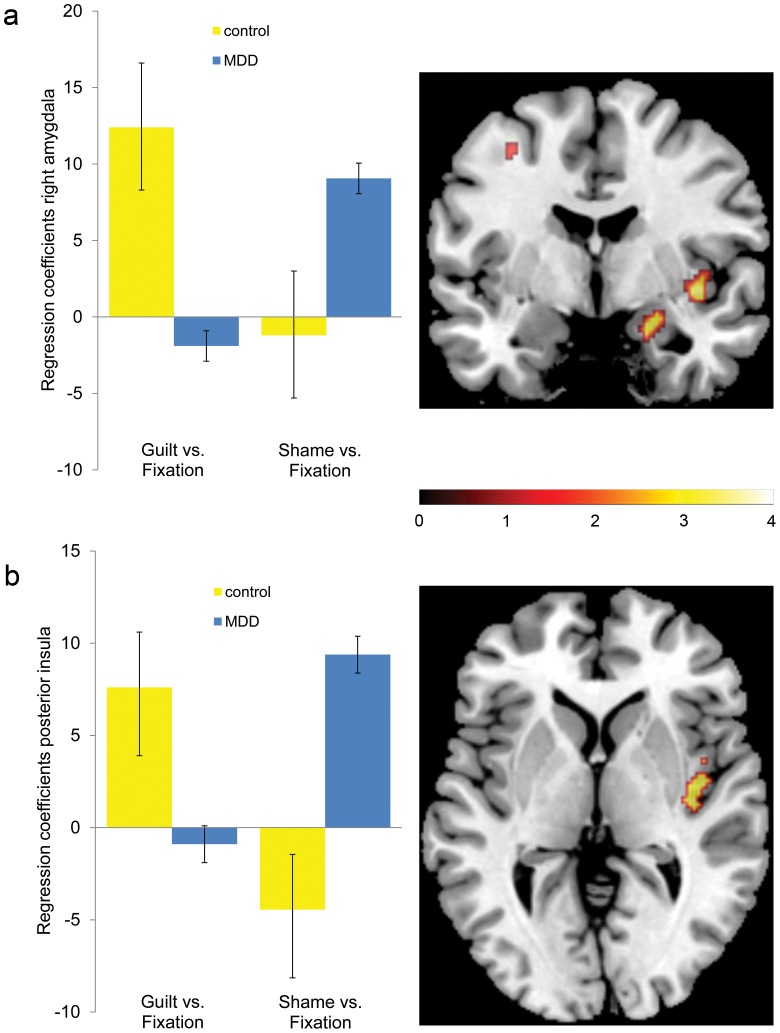
Proneness to self-blaming moral emotions such as shame and guilt is increased in major depressive disorder (MDD), and may play an important role in vulnerability even after symptoms have subsided. Social psychologists have argued that shame-proneness is relevant for depression vulnerability and is distinct from guilt. Shame depends on the imagined critical perception of others, whereas guilt results from one's own judgement. The neuroanatomy of shame in MDD is unknown. Using fMRI, we compared 21 participants with MDD remitted from symptoms with no current co-morbid axis-I disorders, and 18 control participants with no personal or family history of MDD. The MDD group exhibited higher activation of the right amygdala and posterior insula for shame relative to guilt (SPM8). This neural difference was observed despite equal levels of rated negative emotional valence and frequencies of induced shame and guilt experience across groups. These same results were found in the medication-free MDD subgroup (N = 15). Increased amygdala and posterior insula activations, known to be related to sensory perception of emotional stimuli, distinguish shame from guilt responses in remitted MDD. People with MDD thus exhibit changes in the neural response to shame after symptoms have subsided. This supports the hypothesis that shame and guilt play at least partly distinct roles in vulnerability to MDD. Shame-induction may be a more sensitive probe of residual amygdala hypersensitivity in MDD compared with facial emotion-evoked responses previously found to normalize on remission.
在重度抑郁症(MDD)中,出现诸如羞耻和内疚等自我责备道德情绪的倾向会增加,并且即使在症状消退后,这种倾向在易感性方面可能也起着重要作用。社会心理学家认为,羞耻倾向与抑郁症易感性相关,且与内疚不同。羞耻取决于对他人批判性看法的想象,而内疚则源于个人自身的判断。MDD中羞耻的神经解剖学尚不清楚。我们使用功能磁共振成像(fMRI),比较了21名症状已缓解且目前无共病轴I障碍的MDD患者,以及18名无MDD个人或家族史的对照参与者。与内疚相比,MDD组在体验羞耻时右侧杏仁核和后岛叶表现出更高的激活(SPM8)。尽管两组在评定的负面情绪效价水平以及诱发的羞耻和内疚体验频率相同,但仍观察到这种神经差异。在未服药的MDD亚组(N = 15)中也发现了相同的结果。杏仁核和后岛叶激活增加,已知与情绪刺激的感觉知觉有关,这在缓解期的MDD中将羞耻反应与内疚反应区分开来。因此,MDD患者在症状消退后对羞耻的神经反应会发生变化。这支持了羞耻和内疚在MDD易感性中至少部分发挥不同作用的假设。与之前发现的面部情绪诱发反应在缓解时恢复正常相比,羞耻诱导可能是检测MDD中杏仁核残留超敏反应更敏感的指标。