Núcleo de Bioinformática do Laboratório de Imunogenética (NBLI), Departamento de Genética, Universidade Federal do Rio Grande do Sul. Porto Alegre, Rio Grande do Sul, Brazil ; Programa de Pós-Graduação em Genética e Biologia Molecular (PPGBM), Universidade Federal do Rio Grande do Sul (UFRGS), Porto Alegre, Rio Grande do Sul, Brazil.
Technological and Scientific Development Center (CDCT), State Foundation in Production and Health Research (FEPPS), Porto Alegre, Rio Grande do Sul, Brazil ; Programa de Pós-Graduação em Genética e Biologia Molecular (PPGBM), Universidade Federal do Rio Grande do Sul (UFRGS), Porto Alegre, Rio Grande do Sul, Brazil.
PLoS One. 2014 Jan 31;9(1):e87520. doi: 10.1371/journal.pone.0087520. eCollection 2014.
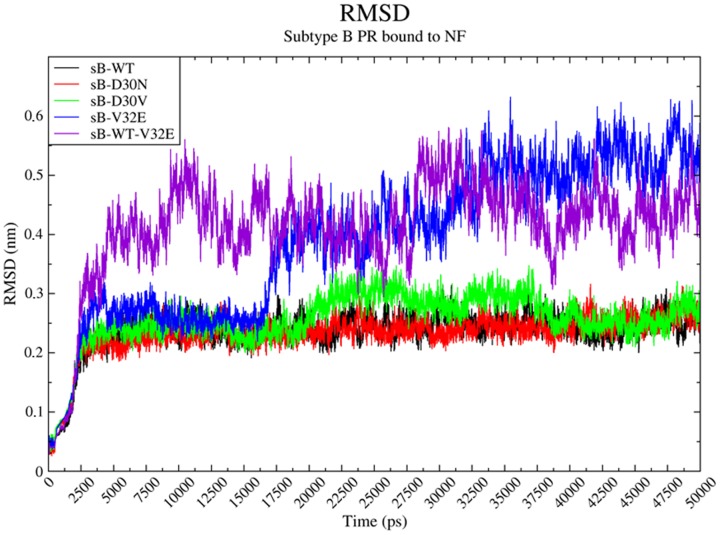
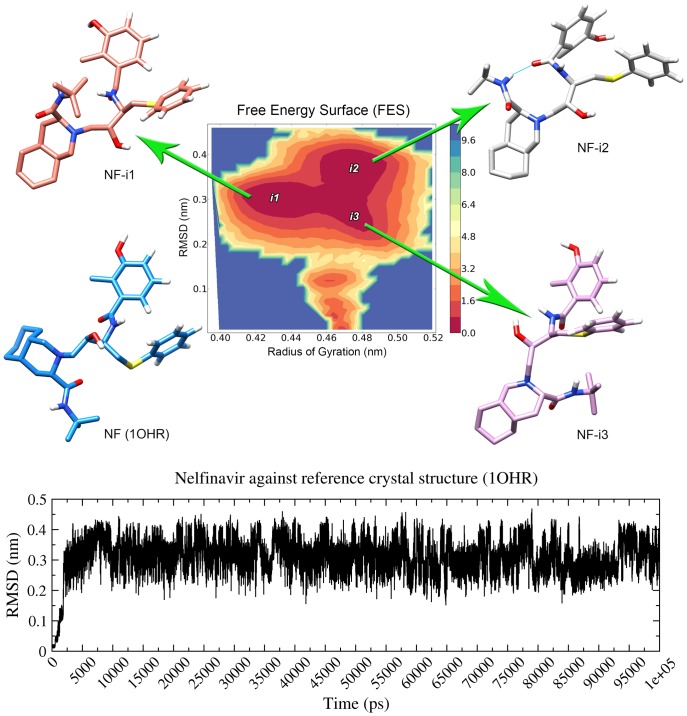
The Human Immunodeficiency Virus type 1 protease enzyme (HIV-1 PR) is one of the most important targets of antiretroviral therapy used in the treatment of AIDS patients. The success of protease-inhibitors (PIs), however, is often limited by the emergence of protease mutations that can confer resistance to a specific drug, or even to multiple PIs. In the present study, we used bioinformatics tools to evaluate the impact of the unusual mutations D30V and V32E over the dynamics of the PR-Nelfinavir complex, considering that codons involved in these mutations were previously related to major drug resistance to Nelfinavir. Both studied mutations presented structural features that indicate resistance to Nelfinavir, each one with a different impact over the interaction with the drug. The D30V mutation triggered a subtle change in the PR structure, which was also observed for the well-known Nelfinavir resistance mutation D30N, while the V32E exchange presented a much more dramatic impact over the PR flap dynamics. Moreover, our in silico approach was also able to describe different binding modes of the drug when bound to different proteases, identifying specific features of HIV-1 subtype B and subtype C proteases.
人类免疫缺陷病毒 1 型蛋白酶酶(HIV-1 PR)是抗逆转录病毒疗法中治疗艾滋病患者的最重要靶标之一。然而,蛋白酶抑制剂(PIs)的成功往往受到蛋白酶突变的限制,这些突变可以赋予对特定药物的耐药性,甚至对多种 PIs 产生耐药性。在本研究中,我们使用生物信息学工具来评估不常见突变 D30V 和 V32E 对 PR-Nelfinavir 复合物动力学的影响,因为涉及这些突变的密码子先前与 Nelfinavir 的主要耐药性有关。这两种研究的突变都表现出对 Nelfinavir 耐药性的结构特征,每个突变对与药物的相互作用都有不同的影响。D30V 突变引发了 PR 结构的微妙变化,这在众所周知的 Nelfinavir 耐药性突变 D30N 中也观察到,而 V32E 交换对 PR 瓣动力学的影响则更为显著。此外,我们的计算方法还能够描述药物与不同蛋白酶结合时的不同结合模式,确定 HIV-1 亚型 B 和亚型 C 蛋白酶的特定特征。