Weinberg Seth M, Parsons Trish E, Marazita Mary L, Maher Brion S
Center for Craniofacial and Dental Genetics, Department of Oral Biology, School of Dental Medicine, University of Pittsburgh, Pittsburgh, PA, USA.
Department of Mental Health, Bloomberg School of Public Health, Johns Hopkins University, Baltimore, MD, USA.
Dent 3000. 2013;1(1). doi: 10.5195/d3000.2013.14.
Previous research suggests that aspects of facial surface morphology are heritable. Traditionally, heritability studies have used a limited set of linear distances to quantify facial morphology and often employ statistical methods poorly designed to deal with biological shape. In this preliminary report, we use a combination of 3D photogrammetry and landmark-based morphometrics to explore which aspects of face shape show the strongest evidence of heritability in a sample of twins.
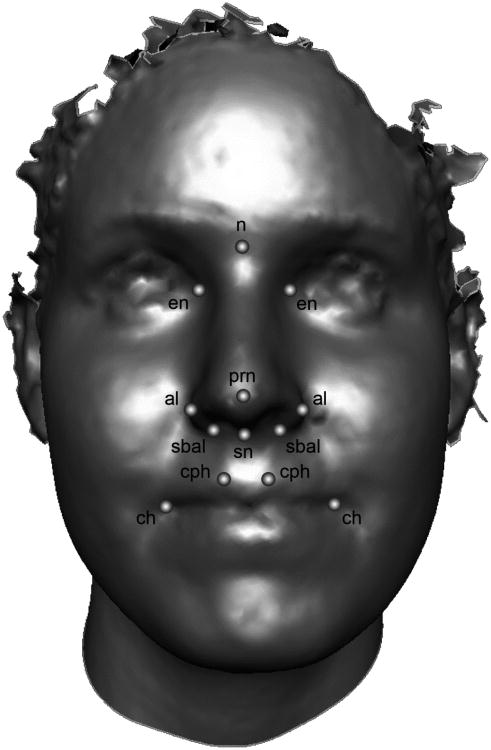
3D surface images were obtained from 21 twin pairs (10 monozygotic, 11 same-sex dizygotic). Thirteen 3D landmarks were collected from each facial surface and their coordinates subjected to geometric morphometric analysis. This involved superimposing the individual landmark configurations and then subjecting the resulting shape coordinates to a principal components analysis. The resulting PC scores were then used to calculate rough narrow-sense heritability estimates.
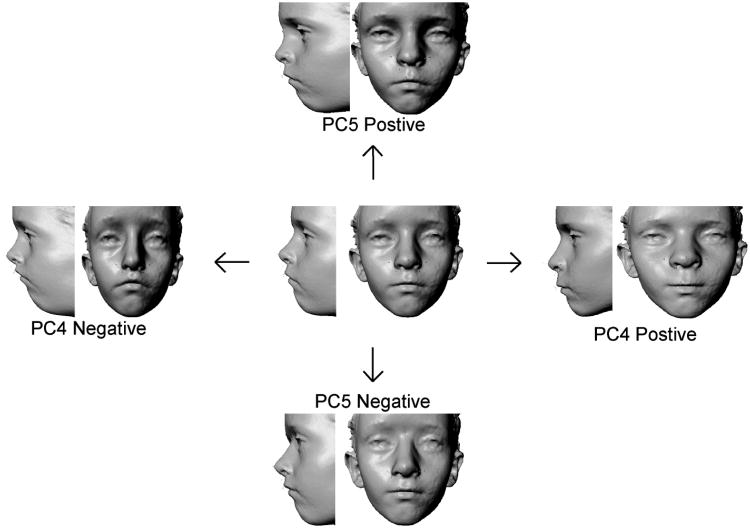
Three principal components displayed evidence of moderate to high heritability and were associated with variation in the breadth of orbital and nasal structures, upper lip height and projection, and the vertical and forward projection of the root of the nose due to variation in the position of nasion.
Aspects of facial shape, primarily related to variation in length and breadth of central midfacial structures, were shown to demonstrate evidence of strong heritability. An improved understanding of which facial features are under strong genetic control is an important step in the identification of specific genes that underlie normal facial variation.
先前的研究表明,面部表面形态的某些方面是可遗传的。传统上,遗传性研究使用有限的一组线性距离来量化面部形态,并且常常采用设计不佳的统计方法来处理生物形状。在本初步报告中,我们结合使用三维摄影测量法和基于地标点的形态测量学,以探究在双胞胎样本中面部形状的哪些方面显示出最强的遗传证据。
从21对双胞胎(10对同卵双胞胎,11对同性异卵双胞胎)获取三维表面图像。从每个面部表面收集13个三维地标点,并对其坐标进行几何形态测量分析。这包括叠加各个地标点配置,然后对所得的形状坐标进行主成分分析。然后使用所得的主成分得分来计算粗略的狭义遗传力估计值。
三个主成分显示出中度至高遗传性的证据,并且与眶部和鼻部结构的宽度变化、上唇高度和突出度以及由于鼻根点位置变化导致的鼻根部垂直和向前突出度的变化相关。
面部形状的各个方面,主要与面中部中央结构的长度和宽度变化有关,显示出强烈的遗传证据。更好地理解哪些面部特征受强大的基因控制,是识别构成正常面部变异基础的特定基因的重要一步。