Jeong Songmi, Yoo Eun Jung, Kim Ji Yoon, Han Chi Wha, Kim Ki Jun, Kay Chul Seung
Department of Radiation Oncology, The Catholic University of Korea College of Medicine, Seoul, Korea.
Department of Internal Medicine, The Catholic University of Korea College of Medicine, Seoul, Korea.
Radiat Oncol J. 2013 Dec;31(4):206-15. doi: 10.3857/roj.2013.31.4.206. Epub 2013 Dec 31.
Re-irradiation (re-RT) is considered a treatment option for inoperable locoregionally recurrent head and neck cancer (HNC) after prior radiotherapy. We evaluated the efficacy and safety of re-RT using Helical Tomotherapy as image-guided intensity-modulated radiotherapy in recurrent HNC.
Patients diagnosed with recurrent HNC and received re-RT were retrospectively reviewed. Primary endpoint was overall survival (OS) and secondary endpoints were locoregional control and toxicities.
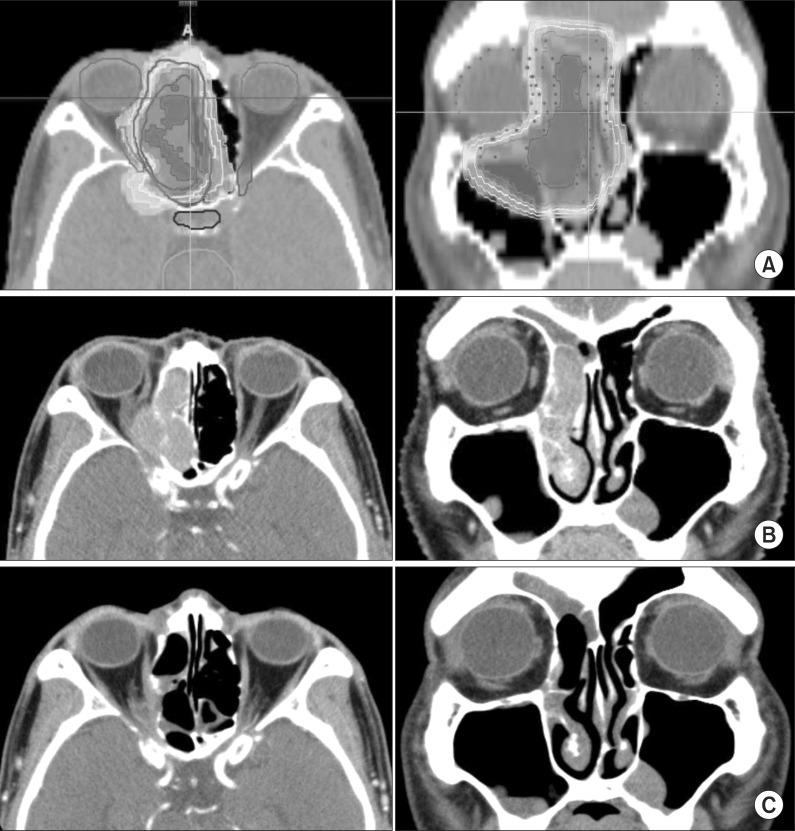
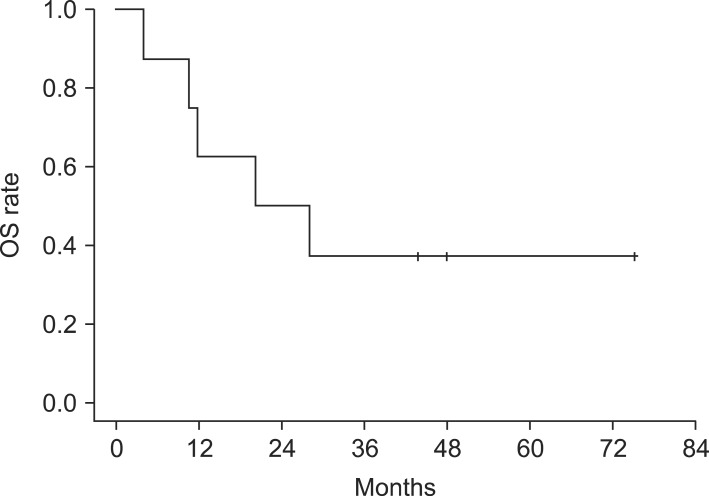
The median follow-up period of total 9 patients was 18.7 months (range, 4.1 to 76 months) and that of 3 alive patients was 49 months (range, 47 to 76 months). Median dose of first radiotherapy and re-RT was 64.8 and 47.5 Gy10. Median cumulative dose of the two courses of radiotherapy was 116.3 Gy10 (range, 91.8 to 128.9 Gy10) while the median interval between the two courses of radiation was 25 months (range, 4 to 137 months). The response rate after re-RT of the evaluated 8 patients was 75% (complete response, 4; partial response, 2). Median locoregional relapse-free survival after re-RT was 11.9 months (range, 3.4 to 75.1 months) and 5 patients eventually presented with treatment failure (in-field failure, 2; in- and out-field failure, 2; out-field failure, 1). Median OS of the 8 patients was 20.3 months (range, 4.1 to 75.1 months). One- and two-year OS rates were 62.5% and 50%, respectively. Grade 3 leucopenia developed in one patient as acute toxicity, and grade 2 osteonecrosis and trismus as chronic toxicity in another patient.
Re-RT using Helical Tomotherapy for previously irradiated patients with unresectable locoregionally recurrent HNC may be a feasible treatment option with long-term survival and acceptable toxicities.
再程放疗(re-RT)被认为是先前接受过放疗的不可切除的局部区域复发性头颈癌(HNC)的一种治疗选择。我们评估了使用螺旋断层放疗作为图像引导调强放疗用于复发性HNC再程放疗的疗效和安全性。
对诊断为复发性HNC并接受再程放疗的患者进行回顾性分析。主要终点是总生存期(OS),次要终点是局部区域控制和毒性反应。
9例患者的中位随访期为18.7个月(范围4.1至76个月),3例存活患者的中位随访期为49个月(范围47至76个月)。首次放疗和再程放疗的中位剂量分别为64.8 Gy10和47.5 Gy10。两程放疗的中位累积剂量为116.3 Gy10(范围91.8至128.9 Gy10),而两程放疗之间的中位间隔为25个月(范围4至137个月)。8例评估患者再程放疗后的缓解率为75%(完全缓解4例;部分缓解2例)。再程放疗后的中位局部区域无复发生存期为11.9个月(范围3.4至75.1个月),5例患者最终出现治疗失败(野内失败2例;野内和野外失败2例;野外失败1例)。8例患者的中位OS为20.3个月(范围4.1至75.1个月)。1年和2年OS率分别为62.5%和50%。1例患者发生3级白细胞减少作为急性毒性反应,另1例患者发生2级骨坏死和牙关紧闭作为慢性毒性反应。
对于先前接受过放疗的不可切除的局部区域复发性HNC患者,使用螺旋断层放疗进行再程放疗可能是一种可行的治疗选择,具有长期生存和可接受的毒性反应。