Department of Health, Behavior, and Society, Johns Hopkins Bloomberg School of Public Health, 624 N. Broadway, Room 704, Baltimore, MD 21205. E-mail:
University of Maryland School of Public Health, College Park, Maryland.
Prev Chronic Dis. 2014 Feb 6;11:130258. doi: 10.5888/pcd11.130258.
Asian Americans have the highest incidence of hepatocellular carcinoma (HCC), the major form of primary liver cancer, of all ethnic groups in the United States. Chronic hepatitis B virus (HBV) infection is the most common cause of HCC, and as many as 1 in 10 foreign-born Asian Americans are chronically infected with HBV. We tested the effectiveness of a culturally tailored liver cancer education program for increasing screening for HBV among Chinese, Korean, and Vietnamese Americans residing in the Baltimore-Washington metropolitan area, from November 2009 through June 2010.
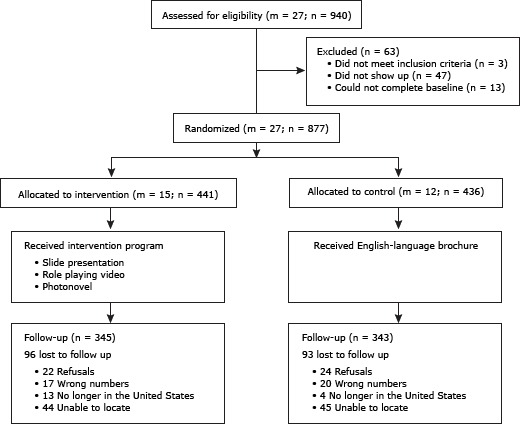
We used a cluster randomized controlled trial to recruit volunteer participants from community-based organizations (CBOs) in the Baltimore-Washington metropolitan area. We selected 877 participants by using a pretest survey. People were eligible to participate if they had not attended a hepatitis B-related education program in the past 5 years. The intervention group (n = 441) received a 30-minute educational program, and the control group (n = 436) received an educational brochure. After attending the educational program, the intervention group completed a post-education survey. Six months later, participants in both groups were followed up by telephone. Receipt of HBV screening was the outcome measure.
Approximately 79% (n = 688) of participants completed the 6-month follow-up telephone survey. Among those who had not had HBV screening at baseline (n = 446), the adjusted odds of self-reported receipt of HBV screening at the 6-month follow-up to the educational program were significantly higher for the intervention group than for the control group (odds ratio = 5.13; 95% confidence interval, 3.14-8.39; P < .001). Chinese Americans and Vietnamese Americans had significantly higher odds of having HBV screening in the 6-month period than Korean Americans.
Culturally tailored education programs that increase liver cancer awareness can be effective in increasing HBV screening among underserved Asian American populations.
在美国,亚裔美国人的肝细胞癌(HCC)发病率最高,HCC 是原发性肝癌的主要形式。慢性乙型肝炎病毒(HBV)感染是 HCC 的最常见原因,多达十分之一的亚裔美国人是慢性 HBV 感染者。我们于 2009 年 11 月至 2010 年 6 月期间,在巴尔的摩-华盛顿大都市区,测试了针对中国、韩国和越南裔美国人的肝癌教育计划的有效性,以增加乙型肝炎病毒的筛查。
我们使用聚类随机对照试验,从巴尔的摩-华盛顿大都市区的社区组织(CBO)招募志愿参与者。我们使用预测试调查选择了 877 名参与者。如果参与者在过去 5 年内未参加过与乙型肝炎相关的教育计划,则有资格参加。干预组(n = 441)接受了 30 分钟的教育计划,对照组(n = 436)接受了教育手册。参加教育计划后,干预组完成了教育后调查。6 个月后,两组参与者均通过电话进行随访。乙型肝炎病毒筛查的结果是测量指标。
大约 79%(n = 688)的参与者完成了 6 个月的随访电话调查。在基线时未接受乙型肝炎病毒筛查的参与者中(n = 446),干预组在教育计划的 6 个月随访时自我报告接受乙型肝炎病毒筛查的调整后优势比显著高于对照组(优势比 = 5.13;95%置信区间,3.14-8.39;P <.001)。中国裔美国人和越南裔美国人在 6 个月期间接受乙型肝炎病毒筛查的几率明显高于韩裔美国人。
提高肝癌意识的文化适应性教育计划可以有效增加服务不足的亚裔美国人人群的乙型肝炎病毒筛查。