Eleftheriadou Viktoria, Thomas Kim, Ravenscroft Jane, Whitton Maxine, Batchelor Jonathan, Williams Hywel
Centre of Evidence Based Dermatology, University of Nottingham, Kings Meadow Campus, Lenton Lane, Nottingham NG7 2NR, UK.
Trials. 2014 Feb 8;15:51. doi: 10.1186/1745-6215-15-51.
Hand-held NB-UVB units are lightweight devices that may overcome the need to treat vitiligo in hospital-based phototherapy cabinets, allowing early treatment at home that may enhance the likelihood of successful repigmentation. The pilot Hi-Light trial examined the feasibility of conducting a large multi-centre randomised controlled trial (RCT) on the use of such devices by exploring recruitment, adherence, acceptability, and patient education.
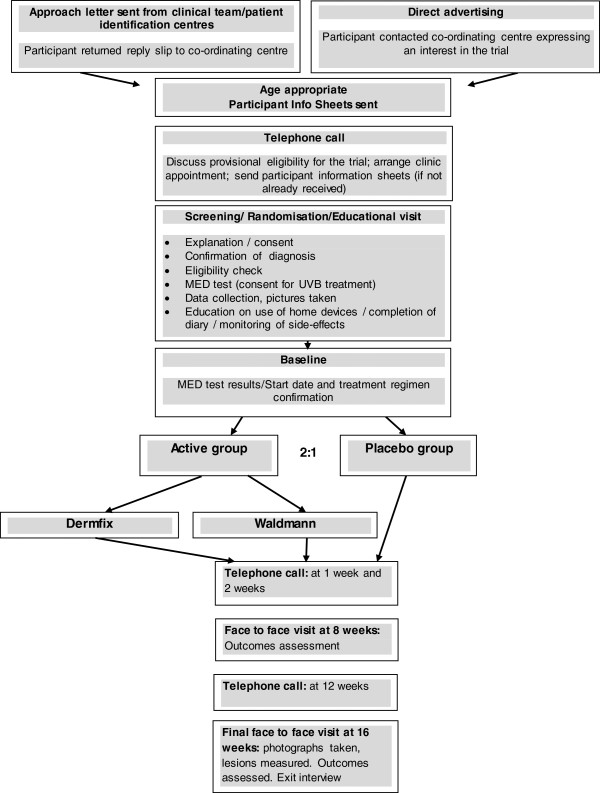
This was a feasibility, double-blind, multi-centre, parallel group randomised placebo-controlled trial of hand-held NB-UVB phototherapy for the treatment of vitiligo at home. The overall duration of the trial was seven months; three months recruitment and four months treatment. Participants were randomly allocated to active or placebo groups (2:1 ratio). The primary outcome measure was the proportion of eligible participants who were willing to be randomised. The secondary outcomes included proportion of participants expressing interest in the trial and fulfilling eligibility criteria, withdrawal rates and missing data, proportion of participants adhering to and satisfied with the treatment, and incidence of NB-UVB short-term adverse events.
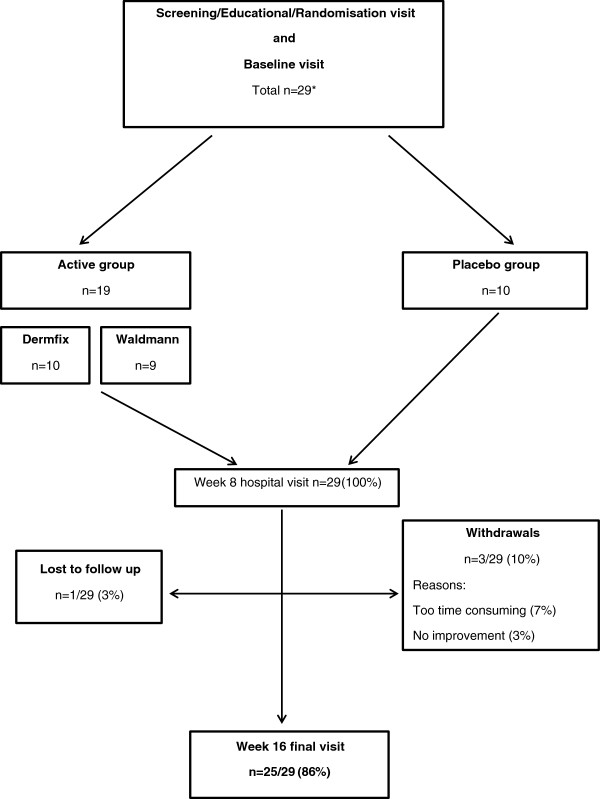
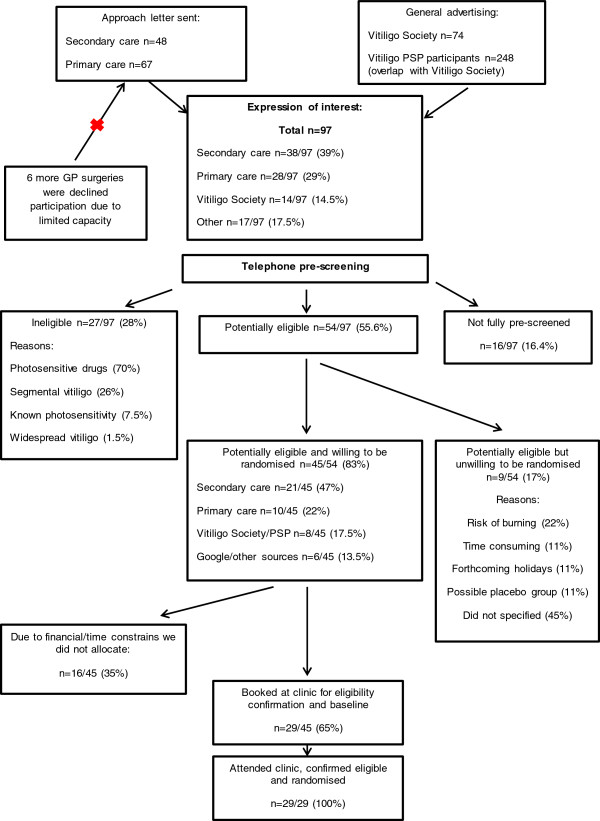
Eighty-three percent (45/54) of vitiligo patients who expressed interest in the trial were willing to be randomised. Due to time and financial constraints, only 29/45 potential participants were booked to attend a baseline hospital visit. All 29 (100%) potential participants were confirmed as being eligible and were subsequently randomised. Willingness to participate in the study for General Practice (family physicians) surgeries and hospitals were 40% and 79%, respectively; 86% (25/29) of patients adhered to the treatment and 65% (7/11) of patients in the active group had some degree of repigmentation. Only one patient in the active group reported erythema grade 3 (3%). Both devices (Dermfix 1000 NB-UVB and Waldmann NB-UVB 109) were acceptable to participants.
Hand-held NB-UVB devices need evaluation in a large, pragmatic RCT. This pilot trial has explored many of the uncertainties that need to be overcome before embarking on a full scale trial, including the development of a comprehensive training package and treatment protocol. The study has shown strong willingness of participants to be randomised, very good treatment adherence and repigmentation rates, and provided evidence of feasibility for a definitive trial.
NCT01478945.
手持式窄谱中波紫外线(NB-UVB)设备是一种轻便型装置,可能无需在医院的光疗箱中治疗白癜风,从而实现在家中早期治疗,这可能会提高色素成功再生的可能性。先导性高光试验通过探讨招募、依从性、可接受性和患者教育情况,研究了开展一项关于使用此类设备的大型多中心随机对照试验(RCT)的可行性。
这是一项关于在家中使用手持式NB-UVB光疗治疗白癜风的可行性、双盲、多中心、平行组随机安慰剂对照试验。试验总时长为七个月;三个月招募期和四个月治疗期。参与者被随机分配到活性组或安慰剂组(比例为2:1)。主要结局指标是愿意被随机分组的符合条件参与者的比例。次要结局指标包括表达对试验感兴趣并符合入选标准的参与者比例、退出率和缺失数据、坚持治疗并对治疗满意的参与者比例,以及NB-UVB短期不良事件的发生率。
对试验感兴趣的白癜风患者中有83%(45/54)愿意被随机分组。由于时间和资金限制,只有29/45名潜在参与者预约进行基线医院访视。所有29名(100%)潜在参与者均被确认为符合条件,随后被随机分组。普通全科(家庭医生)诊所和医院参与研究的意愿分别为40%和79%;86%(25/29)的患者坚持治疗,活性组中65%(7/11)的患者有一定程度的色素再生。活性组中只有一名患者报告出现3级红斑(3%)。两种设备(Dermfix 1000 NB-UVB和Waldmann NB-UVB 109)参与者均可接受。
手持式NB-UVB设备需要在一项大型实用性RCT中进行评估。这项先导试验探讨了在开展全面试验之前需要克服的许多不确定性,包括制定全面的培训方案和治疗方案。该研究表明参与者有很强的意愿被随机分组,治疗依从性和色素再生率非常好,并为确定性试验的可行性提供了证据。
NCT01478945