Seltzer Laurie E, Swartz Michael, Kwon Jennifer M, Burchfiel James, Alfieris George M, Guillet Ronnie
Department of Neurology, University of Rochester Medical Center, Rochester, New York.
Department of Surgery, University of Rochester Medical Center, Rochester, New York.
Pediatr Neurol. 2014 Apr;50(4):313-7. doi: 10.1016/j.pediatrneurol.2013.12.017. Epub 2013 Dec 19.
During the surgical repair of infants with congenital cardiac defects, there can be periods of decreased cerebral blood flow, particularly during deep hypothermic circulatory arrest. As a result, these infants are at increased risk for seizures and long-term neurodevelopmental difficulties.
Thirty-two infants with congenital heart disease had continuous video-electroencephalographic (EEG) monitoring pre-, intra-, and postoperatively for 48 hours after surgery.
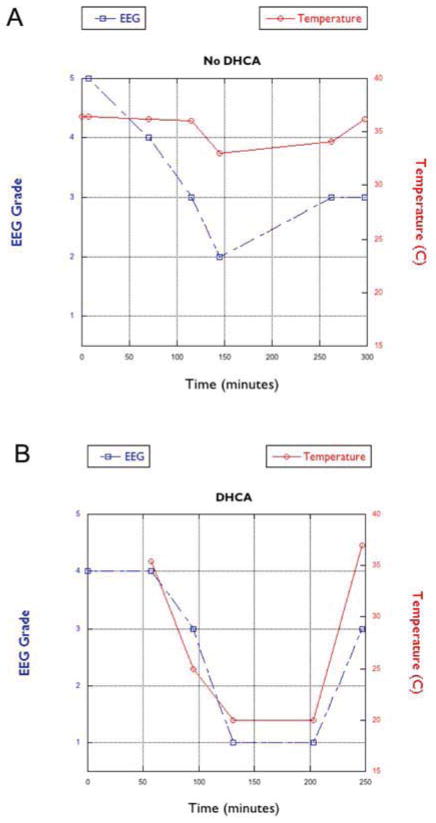
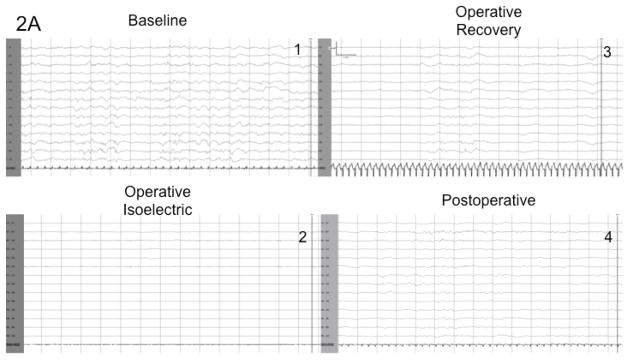
For patients requiring deep hypothermic circulatory arrest (n = 17) the EEG pattern for all patients became suppressed and eventually isoelectric below 25 °C. Two of the 32 infants had electrical seizures within the 48-hour monitoring period. Both required deep hypothermic circulatory arrest, and the burst pattern during recovery had rhythmic, sharp components that were high amplitude and often asynchronous between the hemispheres. The interval between the onset of seizure activity and initiation of the sharp burst pattern during surgery was 29 and 40 hours. This pattern was not observed during isoelectric recovery from infants who did not develop postoperative seizures.
The EEG in infants during deep hypothermic circulatory arrest displayed predictable changes. We identified an electroencephalographic pattern following the isoelectric period that may predict seizure development in the subsequent 48 hours.
在对患有先天性心脏缺陷的婴儿进行手术修复期间,可能会出现脑血流量减少的时期,尤其是在深度低温循环停搏期间。因此,这些婴儿发生癫痫和长期神经发育障碍的风险增加。
32例先天性心脏病婴儿在术前、术中和术后进行了48小时的连续视频脑电图(EEG)监测。
对于需要深度低温循环停搏的患者(n = 17),所有患者的脑电图模式在体温低于25°C时均受到抑制,最终变为等电位。32例婴儿中有2例在48小时监测期内发生电惊厥。两者均需要深度低温循环停搏,恢复期间的爆发模式具有节律性、尖锐成分,振幅高,且半球间常不同步。手术期间癫痫活动开始与尖锐爆发模式开始之间的间隔分别为29小时和40小时。在未发生术后癫痫的婴儿等电位恢复期间未观察到这种模式。
深度低温循环停搏期间婴儿的脑电图显示出可预测的变化。我们确定了等电位期后的一种脑电图模式,该模式可能预测随后48小时内癫痫的发生。