El-Ghlban Samah, Kasai Tomonari, Shigehiro Tsukasa, Yin Hong Xia, Sekhar Sreeja, Ida Mikiko, Sanchez Anna, Mizutani Akifumi, Kudoh Takayuki, Murakami Hiroshi, Seno Masaharu
Division of Chemistry and Biotechnology, Graduate School of Natural Science and Technology, Okayama University, Okayama 7008530, Japan.
Biomed Res Int. 2014;2014:152659. doi: 10.1155/2014/152659. Epub 2014 Jan 6.
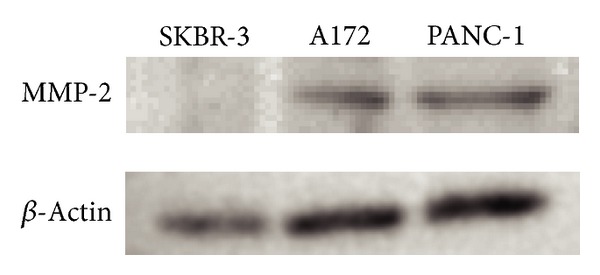
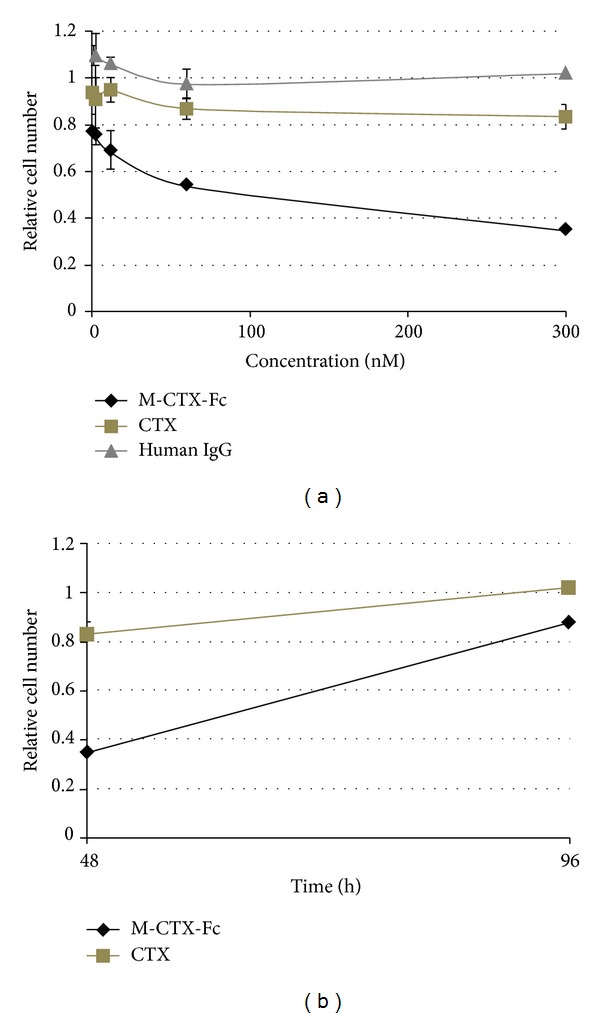
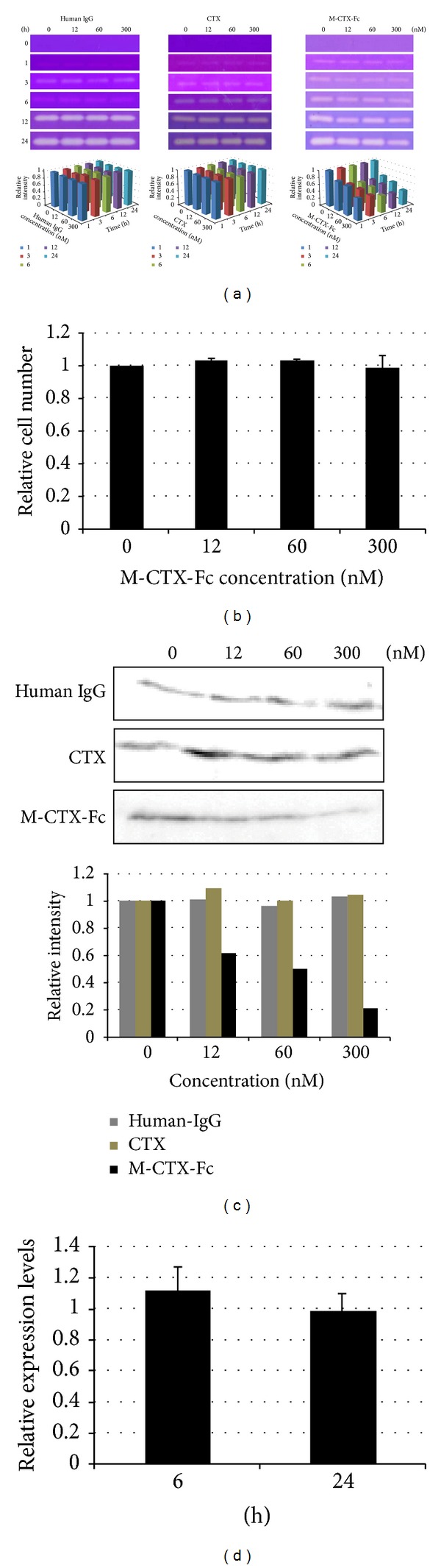
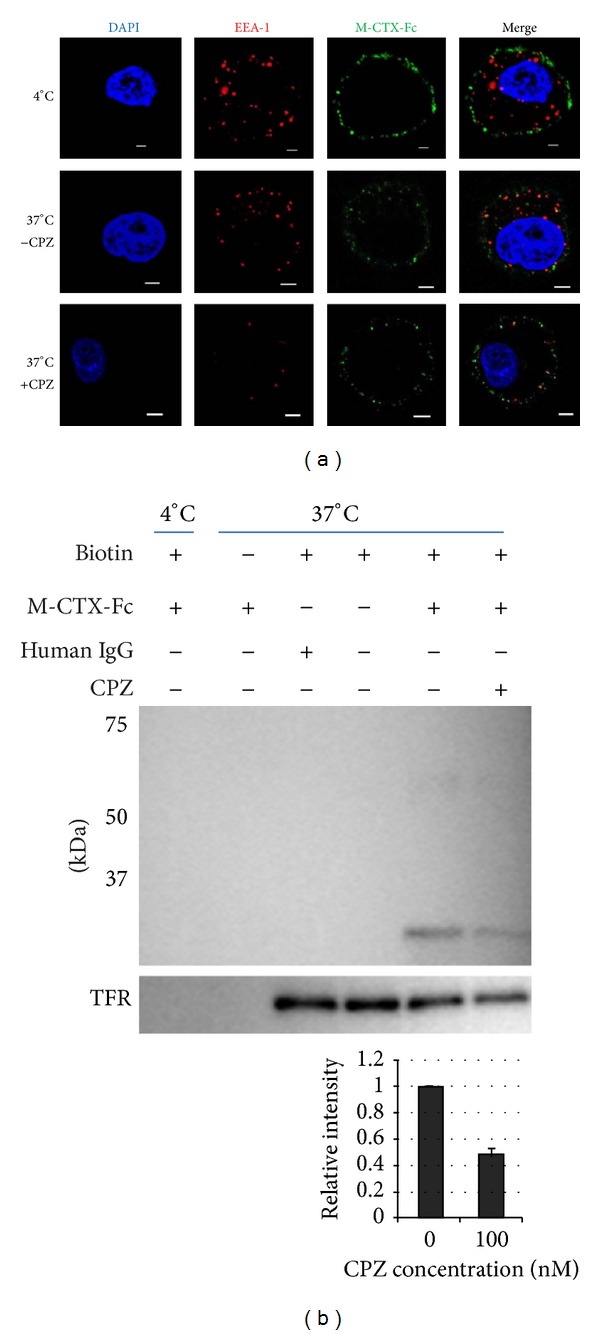
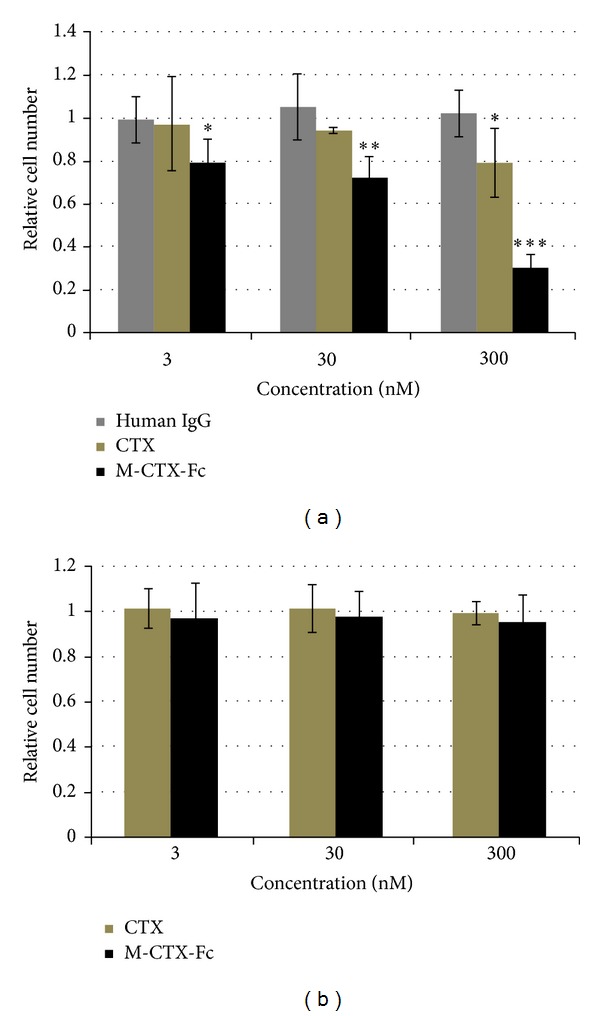
Chlorotoxin (CTX) is a 36-amino acid peptide derived from Leiurus quinquestriatus (scorpion) venom, which inhibits low-conductance chloride channels in colonic epithelial cells. It has been reported that CTX also binds to matrix metalloproteinase-2 (MMP-2), membrane type-1 MMP, and tissue inhibitor of metalloproteinase-2, as well as CLC-3 chloride ion channels and other proteins. Pancreatic cancer cells require the activation of MMP-2 during invasion and migration. In this study, the fusion protein was generated by joining the CTX peptide to the amino terminus of the human IgG-Fc domain without a hinge domain, the monomeric form of chlorotoxin (M-CTX-Fc). The resulting fusion protein was then used to target pancreatic cancer cells (PANC-1) in vitro. M-CTX-Fc decreased MMP-2 release into the media of PANC-1 cells in a dose-dependent manner. M-CTX-Fc internalization into PANC-1 cells was observed. When the cells were treated with chlorpromazine (CPZ), the internalization of the fusion protein was reduced, implicating a clathrin-dependent internalization mechanism of M-CTX-Fc in PANC-1 cells. Furthermore, M-CTX-Fc clearly exhibited the inhibition of the migration depending on the concentration, but human IgG, as negative control of Fc, was not affected. The M-CTX-Fc may be an effective instrument for targeting pancreatic cancer.
氯毒素(CTX)是一种由以色列金蝎毒液衍生而来的36个氨基酸的肽,它能抑制结肠上皮细胞中的低电导氯离子通道。据报道,CTX还能与基质金属蛋白酶-2(MMP-2)、膜型-1 MMP、金属蛋白酶组织抑制剂-2以及CLC-3氯离子通道和其他蛋白质结合。胰腺癌细胞在侵袭和迁移过程中需要MMP-2的激活。在本研究中,通过将CTX肽连接到人IgG-Fc结构域的氨基末端(无铰链结构域)生成融合蛋白,即氯毒素的单体形式(M-CTX-Fc)。然后将所得融合蛋白用于体外靶向胰腺癌细胞(PANC-1)。M-CTX-Fc以剂量依赖性方式减少MMP-2释放到PANC-1细胞培养基中。观察到M-CTX-Fc内化进入PANC-1细胞。当用氯丙嗪(CPZ)处理细胞时,融合蛋白的内化减少,这表明M-CTX-Fc在PANC-1细胞中的内化机制依赖于网格蛋白。此外,M-CTX-Fc明显表现出对迁移的抑制作用,且呈浓度依赖性,但作为Fc阴性对照的人IgG不受影响。M-CTX-Fc可能是一种靶向胰腺癌的有效工具。