Zhang Zhi-Feng, Duan Zhi-Jun, Wang Li-Xia, Yang Dong, Zhao Gang, Zhang Lin
Department of Gastroenterology, The First Affiliated Hospital of Dalian Medical University, 116000 Dalian, Liaoning province, China.
BMC Gastroenterol. 2014 Feb 10;14:23. doi: 10.1186/1471-230X-14-23.
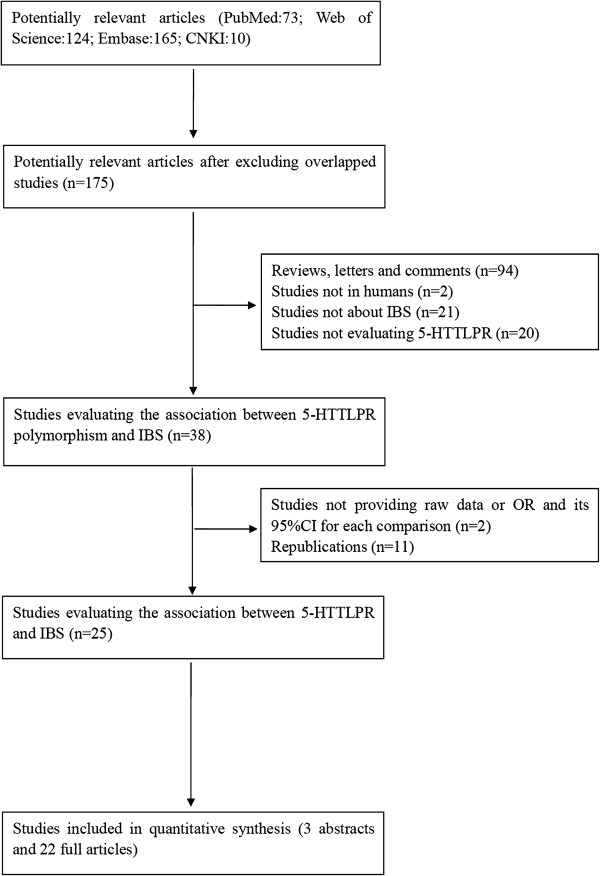
The results of previous studies assessing the association between the 5-HTTLPR polymorphism of serotonin transporter gene and irritable bowel syndrome (IBS) are inconsistent. The aim of this study was to clarify the association between the 5-HTTLPR mutation and the presence of IBS and its subtypes with a meta-analysis of 25 studies.
A thorough search for case-control studies evaluating the association between the 5-HTTLPR polymorphism of serotonin transporter gene and the presence of IBS was carried out in four electronic databases. A meta-analysis was performed in accordance with the Cochrane Handbook for systemic reviews.
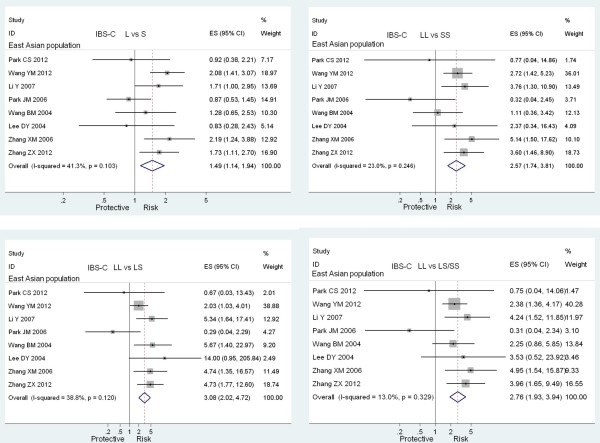
A total of 25 articles with 3443 IBS cases and 3359 controls were included into our meta-analysis. No significant association was found between this polymorphism and IBS in all populations. Whereas the LL genotype was demonstrated to be a risk factor for constipation predominant IBS (IBS-C) development in the overall population (LL vs SS: OR = 1.570, 95% CI = 1.147-2.148, P = 0.005, Bon = 0.030; LL vs LS: OR = 1.658, 95% CI = 1.180-2.331, P = 0.004, Bon = 0.024; LL vs LS/SS: OR = 1.545, 95% CI = 1.187-2.012, P = 0.001, Bon = 0.006). In the analysis of different ethnicities, L allele and LL genotype were significantly associated with increased IBS-C risk in the East Asian population (L vs S: OR = 1.487, 95% CI = 1.139-1.941, P = 0.003, Bon = 0.018; LL vs SS: OR = 2.575, 95% CI = 1.741-3.808, P = 0.000, Bon = 0.000; LL vs LS: OR = 3.084, 95% CI = 2.017-4.715, P = 0.000, Bon = 0.000; LL vs LS/SS: OR = 2.759, 95% CI = 1.933-3.938, P = 0.000, Bon = 0.000), but not in the Caucasian population.
Different from the conclusions of the earlier meta-analyses, the 5-HTTLPR mutation affects IBS-C but not IBS-D and IBS-M development and this effect only exists in the East Asian population but not other populations.
先前评估血清素转运体基因5-HTTLPR多态性与肠易激综合征(IBS)之间关联的研究结果并不一致。本研究的目的是通过对25项研究进行荟萃分析,阐明5-HTTLPR突变与IBS及其亚型之间的关联。
在四个电子数据库中全面检索评估血清素转运体基因5-HTTLPR多态性与IBS存在之间关联的病例对照研究。根据Cochrane系统评价手册进行荟萃分析。
我们的荟萃分析共纳入25篇文章,其中包括3443例IBS病例和3359例对照。在所有人群中,该多态性与IBS之间未发现显著关联。然而,在总体人群中,LL基因型被证明是便秘型IBS(IBS-C)发生的危险因素(LL与SS比较:OR = 1.570,95%CI = 1.147 - 2.148,P = 0.005,Bon = 0.030;LL与LS比较:OR = 1.658,95%CI = 1.180 - 2.331,P = 0.004,Bon = 0.024;LL与LS/SS比较:OR = 1.545,95%CI = 1.187 - 2.012,P = 0.001,Bon = 0.006)。在不同种族分析中,L等位基因和LL基因型与东亚人群中IBS-C风险增加显著相关(L与S比较:OR = 1.487,95%CI = 1.139 - 1.941,P = 0.003,Bon = 0.