• 文献检索
  • 文档翻译
  • 深度研究
  • 学术资讯
  • Suppr Zotero 插件Zotero 插件
  • 邀请有礼
  • 套餐&价格
  • 历史记录
应用&插件
Suppr Zotero 插件Zotero 插件浏览器插件Mac 客户端Windows 客户端微信小程序
定价
高级版会员购买积分包购买API积分包
服务
文献检索文档翻译深度研究API 文档MCP 服务
关于我们
关于 Suppr公司介绍联系我们用户协议隐私条款
关注我们

Suppr 超能文献

核心技术专利:CN118964589B侵权必究
粤ICP备2023148730 号-1Suppr @ 2026

文献检索

告别复杂PubMed语法,用中文像聊天一样搜索,搜遍4000万医学文献。AI智能推荐,让科研检索更轻松。

立即免费搜索

文件翻译

保留排版,准确专业,支持PDF/Word/PPT等文件格式,支持 12+语言互译。

免费翻译文档

深度研究

AI帮你快速写综述,25分钟生成高质量综述,智能提取关键信息,辅助科研写作。

立即免费体验

迈向挑食/偏食的手术诊断:基于人群队列的潜在类别分析方法

Toward an operative diagnosis of fussy/picky eating: a latent profile approach in a population-based cohort.

作者信息

Tharner Anne, Jansen Pauline W, Kiefte-de Jong Jessica C, Moll Henriette A, van der Ende Jan, Jaddoe Vincent W V, Hofman Albert, Tiemeier Henning, Franco Oscar H

机构信息

Department of Epidemiology, Erasmus University Medical Center, Rotterdam, The Netherlands.

出版信息

Int J Behav Nutr Phys Act. 2014 Feb 10;11:14. doi: 10.1186/1479-5868-11-14.

DOI:10.1186/1479-5868-11-14
PMID:24512388
原文链接:https://pmc.ncbi.nlm.nih.gov/articles/PMC3922255/
Abstract

BACKGROUND

Definitions and assessment methods of fussy/picky eating are heterogeneous and remain unclear.We aimed to identify an eating behavior profile reflecting fussy/picky eating in children and to describe characteristics of fussy eaters.

METHODS

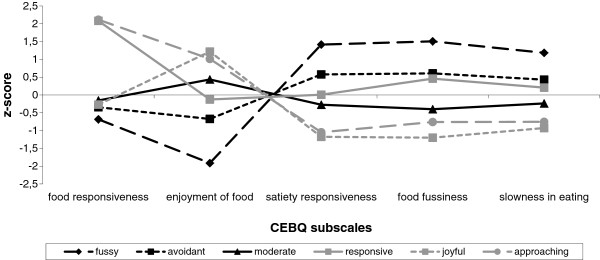
Eating behavior was assessed with the Child Eating Behavior Questionnaire (CEBQ) in 4914 4-year olds in a population-based birth cohort study. Latent Profile Analysis (LPA) was used to identify eating behavior profiles based on CEBQ subscales.

RESULTS AND DISCUSSION

We found a "fussy" eating behavior profile (5.6% of children) characterized by high food fussiness, slowness in eating, and satiety responsiveness in combination with low enjoyment of food and food responsiveness. Fussy eaters were more often from families with low household income than non-fussy eaters (42% vs. 31.8% respectively; Χ²(1) = 9.97, p < .01). When they were 14 months old, fussy eaters had a lower intake of vegetables (t [3008] = 2.42, p < .05) and fish (t [169.77] = 2.40, p < .05) but higher intake of savory snacks (t [153.69] = -2.03, p < .05) and sweets (t [3008] = -2.30, p < .05) compared to non-fussy eaters. Also, fussy eaters were more likely to be underweight at 4 years of age (19.3%) than non-fussy eaters (12.3%; Χ²(1) = 7.71, p < .01).

CONCLUSIONS

A distinct fussy eating behavior profile was identified by LPA, which was related to family and child characteristics, food intake, and BMI. This behavior profile might be used in future research and the development of interventions.

摘要

背景

挑食/偏食的定义和评估方法存在异质性,仍不明确。我们旨在确定一种反映儿童挑食/偏食的饮食行为特征,并描述挑食儿童的特征。

方法

在一项基于人群的出生队列研究中,使用儿童饮食行为问卷(CEBQ)对4914名4岁儿童的饮食行为进行评估。潜在剖面分析(LPA)用于根据CEBQ分量表确定饮食行为特征。

结果与讨论

我们发现了一种“挑食”的饮食行为特征(占儿童的5.6%),其特点是食物挑剔程度高、进食速度慢、饱腹感反应性强,同时对食物的享受程度低和食物反应性低。挑食儿童来自低收入家庭的比例高于非挑食儿童(分别为42%和31.8%;Χ²(1)=9.97,p<.01)。在14个月大时,挑食儿童的蔬菜摄入量(t[3008]=2.42,p<.05)和鱼类摄入量(t[169.77]=2.40,p<.05)低于非挑食儿童,但咸味零食摄入量(t[153.69]=-2.03,p<.05)和甜食摄入量(t[3008]=-2.30,p<.05)高于非挑食儿童。此外,挑食儿童在4岁时体重过轻的可能性(19.3%)高于非挑食儿童(12.3%;Χ²(1)=7.71,p<.01)。

结论

通过潜在剖面分析确定了一种独特的挑食饮食行为特征,该特征与家庭和儿童特征、食物摄入量和体重指数有关。这种行为特征可能会用于未来的研究和干预措施的开发。
https://cdn.ncbi.nlm.nih.gov/pmc/blobs/0b70/3922255/35cc72f1f37d/1479-5868-11-14-1.jpg

相似文献

1
Toward an operative diagnosis of fussy/picky eating: a latent profile approach in a population-based cohort.迈向挑食/偏食的手术诊断:基于人群队列的潜在类别分析方法
Int J Behav Nutr Phys Act. 2014 Feb 10;11:14. doi: 10.1186/1479-5868-11-14.
2
Longitudinal association between preschool fussy eating and body composition at 6 years of age: The Generation R Study.学龄前挑食与6岁时身体成分的纵向关联:Generation R研究
Int J Behav Nutr Phys Act. 2015 Dec 14;12:153. doi: 10.1186/s12966-015-0313-2.
3
A functional description of adult picky eating using latent profile analysis.采用潜在剖面分析对成人挑食进行功能描述。
Int J Behav Nutr Phys Act. 2018 Nov 6;15(1):109. doi: 10.1186/s12966-018-0743-8.
4
A comparison of maternal feeding responses to child fussy eating in low-income food secure and food insecure households.比较低收入有保障和无保障家庭中母亲对孩子挑剔进食的喂养反应。
Appetite. 2019 Jun 1;137:259-266. doi: 10.1016/j.appet.2019.03.005. Epub 2019 Mar 8.
5
Picky eating in Swedish preschoolers of different weight status: application of two new screening cut-offs.不同体重状态的瑞典学龄前儿童的挑食行为:两种新筛选界限的应用。
Int J Behav Nutr Phys Act. 2018 Aug 9;15(1):74. doi: 10.1186/s12966-018-0706-0.
6
Girls' picky eating in childhood is associated with normal weight status from ages 5 to 15 y.女孩童年时期挑食与5至15岁的正常体重状况相关。
Am J Clin Nutr. 2016 Dec;104(6):1577-1582. doi: 10.3945/ajcn.116.142430. Epub 2016 Oct 26.
7
Infant feeding and child fussy eating: The Generation R Study.婴儿喂养与儿童挑食:代际R研究
Appetite. 2017 Jul 1;114:374-381. doi: 10.1016/j.appet.2017.04.006. Epub 2017 Apr 8.
8
Perceived fussy eating in Australian children at 14 months of age and subsequent use of maternal feeding practices at 2 years.澳大利亚14个月大儿童的挑食认知情况及2岁时母亲喂养方式的后续使用情况。
Int J Behav Nutr Phys Act. 2017 Sep 11;14(1):123. doi: 10.1186/s12966-017-0582-z.
9
Diet at Age 10 and 13 Years in Children Identified as Picky Eaters at Age 3 Years and in Children Who Are Persistent Picky Eaters in A Longitudinal Birth Cohort Study.3 岁时被认定为挑食儿童和在纵向出生队列研究中持续挑食的儿童在 10 岁和 13 岁时的饮食。
Nutrients. 2019 Apr 10;11(4):807. doi: 10.3390/nu11040807.
10
Effect of being a persistent picky eater on feeding difficulties in school-aged children.持续挑食对学龄儿童进食困难的影响。
Appetite. 2023 Apr 1;183:106483. doi: 10.1016/j.appet.2023.106483. Epub 2023 Feb 3.

引用本文的文献

1
The Impact of Eating Behaviors on Ultraprocessed Food Consumption Over 12 Months in Children.儿童饮食行为对12个月内超加工食品消费的影响
Obesity (Silver Spring). 2025 Jul 27. doi: 10.1002/oby.24361.
2
Do Children Who Were Preschool Picky Eaters Eat Different Foods at School Lunch When Aged 13 Years Than Their Non-Picky Peers?与非挑食的同龄人相比,曾在学龄前挑食的儿童在13岁时学校午餐吃的食物会有所不同吗?
J Hum Nutr Diet. 2025 Jun;38(3):e70063. doi: 10.1111/jhn.70063.
3
Food Fussiness Processes in Middle Childhood: Application of a Dual-Processing Model Using Measures of Temperament.

本文引用的文献

1
Children's eating behavior, feeding practices of parents and weight problems in early childhood: results from the population-based Generation R Study.儿童的饮食行为、父母的喂养行为与幼儿期的体重问题:基于人群的 Generation R 研究结果。
Int J Behav Nutr Phys Act. 2012 Oct 30;9:130. doi: 10.1186/1479-5868-9-130.
2
The Generation R Study: design and cohort update 2012.《生育队列研究:设计与 2012 年队列更新》
Eur J Epidemiol. 2012 Sep;27(9):739-56. doi: 10.1007/s10654-012-9735-1. Epub 2012 Oct 20.
3
Beyond picky eating: avoidant/restrictive food intake disorder.
童年中期的食物挑剔过程:运用气质测量的双加工模型
Nutrients. 2025 Apr 28;17(9):1489. doi: 10.3390/nu17091489.
4
Diet fortification for mild and moderate picky eating in typically developed children: Opinion review of Middle East consensus.针对发育正常儿童轻度和中度挑食的饮食强化:中东共识意见综述
World J Clin Pediatr. 2025 Mar 9;14(1):101769. doi: 10.5409/wjcp.v14.i1.101769.
5
Identifying Parental Feeding Patterns in a Spanish Sample of Toddlers Using a Latent Class Analysis.使用潜在类别分析确定西班牙幼儿样本中的父母喂养模式。
Matern Child Nutr. 2025 Apr;21(2):e13799. doi: 10.1111/mcn.13799. Epub 2025 Jan 27.
6
Risk Factors and Consequences of Food Neophobia and Pickiness in Children and Adolescents: A Systematic Review.儿童和青少年食物恐新症及挑食的风险因素与后果:一项系统综述
Foods. 2024 Dec 30;14(1):69. doi: 10.3390/foods14010069.
7
Psychometric properties of the nine-item avoidant/restrictive food intake disorder screen (NIAS) in Turkish adolescents.土耳其青少年中九项回避/限制性食物摄入障碍筛查量表(NIAS)的心理测量特性。
J Eat Disord. 2024 Jul 25;12(1):105. doi: 10.1186/s40337-024-01066-0.
8
Relation between ARFID symptomatology and picky eating onset and duration.进食障碍症状与挑食发生和持续时间的关系。
Eat Behav. 2024 Aug;54:101900. doi: 10.1016/j.eatbeh.2024.101900. Epub 2024 Jun 24.
9
Eating Behaviours and Dietary Intake in Children and Adolescents: A Systematic Review.儿童和青少年的饮食行为和膳食摄入:系统评价。
Curr Nutr Rep. 2024 Sep;13(3):363-376. doi: 10.1007/s13668-024-00544-w. Epub 2024 May 26.
10
Impact of Dietary Coparenting and Parenting Strategies on Picky Eating Behaviors in Young Children.膳食共同养育和养育策略对幼儿挑食行为的影响。
Nutrients. 2024 Mar 20;16(6):898. doi: 10.3390/nu16060898.
挑食之外:回避/限制型食物摄入障碍。
Curr Psychiatry Rep. 2012 Aug;14(4):421-31. doi: 10.1007/s11920-012-0293-8.
4
Socio-demographic and lifestyle determinants of 'Western-like' and 'Health conscious' dietary patterns in toddlers.幼儿时期“西式”和“健康意识”饮食模式的社会人口统计学和生活方式决定因素。
Br J Nutr. 2013 Jan 14;109(1):137-47. doi: 10.1017/S0007114512000682. Epub 2012 Apr 5.
5
Role of dietary patterns, sedentary behaviour and overweight on the longitudinal development of childhood constipation: the Generation R study.饮食模式、久坐行为和超重对儿童便秘纵向发展的作用:Generation R 研究。
Matern Child Nutr. 2013 Oct;9(4):511-23. doi: 10.1111/j.1740-8709.2011.00395.x. Epub 2012 Jan 30.
6
Eating patterns in a population-based sample of children aged 5 to 7 years: association with psychopathology and parentally perceived impairment.基于人群的 5 至 7 岁儿童饮食模式:与精神病理学和父母感知障碍的关联。
J Dev Behav Pediatr. 2011 Oct;32(8):572-80. doi: 10.1097/DBP.0b013e31822bc7b7.
7
Associations of infant feeding practices and picky eating behaviors of preschool children.幼儿喂养方式与学龄前儿童挑食行为的关联
J Am Diet Assoc. 2011 Sep;111(9):1363-8. doi: 10.1016/j.jada.2011.06.410.
8
The Generation R Study: design and cohort update 2010.《生育队列研究:设计与 2010 年队列更新》
Eur J Epidemiol. 2010 Nov;25(11):823-41. doi: 10.1007/s10654-010-9516-7. Epub 2010 Oct 22.
9
Parent mealtime actions that mediate associations between children's fussy-eating and their weight and diet.家长在就餐时的行为会影响儿童挑食与体重和饮食之间的关联。
Appetite. 2010 Feb;54(1):191-5. doi: 10.1016/j.appet.2009.10.006. Epub 2009 Nov 1.
10
Does picky eating affect weight-for-length measurements in young children?挑食会影响幼儿的身长别体重测量结果吗?
Clin Pediatr (Phila). 2010 Mar;49(3):217-20. doi: 10.1177/0009922809337331. Epub 2009 May 29.