Laboratory of Biochemistry, Faculty of Biotechnology, University of Wroclaw, F, Joliot-Curie 14A St,, 50-383 Wroclaw, Poland.
BMC Biochem. 2014 Feb 10;15:2. doi: 10.1186/1471-2091-15-2.
We have previously shown that the P. gingivalis HmuY hemophore-like protein binds heme and scavenges heme from host hemoproteins to further deliver it to the cognate heme receptor HmuR. The aim of this study was to characterize structural features of HmuY variants in the presence and absence of heme with respect to roles of tryptophan residues in conformational stability.
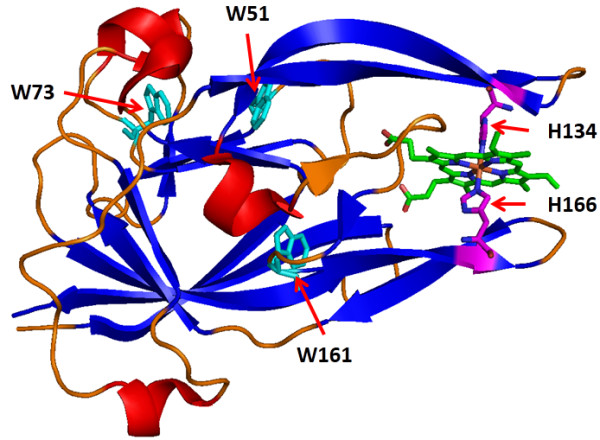
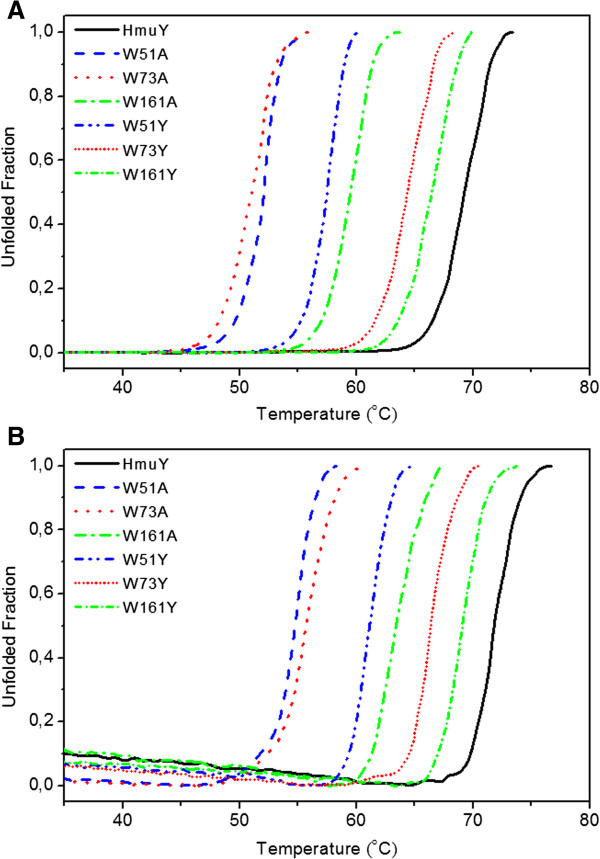
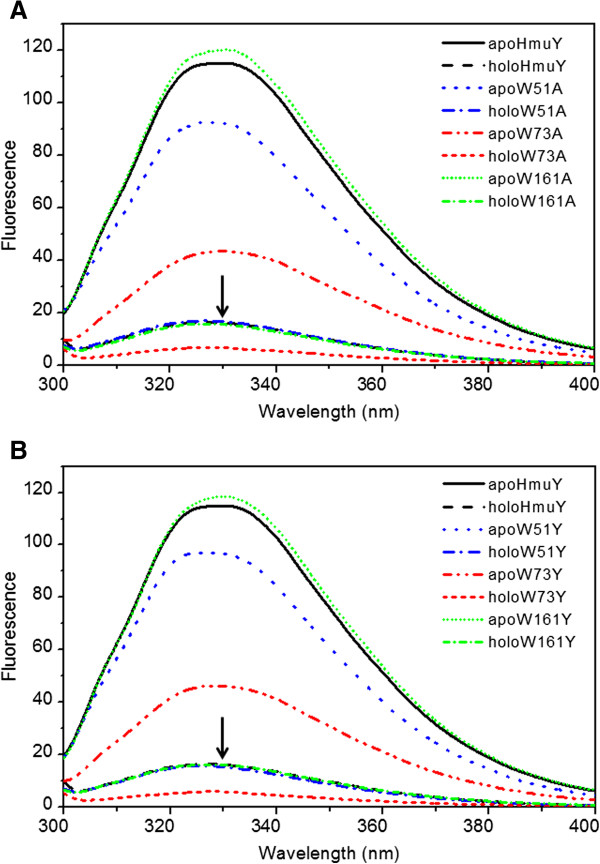
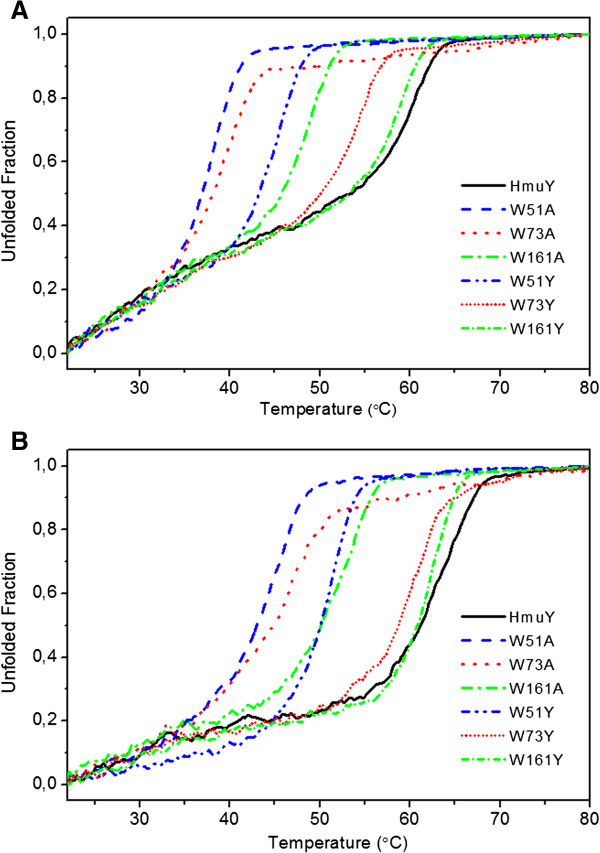
HmuY possesses tryptophan residues at positions 51 and 73, which are conserved in HmuY homologs present in a variety of bacteria, and a tryptophan residue at position 161, which has been found only in HmuY identified in P. gingivalis strains. We expressed and purified the wildtype HmuY and its protein variants with single tryptophan residues replaced by alanine or tyrosine residues. All HmuY variants were subjected to thermal denaturation and fluorescence spectroscopy analyses. Replacement of the most buried W161 only moderately affects protein stability. The most profound effect of the lack of a large hydrophobic side chain in respect to thermal stability is observed for W73. Also replacement of the W51 exposed on the surface results in the greatest loss of protein stability and even the large aromatic side chain of a tyrosine residue has little potential to substitute this tryptophan residue. Heme binding leads to different exposure of the tryptophan residue at position 51 to the surface of the protein. Differences in structural stability of HmuY variants suggest the change of the tertiary structure of the protein upon heme binding.
Here we demonstrate differential roles of tryptophan residues in the protein conformational stability. We also propose different conformations of apo- and holoHmuY caused by tertiary changes which allow heme binding to the protein.
我们之前已经表明,牙龈卟啉单胞菌 HmuY 类血红素载体样蛋白结合血红素并从宿主血红素蛋白中清除血红素,以进一步将其递送给同源血红素受体 HmuR。本研究旨在研究在存在和不存在血红素的情况下,HmuY 变体的结构特征,以及色氨酸残基在构象稳定性中的作用。
HmuY 在位置 51 和 73 处具有色氨酸残基,这些残基在各种细菌中的 HmuY 同源物中保守,在位置 161 处具有色氨酸残基,该残基仅在牙龈卟啉单胞菌菌株中鉴定的 HmuY 中发现。我们表达和纯化了野生型 HmuY 及其蛋白质变体,其中单个色氨酸残基被丙氨酸或酪氨酸残基取代。所有 HmuY 变体都进行了热变性和荧光光谱分析。仅替换最埋的 W161 对蛋白质稳定性的影响适中。与热稳定性相比,缺乏大的疏水性侧链对 W73 的影响最为明显。此外,替换暴露在表面的 W51 也会导致蛋白质稳定性的最大损失,甚至大的酪氨酸侧链几乎没有潜力取代该色氨酸残基。血红素结合导致位于位置 51 的色氨酸残基在蛋白质表面的不同暴露。HmuY 变体结构稳定性的差异表明,血红素结合后蛋白质三级结构发生变化。
在这里,我们证明了色氨酸残基在蛋白质构象稳定性中的不同作用。我们还提出了apo- 和 holoHmuY 的不同构象,这是由于三级结构的变化允许血红素与蛋白质结合。