Boonjaraspinyo Sirintip, Boonmars Thidarut, Kaewsamut Butsara, Ekobol Nuttapon, Laummaunwai Porntip, Aukkanimart Ratchadawan, Wonkchalee Nadchanan, Juasook Amornrat, Sriraj Pranee
Department of Community Medicine, Faculty of Medicine, Khon Kaen University, Khon Kaen 40002; Thailand.
Department of Parasitology, Faculty of Medicine, Khon Kaen University, Khon Kaen 40002; Thailand. ; Liver Fluke and Cholangiocarcinoma Research Center, Faculty of Medicine, Khon Kaen University, Khon Kaen 40002, Thailand. ; Northeast Animal Laboratory Center, Khon Kaen University, Khon Kaen 40002, Thailand.
Korean J Parasitol. 2013 Dec;51(6):727-34. doi: 10.3347/kjp.2013.51.6.727. Epub 2013 Dec 31.
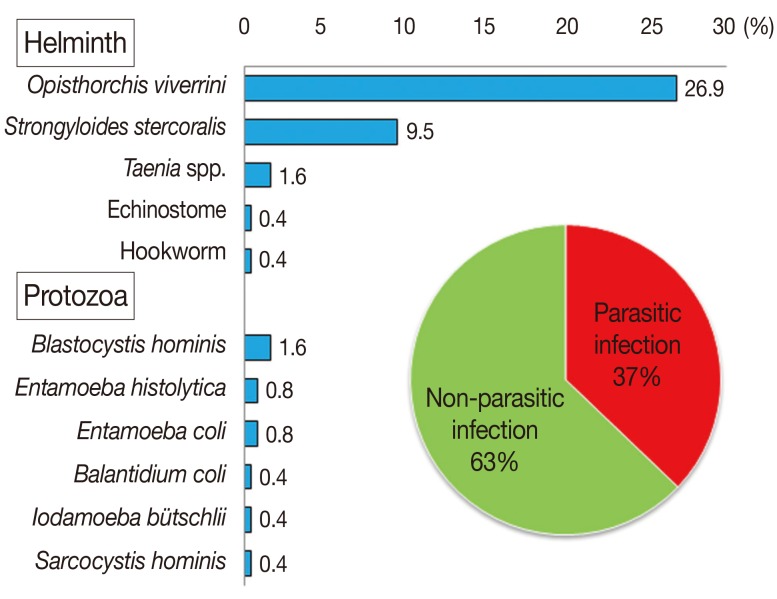
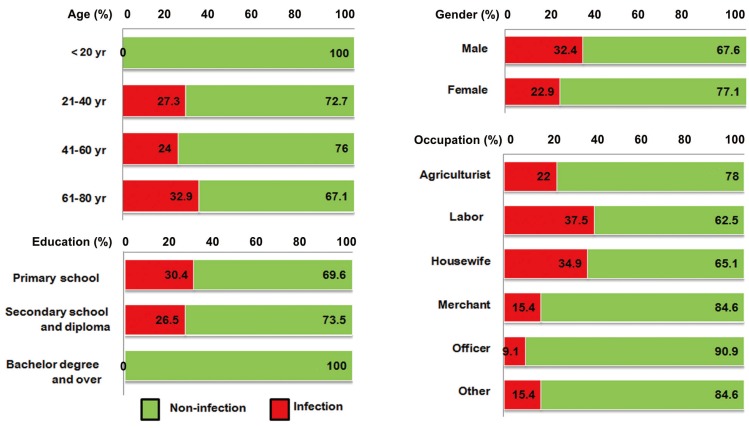
Despite the existence of effective anthelmintics, parasitic infections remain a major public health problem in Southeast Asia, including Thailand. In rural communities, continuing infection is often reinforced by dietary habits that have a strong cultural basis and by poor personal hygiene and sanitation. This study presents a survey of the prevalence of intestinal parasitic infections among the people in rural Thailand. The community-based cross-sectional study was conducted in villages in Khon Kaen Province, northeastern Thailand, from March to August 2013. A total of 253 stool samples from 102 males and 140 females, aged 2-80 years, were prepared using formalin-ethyl acetate concentration methods and examined using light microscopy. Ninety-four individuals (37.2%) were infected with 1 or more parasite species. Presence of parasitic infection was significantly correlated with gender (P=0.001); nearly half of males in this survey (49.0%) were infected. Older people had a higher prevalence than younger members of the population. The most common parasite found was Opisthorchis viverrini (26.9%), followed by Strongyloides stercoralis (9.5%), Taenia spp. (1.6%), echinostomes (0.4%), and hookworms (0.4%). The prevalence of intestinal protozoa was Blastocystis hominis 1.6%, Entamoeba histolytica 0.8%, Entamoeba coli 0.8%, Balantidium coli 0.4%, Iodamoeba bütschlii 0.4%, and Sarcocystis hominis 0.4%. Co-infections of various helminths and protozoa were present in 15.9% of the people. The present results show that the prevalence of parasitic infections in this region is still high. Proactive education about dietary habits, personal hygiene, and sanitation should be provided to the people in this community to reduce the prevalence of intestinal parasite infections. Moreover, development of policies and programs to control parasites is needed.
尽管有有效的驱虫药,但包括泰国在内的东南亚地区,寄生虫感染仍是一个重大的公共卫生问题。在农村社区,由于饮食习惯具有浓厚的文化基础,加上个人卫生和环境卫生较差,持续感染的情况经常加剧。本研究对泰国农村地区人群肠道寄生虫感染的患病率进行了调查。这项基于社区的横断面研究于2013年3月至8月在泰国东北部孔敬府的村庄中进行。使用福尔马林 - 乙酸乙酯浓缩法制备了来自102名男性和140名女性、年龄在2至80岁之间的总共253份粪便样本,并使用光学显微镜进行检查。94人(37.2%)感染了1种或更多种寄生虫。寄生虫感染的存在与性别显著相关(P = 0.001);本次调查中近一半的男性(49.0%)被感染。老年人的患病率高于该人群中的年轻人。发现的最常见寄生虫是华支睾吸虫(26.9%),其次是粪类圆线虫(9.5%)、带绦虫属(1.6%)、棘口吸虫(0.4%)和钩虫(0.4%)。肠道原生动物的患病率为:人芽囊原虫1.6%、溶组织内阿米巴0.8%、结肠内阿米巴0.8%、结肠小袋纤毛虫0.4%、布氏嗜碘阿米巴0.4%和人肉孢子虫0.4%。15.9%的人存在各种蠕虫和原生动物的混合感染。目前的结果表明,该地区寄生虫感染的患病率仍然很高。应向该社区的人们提供关于饮食习惯、个人卫生和环境卫生的积极教育,以降低肠道寄生虫感染的患病率。此外,需要制定控制寄生虫的政策和计划。