Laboratório de Estudos Integrados em Protozoologia, Instituto Oswaldo Cruz/Fundação Oswaldo Cruz (FIOCRUZ), Rio de Janeiro, Brazil.
Laboratório de Avaliação e Promoção da Saúde Ambiental, Instituto Oswaldo Cruz/FIOCRUZ, Rio de Janeiro, Brazil.
PLoS One. 2018 Mar 9;13(3):e0193860. doi: 10.1371/journal.pone.0193860. eCollection 2018.
Intestinal parasitic infections are considered a serious public health problem and widely distributed worldwide, mainly in urban and rural environments of tropical and subtropical countries. Globally, soil-transmitted helminths and protozoa are the most common intestinal parasites. Blastocystis sp. is a highly prevalent suspected pathogenic protozoan, and considered an unusual protist due to its significant genetic diversity and host plasticity.
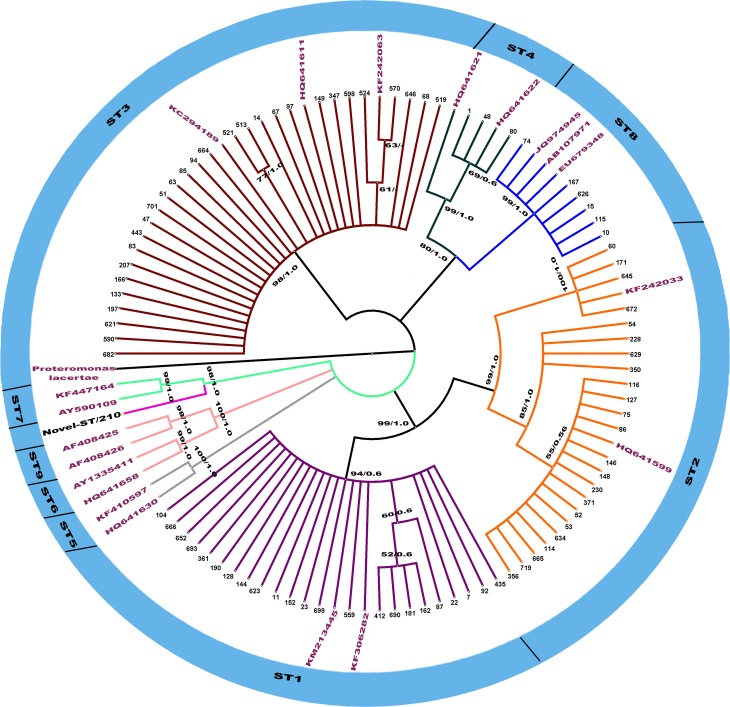
METHODOLOGY/MAIN FINDINGS: A total of 294 stool samples were collected from inhabitants of three rural valleys in Rio de Janeiro, Brazil. The stool samples were evaluated by parasitological methods, fecal culture, nested PCR and PCR/Sequencing. Overall prevalence by parasitological analyses was 64.3% (189 out of 294 cases). Blastocystis sp. (55.8%) was the most prevalent, followed by Endolimax nana (18.7%), Entamoeba histolytica complex (7.1%), hookworm infection (7.1%), Entomoeba coli (5.8%), Giardia intestinalis (4.1%), Iodamoeba butchilii (1.0%), Trichuris trichiura (1.0%), Pentatrichomonas hominis (0.7%), Enterobius vermicularis (0.7%), Ascaris lumbricoides (0.7%) and Strongyloides stercoralis (0.7%). Prevalence of IPIs was significantly different by gender. Phylogenetic analysis of Blastocystis sp. and BLAST search revealed five different subtypes: ST3 (34.0%), ST1 (27.0%), ST2 (27.0%), ST4 (3.5%), ST8 (7.0%) and a non-identified subtype.
CONCLUSIONS/SIGNIFICANCE: Our findings demonstrate that intestinal parasite infection rates in rural areas of the Sumidouro municipality of Rio de Janeiro, Brazil are still high and remain a challenge to public health. Moreover, our data reveals significant genetic heterogeneity of Blastocystis sp. subtypes and a possible novel subtype, whose confirmation will require additional data. Our study contributes to the understanding of potential routes of transmission, epidemiology, and genetic diversity of Blastocystis sp. in rural areas both at a regional and global scale.
肠道寄生虫感染被认为是一个严重的公共卫生问题,广泛分布于全球,主要存在于热带和亚热带国家的城乡环境中。在全球范围内,土壤传播的蠕虫和原生动物是最常见的肠道寄生虫。蓝氏贾第鞭毛虫是一种高度流行的疑似致病性原生动物,由于其显著的遗传多样性和宿主可塑性,被认为是一种不寻常的原生生物。
方法/主要发现:从巴西里约热内卢三个农村山谷的居民中采集了 294 份粪便样本。通过寄生虫学方法、粪便培养、巢式 PCR 和 PCR/测序对粪便样本进行了评估。寄生虫学分析的总患病率为 64.3%(294 例中有 189 例)。蓝氏贾第鞭毛虫(55.8%)最为流行,其次是内阿米巴(18.7%)、溶组织内阿米巴复合体(7.1%)、钩虫感染(7.1%)、肠梨形鞭毛虫(5.8%)、贾第虫(4.1%)、碘泡虫(1.0%)、毛首鞭形线虫(1.0%)、人毛滴虫(0.7%)、蠕形住肠线虫(0.7%)、蛔虫(0.7%)和粪类圆线虫(0.7%)。IPIs 的患病率在性别上有显著差异。蓝氏贾第鞭毛虫的系统发育分析和 BLAST 搜索显示了五个不同的亚型:ST3(34.0%)、ST1(27.0%)、ST2(27.0%)、ST4(3.5%)、ST8(7.0%)和一种未鉴定的亚型。
结论/意义:我们的研究结果表明,巴西里约热内卢萨米杜罗市农村地区的肠道寄生虫感染率仍然很高,仍然对公共卫生构成挑战。此外,我们的数据显示,蓝氏贾第鞭毛虫的亚型存在显著的遗传异质性,可能存在一种新的亚型,需要进一步的数据来证实。我们的研究有助于了解蓝氏贾第鞭毛虫在农村地区的潜在传播途径、流行病学和遗传多样性,无论是在区域还是全球范围内。