Sundar Isaac K, Yao Hongwei, Huang Yadi, Lyda Elizabeth, Sime Patricia J, Sellix Michael T, Rahman Irfan
Department of Environmental Medicine, Lung Biology and Disease Program, University of Rochester Medical Center, Rochester, New York, United States of America.
Department of Medicine (Pulmonary), University of Rochester Medical Center, Rochester, New York, United States of America.
PLoS One. 2014 Feb 10;9(2):e87999. doi: 10.1371/journal.pone.0087999. eCollection 2014.
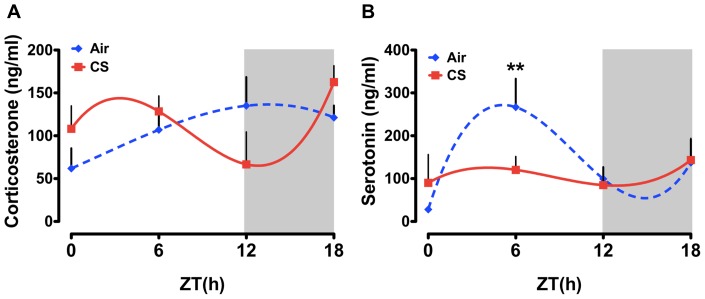
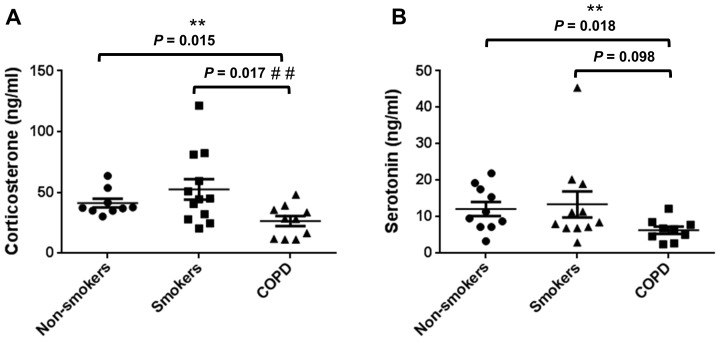
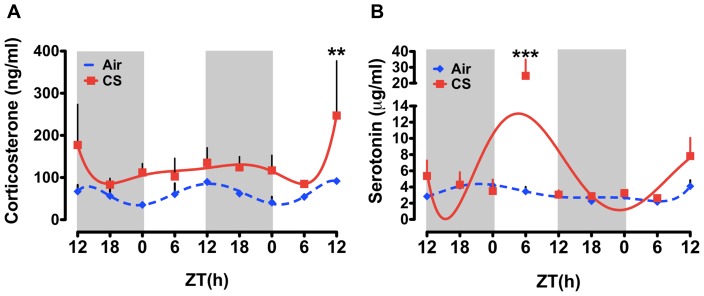
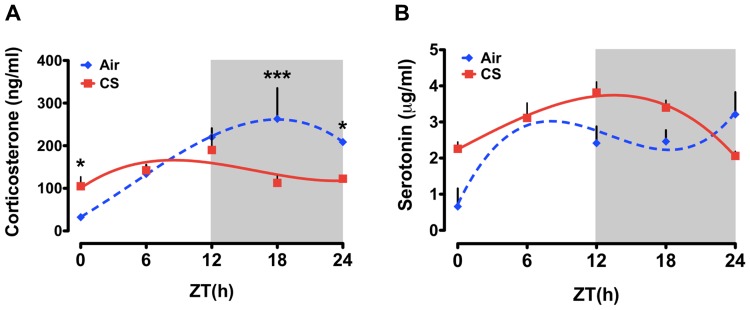
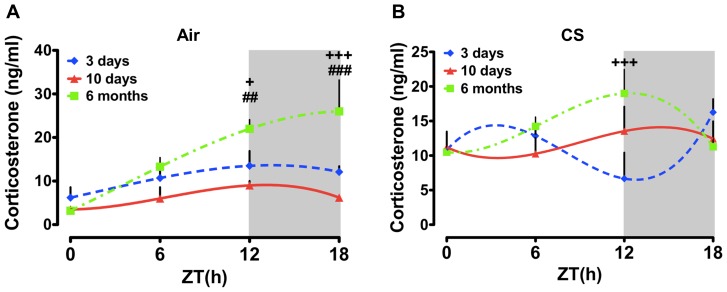
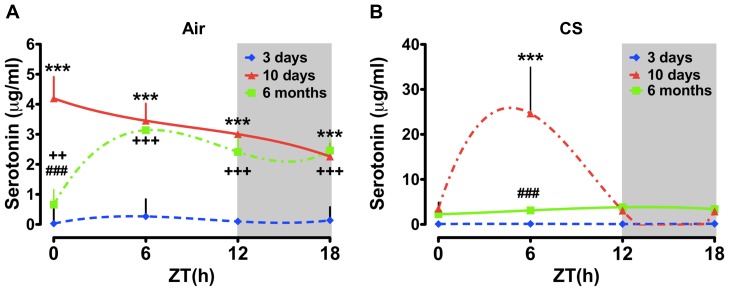
The circadian timing system controls daily rhythms of physiology and behavior, and disruption of clock function can trigger stressful life events. Daily exposure to cigarette smoke (CS) can lead to alteration in diverse biological and physiological processes. Smoking is associated with mood disorders, including depression and anxiety. Patients with chronic obstructive pulmonary disease (COPD) have abnormal circadian rhythms, reflected by daily changes in respiratory symptoms and lung function. Corticosterone (CORT) is an adrenal steroid that plays a considerable role in stress and anti-inflammatory responses. Serotonin (5-hydroxytryptamine; 5HT) is a neurohormone, which plays a role in sleep/wake regulation and affective disorders. Secretion of stress hormones (CORT and 5HT) is under the control of the circadian clock in the suprachiasmatic nucleus. Since smoking is a contributing factor in the development of COPD, we hypothesize that CS can affect circadian rhythms of CORT and 5HT secretion leading to sleep and mood disorders in smokers and patients with COPD. We measured the daily rhythms of plasma CORT and 5HT in mice following acute (3 d), sub-chronic (10 d) or chronic (6 mo) CS exposure and in plasma from non-smokers, smokers and patients with COPD. Acute and chronic CS exposure affected both the timing (peak phase) and amplitude of the daily rhythm of plasma CORT and 5HT in mice. Acute CS appeared to have subtle time-dependent effects on CORT levels but more pronounced effects on 5HT. As compared with CORT, plasma 5HT was slightly elevated in smokers but was reduced in patients with COPD. Thus, the effects of CS on plasma 5HT were consistent between mice and patients with COPD. Together, these data reveal a significant impact of CS exposure on rhythms of stress hormone secretion and subsequent detrimental effects on cognitive function, depression-like behavior, mood/anxiety and sleep quality in smokers and patients with COPD.
昼夜节律系统控制着生理和行为的每日节律,而生物钟功能的紊乱会引发压力大的生活事件。每日接触香烟烟雾(CS)会导致多种生物和生理过程发生改变。吸烟与情绪障碍有关,包括抑郁和焦虑。慢性阻塞性肺疾病(COPD)患者存在异常的昼夜节律,表现为呼吸症状和肺功能的每日变化。皮质酮(CORT)是一种肾上腺类固醇,在应激和抗炎反应中起重要作用。血清素(5-羟色胺;5HT)是一种神经激素,在睡眠/觉醒调节和情感障碍中起作用。应激激素(CORT和5HT)的分泌受视交叉上核生物钟的控制。由于吸烟是COPD发病的一个促成因素,我们推测CS会影响CORT和5HT分泌的昼夜节律,导致吸烟者和COPD患者出现睡眠和情绪障碍。我们测量了急性(3天)、亚慢性(10天)或慢性(6个月)CS暴露后小鼠血浆CORT和5HT的每日节律,以及非吸烟者、吸烟者和COPD患者血浆中的这些指标。急性和慢性CS暴露均影响小鼠血浆CORT和5HT每日节律的时间(峰值相位)和幅度。急性CS对CORT水平似乎有微妙的时间依赖性影响,但对5HT的影响更明显。与CORT相比,吸烟者血浆5HT略有升高,但COPD患者血浆5HT降低。因此,CS对血浆5HT的影响在小鼠和COPD患者之间是一致的。总之,这些数据揭示了CS暴露对应激激素分泌节律有显著影响,并对吸烟者和COPD患者的认知功能、抑郁样行为、情绪/焦虑和睡眠质量产生后续有害影响。