Nieves Ashley, Garza Luis A
Department of Dermatology, Johns Hopkins School of Medicine, Baltimore, MD, USA.
Exp Dermatol. 2014 Apr;23(4):224-7. doi: 10.1111/exd.12348.
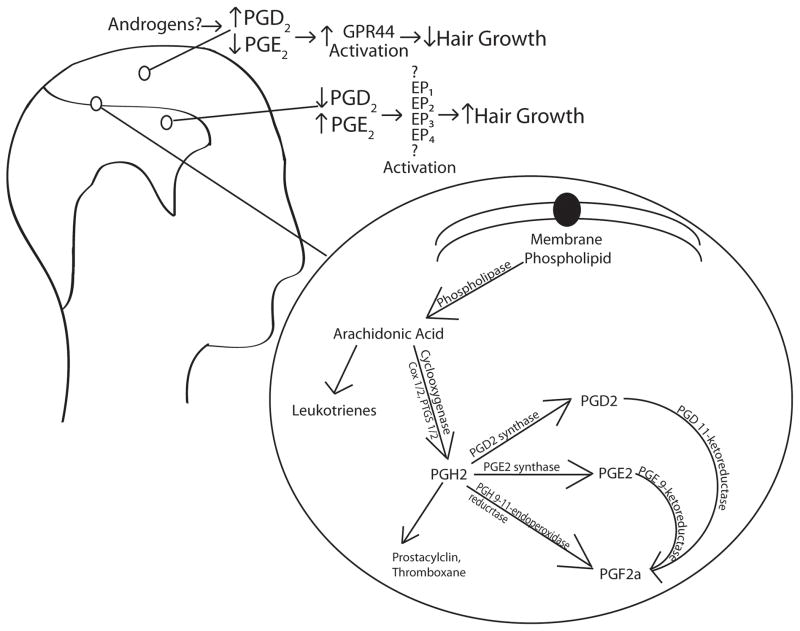
Lipids in the skin are the most diverse in the entire human body. Their bioactivity in health and disease is underexplored. Prostaglandin D2 has recently been identified as a factor which is elevated in the bald scalp of men with androgenetic alopecia (AGA) and has the capacity to decrease hair lengthening. An enzyme which synthesizes it, prostaglandin D2 synthase (PTGDS or lipocalin-PGDS), is hormone responsive in multiple other organs. PGD2 has two known receptors, GPR44 and PTGDR. GPR44 was found to be necessary for the decrease in hair growth by PGD2 . This creates an exciting opportunity to perhaps create novel treatments for AGA, which inhibit the activity of PTGDS, PGD2 or GPR44. This review discusses the current knowledge surrounding PGD2 , and future steps needed to translate these findings into novel therapies for patients with AGA.
皮肤中的脂质是整个人体中最多样化的。它们在健康和疾病中的生物活性尚未得到充分探索。前列腺素D2最近被确定为在雄激素性脱发(AGA)男性的秃发头皮中升高的一种因素,并且有能力减少头发生长。一种合成它的酶,前列腺素D2合酶(PTGDS或脂质运载蛋白-PGDS),在多个其他器官中对激素有反应。PGD2有两种已知的受体,GPR44和PTGDR。发现GPR44是PGD2减少毛发生长所必需的。这为开发针对AGA的新型治疗方法创造了一个令人兴奋的机会,这些治疗方法可以抑制PTGDS、PGD2或GPR44的活性。这篇综述讨论了围绕PGD2的现有知识,以及将这些发现转化为AGA患者新疗法所需的后续步骤。