Grassadonia Antonino, Di Nicola Marta, Grossi Simona, Noccioli Paolo, Tavoletta Saveria, Politi Roberto, Angelucci Domenico, Marinelli Camilla, Zilli Marinella, Ausili Cefaro Giampiero, Tinari Nicola, De Tursi Michele, Iezzi Laura, Cioffi Pasquale, Iacobelli Stefano, Natoli Clara, Cianchetti Ettore
Medical Oncology Unit, Department of Experimental and Clinical Sciences, University 'G. d'Annunzio', Chieti, Italy.
Ann Surg Oncol. 2014 May;21(5):1575-82. doi: 10.1245/s10434-014-3535-7. Epub 2014 Feb 13.
Aromatase inhibitors (AIs) are more effective than tamoxifen as neoadjuvant endocrine therapy (NET) for hormone receptor (HR)-positive breast cancer. Here we report the surgical and long-term outcome of elderly postmenopausal patients with locally advanced, HR-positive breast cancer treated with preoperative AIs.
Between January 2003 and December 2012, 144 postmenopausal patients inoperable with breast conservative surgery (BCS) received letrozole, anastrozole, or exemestane as NET. Patients underwent breast surgery and received adjuvant AIs. Adjuvant systemic therapy, chemotherapy and/or trastuzumab, and adjuvant radiotherapy were administered as appropriate, but limited to high-risk patients with few or no comorbidities.
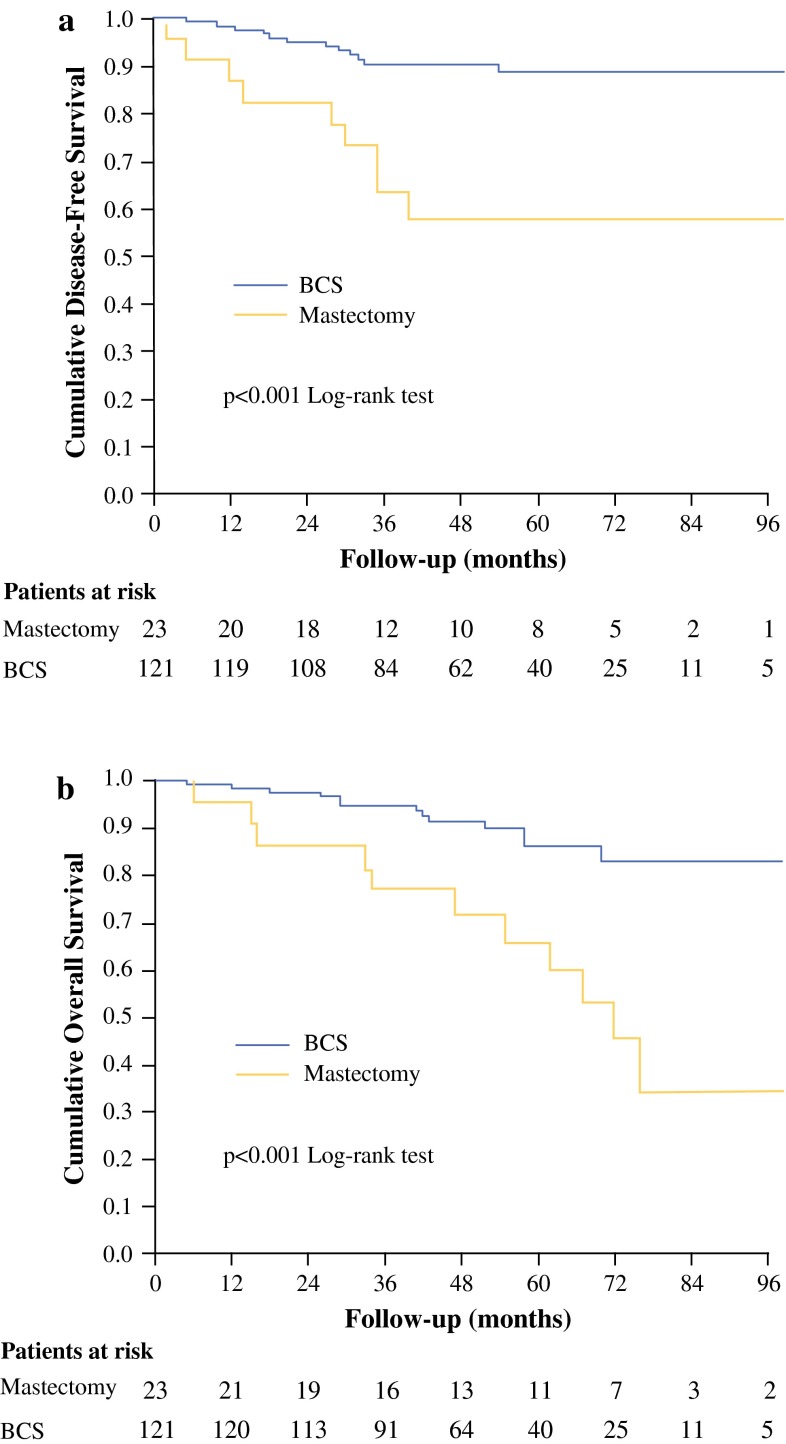
After a median follow-up of 49 months, 4 (3.0 %) patients had local relapse, 18 (12.5 %) had distant metastases, and 24 (17.0 %) died. BCS was performed in 121 (84.0 %) patients. A tumor size <3 cm and human epidermal growth factor receptor 2 (HER2) negativity were predictors of BCS. The achievement of BCS and grade G1 were significantly associated with longer disease-free survival (DFS) (p = 0.009 and p = 0.01, respectively) and overall survival (p = 0.002 and p = 0.005, respectively). Residual tumor ≤2 cm (yT0-yT1) in the longest diameter after NET was also statistically associated with longer DFS (p = 0.005).
The results of this retrospective study indicate that elderly breast cancer patients with a tumor size <3 cm at diagnosis and HER2 negativity have a higher probability of achieving BCS after NET. Moreover, patients treated with BCS and with grade G1 tumor have a reduced risk of recurrence and death in the long-term follow-up.
对于激素受体(HR)阳性乳腺癌,芳香化酶抑制剂(AI)作为新辅助内分泌治疗(NET)比他莫昔芬更有效。在此,我们报告术前接受AI治疗的老年绝经后局部晚期HR阳性乳腺癌患者的手术及长期结局。
2003年1月至2012年12月期间,144例无法进行保乳手术(BCS)的绝经后患者接受来曲唑、阿那曲唑或依西美坦作为NET治疗。患者接受了乳房手术并接受辅助AI治疗。根据情况给予辅助全身治疗、化疗和/或曲妥珠单抗以及辅助放疗,但仅限于合并症少或无合并症的高危患者。
中位随访49个月后,4例(3.0%)患者出现局部复发,18例(12.5%)出现远处转移,24例(17.0%)死亡。121例(84.0%)患者进行了BCS。肿瘤大小<3 cm和人表皮生长因子受体2(HER2)阴性是BCS的预测因素。实现BCS和G1级与更长的无病生存期(DFS)(分别为p = 0.009和p = 0.01)及总生存期(分别为p = 0.002和p = 0.005)显著相关。NET后最长径残留肿瘤≤2 cm(yT0 - yT1)也与更长的DFS有统计学关联(p = 0.005)。
这项回顾性研究结果表明,诊断时肿瘤大小<3 cm且HER2阴性的老年乳腺癌患者在NET后实现BCS的概率更高。此外,接受BCS且肿瘤为G1级的患者在长期随访中复发和死亡风险降低。