Laboratory of Mucosal Exposome and Biomodulation, Department of Microbiology and Immunology, Pusan National University School of Medicine, Yangsan 626-870, Republic of Korea ; Immunoregulatory Therapeutics Group in Brain Busan 21 Project, Busan 609-735, Republic of Korea ; Medical Research Institute, Pusan National University, Busan 609-735, Republic of Korea.
Mediators Inflamm. 2014;2014:708193. doi: 10.1155/2014/708193. Epub 2014 Jan 2.
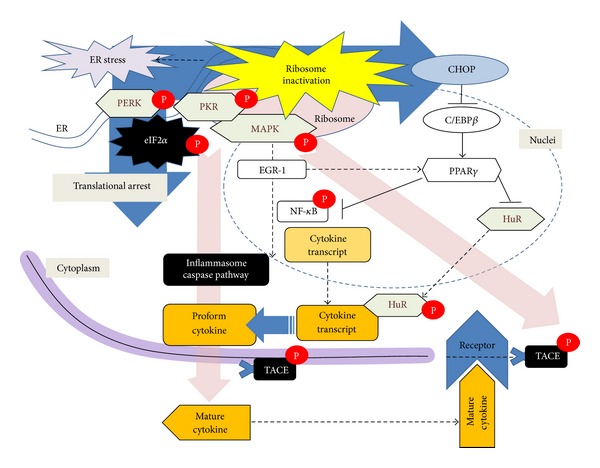
Ribosomal inactivation damages 28S ribosomal RNA by interfering with its functioning during gene translation, leading to stress responses linked to a variety of inflammatory disease processes. Although the primary effect of ribosomal inactivation in cells is the functional inhibition of global protein synthesis, early responsive gene products including proinflammatory cytokines are exclusively induced by toxic stress in highly dividing tissues such as lymphoid tissue and epithelia. In the present study, ribosomal inactivation-related modulation of cytokine production was reviewed in leukocyte and epithelial pathogenesis models to characterize mechanistic evidence of ribosome-derived cytokine induction and its implications for potent therapeutic targets of mucosal and systemic inflammatory illness, particularly those triggered by organellar dysfunctions.
核糖体失活通过干扰基因翻译过程中 28S 核糖体 RNA 的功能来损害其功能,导致与多种炎症性疾病过程相关的应激反应。尽管核糖体失活在细胞中的主要作用是对全球蛋白质合成的功能抑制,但包括促炎细胞因子在内的早期反应性基因产物仅在高度分裂的组织(如淋巴组织和上皮组织)中受到毒性应激的诱导。在本研究中,综述了白细胞和上皮发病机制模型中与核糖体失活相关的细胞因子产生的调节,以描述核糖体衍生细胞因子诱导的机制证据及其对粘膜和全身炎症性疾病的有效治疗靶点的影响,特别是那些由细胞器功能障碍引发的疾病。