Department of Biomedical Sciences, Heritage College of Osteopathic Medicine, Ohio University, 228 Irvine, Athens, OH 45701, USA ; The Diabetes Institute at Ohio University, Ohio University, 228 Irvine, Athens, OH 45701, USA.
Department of Biomedical Sciences, Heritage College of Osteopathic Medicine, Ohio University, 228 Irvine, Athens, OH 45701, USA ; The Diabetes Institute at Ohio University, Ohio University, 228 Irvine, Athens, OH 45701, USA ; Department of Specialty Medicine, Heritage College of Osteopathic Medicine, Ohio University, 228 Irvine, Athens, OH 45701, USA.
Int J Endocrinol. 2014;2014:171546. doi: 10.1155/2014/171546. Epub 2014 Jan 12.
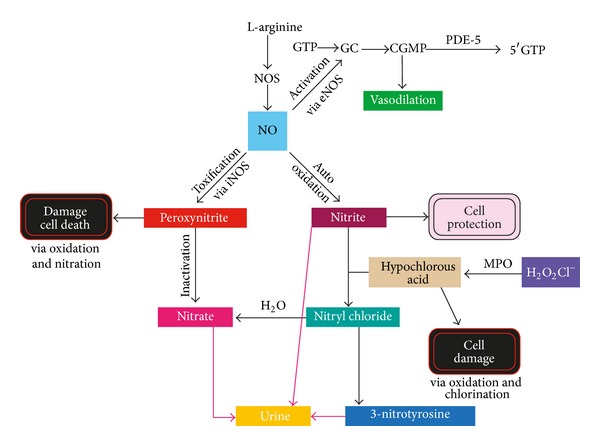
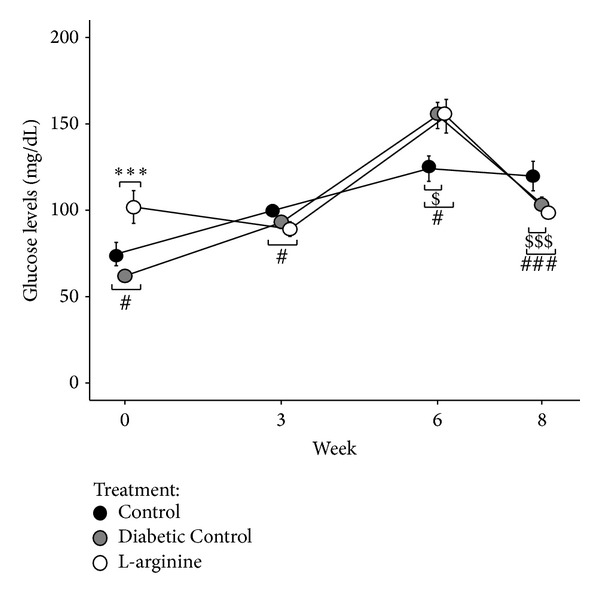
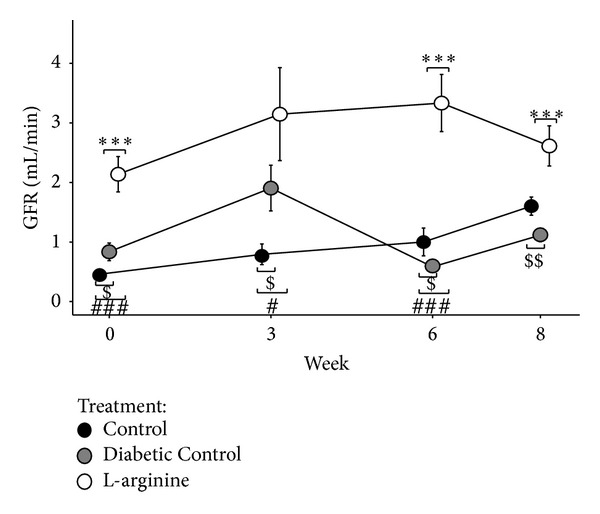
Rat studies demonstrated that type II diabetes mellitus (T2DM) decreases both the production and bioavailability of nitric oxide (NO). L-arginine (LA) provides the precursor for the production of NO. We hypothesized that LA dietary supplementation will preserve NO production via endothelial nitric oxide synthase (eNOS) causing renal microvascular vasodilation and increased glomerular blood flow and thus increasing glomerular filtration rate (GFR). This would impede the formation of reactive oxygen species which contributes to cell damage and death. LA supplementation preserved GFR in the treated diabetic rats compared to untreated diabetic rats. We provide evidence that this effect may be due to increased levels of eNOS and urinary cyclic guanosine monophosphate, which leads to renal microvascular vasodilation. Plasma nitrotyrosine was decreased in the LA treated rats; however, plasma nitrite levels remained unaffected as expected. Marked improvements in glucose tolerance were also observed in the LA treated diabetic rats. These results demonstrate that LA supplementation preserves NO activity and may delay the onset of insulin resistance and renal dysfunction during hyperglycemic stress. These results suggest the importance of the NO pathway in consequent renal dysfunction and in the development of insulin resistance in diabetic rats.
大鼠研究表明,2 型糖尿病(T2DM)会降低一氧化氮(NO)的产生和生物利用度。L-精氨酸(LA)提供了 NO 产生的前体。我们假设 LA 饮食补充将通过内皮型一氧化氮合酶(eNOS)来维持 NO 的产生,从而导致肾微血管扩张和肾小球血流增加,从而增加肾小球滤过率(GFR)。这将阻止形成活性氧,从而导致细胞损伤和死亡。与未治疗的糖尿病大鼠相比,LA 补充剂可保留治疗糖尿病大鼠的 GFR。我们提供的证据表明,这种作用可能是由于 eNOS 和尿环鸟苷酸水平升高,导致肾微血管扩张。LA 治疗组大鼠的血浆硝基酪氨酸减少;然而,正如预期的那样,血浆亚硝酸盐水平保持不变。在 LA 治疗的糖尿病大鼠中,葡萄糖耐量也明显改善。这些结果表明,LA 补充剂可维持 NO 的活性,并可能延迟高血糖应激期间胰岛素抵抗和肾功能障碍的发生。这些结果表明,NO 途径在糖尿病大鼠的继发肾功能障碍和胰岛素抵抗发展中具有重要意义。