Tremblay Yann, Thiebault Andréa, Mullers Ralf, Pistorius Pierre
Centre de Recherche Halieutique Méditerrannéenne et Tropicale, Institut pour la Recherche et le Développement, Unité Mixte de Recherche 212: IRD-IFREMER-UM2 : Expoited Marine Ecosystems, Sète, France.
Percy FitzPatrick Institute and DST/NRF Centre of Excellence, University of Cape Town, Cape Town, South Africa.
PLoS One. 2014 Feb 11;9(2):e88424. doi: 10.1371/journal.pone.0088424. eCollection 2014.
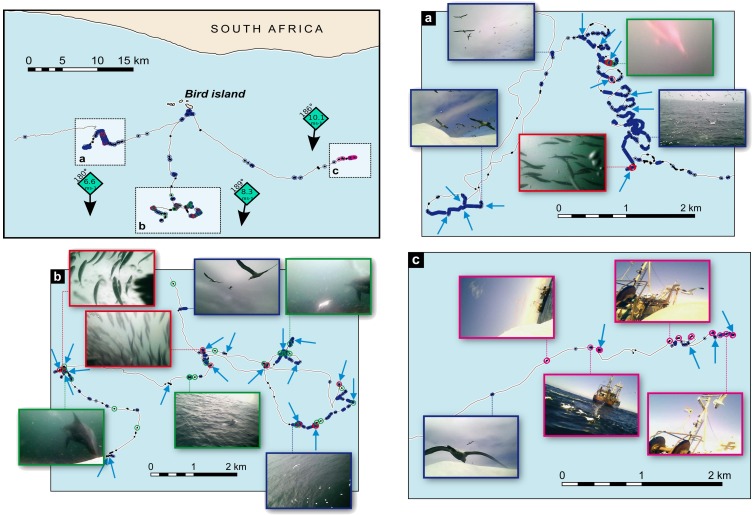
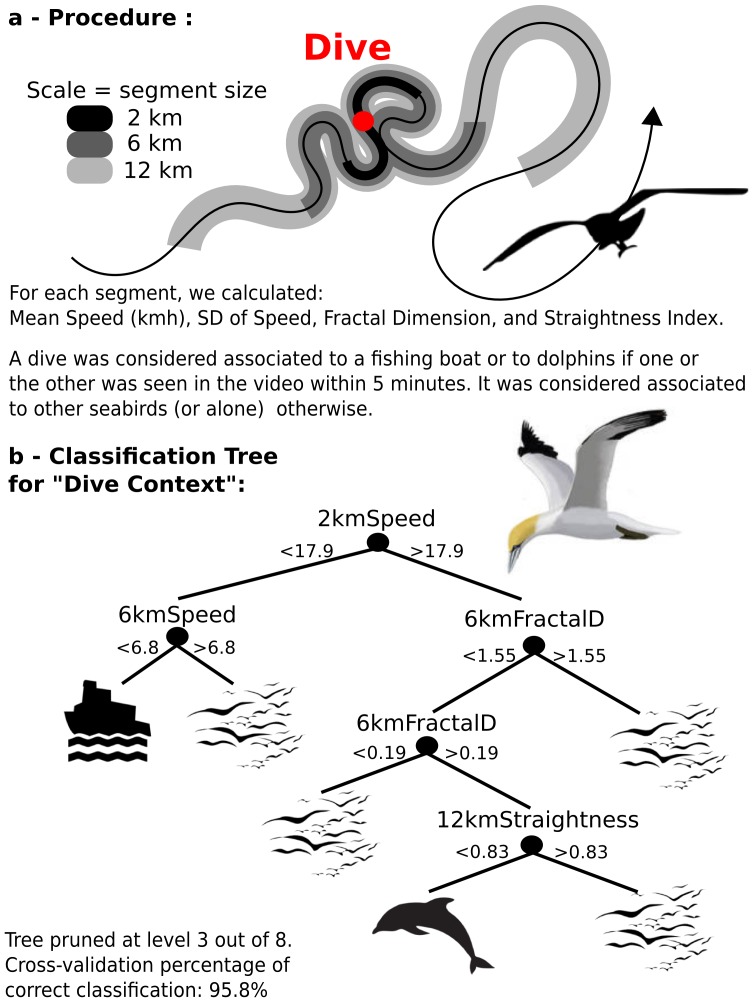
The study of ecological and behavioral processes has been revolutionized in the last two decades with the rapid development of biologging-science. Recently, using image-capturing devices, some pilot studies demonstrated the potential of understanding marine vertebrate movement patterns in relation to their proximate, as opposed to remote sensed environmental contexts. Here, using miniaturized video cameras and GPS tracking recorders simultaneously, we show for the first time that information on the immediate visual surroundings of a foraging seabird, the Cape gannet, is fundamental in understanding the origins of its movement patterns. We found that movement patterns were related to specific stimuli which were mostly other predators such as gannets, dolphins or fishing boats. Contrary to a widely accepted idea, our data suggest that foraging seabirds are not directly looking for prey. Instead, they search for indicators of the presence of prey, the latter being targeted at the very last moment and at a very small scale. We demonstrate that movement patterns of foraging seabirds can be heavily driven by processes unobservable with conventional methodology. Except perhaps for large scale processes, local-enhancement seems to be the only ruling mechanism; this has profounds implications for ecosystem-based management of marine areas.
在过去二十年里,随着生物记录科学的迅速发展,生态与行为过程的研究发生了变革。最近,一些初步研究利用图像捕捉设备,展示了在近距离(而非通过遥感获取的环境背景)理解海洋脊椎动物运动模式的潜力。在此,我们首次同时使用小型化摄像机和GPS跟踪记录器,表明对于觅食的海角鲣鸟而言,有关其即时视觉环境的信息对于理解其运动模式的起源至关重要。我们发现,运动模式与特定刺激相关,这些刺激大多是其他捕食者,如鲣鸟、海豚或渔船。与一个广泛接受的观点相反,我们的数据表明觅食的海鸟并非直接寻找猎物。相反,它们寻找猎物存在的指示物,猎物在最后一刻且在非常小的范围内才成为目标。我们证明,觅食海鸟的运动模式可能受到传统方法无法观测到的过程的强烈驱动。除了可能的大规模过程外,局部增强似乎是唯一的主导机制;这对基于生态系统的海洋区域管理具有深远意义。