Yang Seungwon, Kim Hyun-Man
Laboratory for the Study of Molecular Biointerfaces, Department of Oral Histology and Developmental Biology, Program of Cell and Developmental Biology, School of Dentistry and Dental Research Institute, Seoul National University, Seoul, Republic of Korea.
PLoS One. 2014 Feb 11;9(2):e88489. doi: 10.1371/journal.pone.0088489. eCollection 2014.
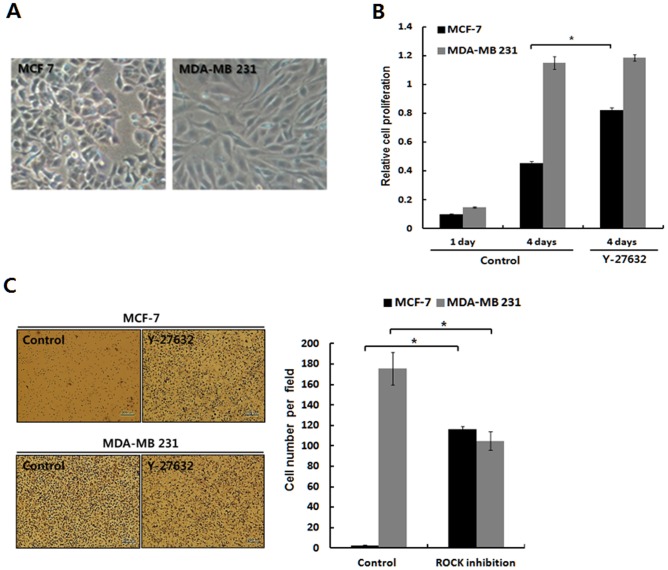
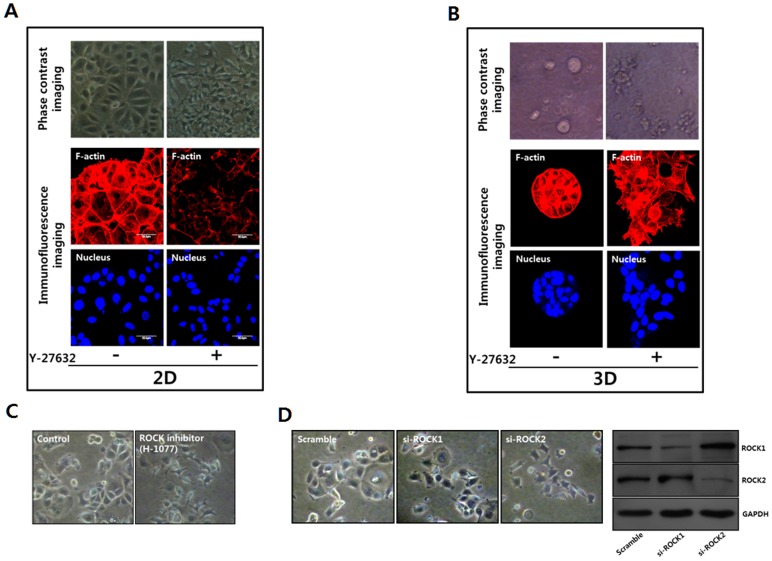
Dormant carcinoma cancer cells showing epithelial characteristics can be activated to dissipate into the surrounding tissue or organs through epithelial-mesenchymal transition (EMT). However, the molecular details underlying the activation of dormant cancer cells have been less explored. In this study, we examined the molecular pathway to activate dormant breast cancer cells. Rho-associated kinase (ROCK) inhibition disrupted cell junction, promoted cell proliferation and migration / invasion in both two-dimensional and three-dimensional substrates. The disintegration of cell junction upon ROCK inhibition, coupled with the loss of E-cadherin and b-catenin from the cell membrane, was associated with the activation of Rac1 upon ROCK inhibition. Migration / invasion also increased upon ROCK inhibition. However, the activation of MCF-7 cells upon ROCK inhibition was not associated with the up-regulation of typical EMT markers, such as snail and slug. Based on these results, we suggest the potential risk for dormant cancer cells to dissipate through non-typical EMT when ROCK activity is down-regulated.
具有上皮特征的休眠癌细胞可通过上皮-间质转化(EMT)被激活,从而扩散到周围组织或器官中。然而,休眠癌细胞激活背后的分子细节尚未得到充分研究。在本研究中,我们探究了激活休眠乳腺癌细胞的分子途径。Rho相关激酶(ROCK)抑制破坏了细胞连接,在二维和三维基质中均促进了细胞增殖以及迁移/侵袭。ROCK抑制后细胞连接的解体,以及细胞膜上E-钙黏蛋白和β-连环蛋白的丢失,与ROCK抑制后Rac1的激活相关。ROCK抑制后迁移/侵袭也增加。然而,ROCK抑制后MCF-7细胞的激活与典型EMT标志物(如蜗牛蛋白和蛞蝓蛋白)的上调无关。基于这些结果,我们提示当ROCK活性下调时,休眠癌细胞通过非典型EMT扩散的潜在风险。