Methodist Hospital Cancer Center, 6550 Fannin Street SM383, Houston, TX 77030, USA.
Breast Cancer Res. 2012 Jan 19;14(1):202. doi: 10.1186/bcr2938.
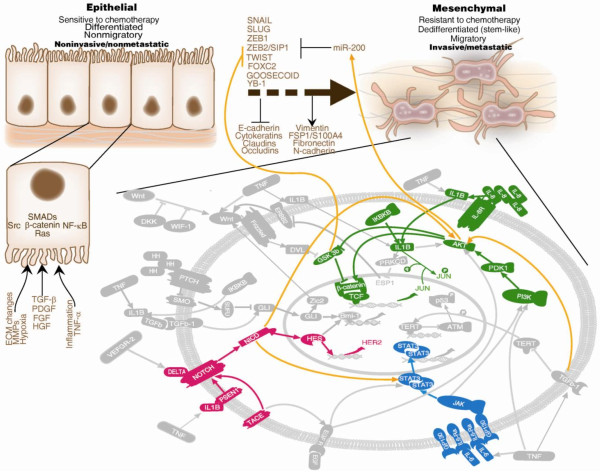
Breast cancer relapse, in a large number of patients, after initial response to standard of care therapy warrants development of novel therapies against recurrent and metastatic cancer. Cancer stem cells (CSCs), present in breast tumors while being intrinsically resistant to conventional therapy, have the ability to self renew and cause tumor recurrence. The residual tumors after therapy, with dramatic enrichment of the CSCs, have all the hallmarks of epithelial- mesenchymal transition (EMT). This review will focus on the link between EMT, CSCs and treatment resistance, since a better understanding of these interactions will allow us to effectively target the residual population after therapy.
在大量患者中,乳腺癌在对标准治疗有初步反应后复发,这就需要针对复发性和转移性癌症开发新的治疗方法。在乳腺癌肿瘤中存在的癌症干细胞(CSC),具有固有耐药性,能够自我更新并导致肿瘤复发。经过治疗后,残余肿瘤中 CSC 的丰度显著增加,具有上皮-间充质转化(EMT)的所有特征。本综述将重点关注 EMT、CSC 和治疗耐药性之间的联系,因为更好地理解这些相互作用将使我们能够有效地针对治疗后的残留人群。