Cheng Huei-Hsuan, Wang Kai-Hsuan, Chu Ling-yun, Chang Tzu-Ching, Kuo Cheng-Chin, Wu Kenneth K
Metabolomic Medicine Research Center, China Medical University, Taichung, Taiwan ; Graduate Institute of Clinical Medicine Science, China Medical University, Taichung, Taiwan.
Institute of Cellular and System Medicine, National Health Research Institutes, Zhunan, Miaoli, Taiwan ; Institute of Biotechnology, National Tsing Hua University, Hsin-Chu, Taiwan.
PLoS One. 2014 Feb 11;9(2):e88507. doi: 10.1371/journal.pone.0088507. eCollection 2014.
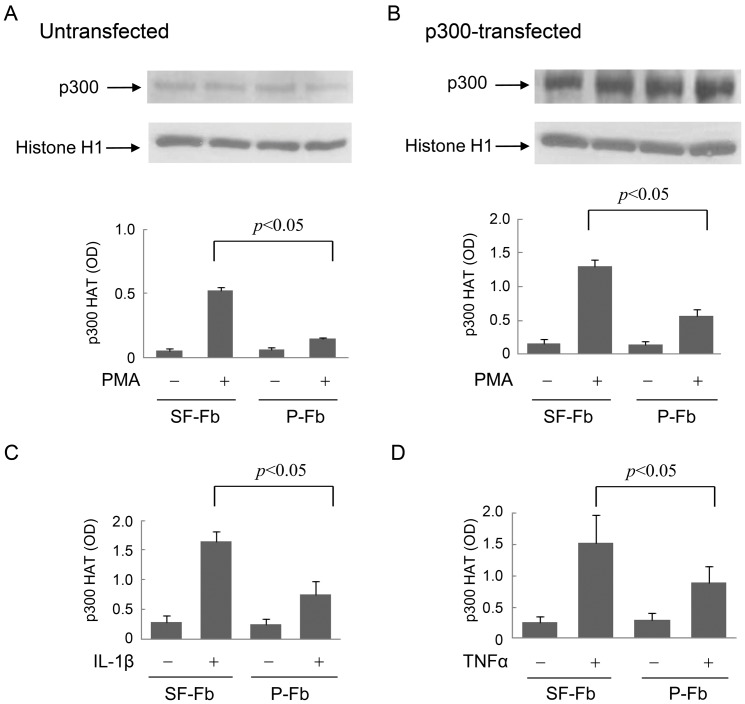
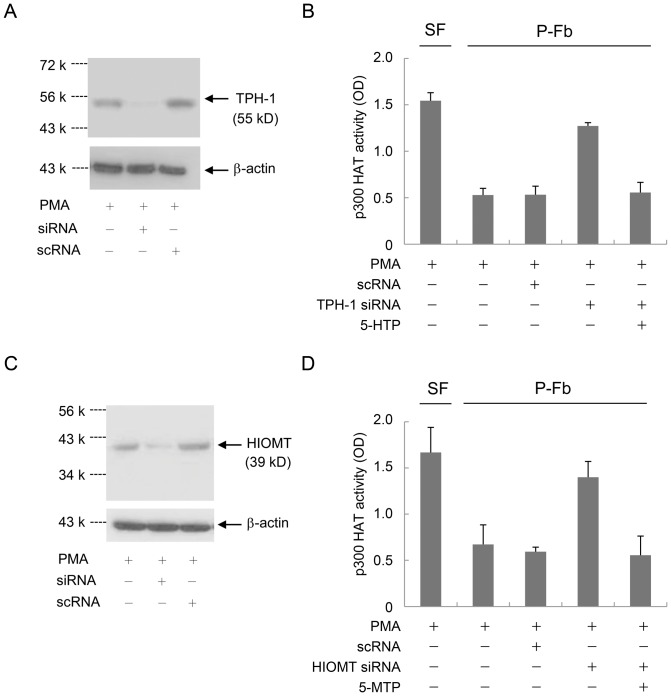
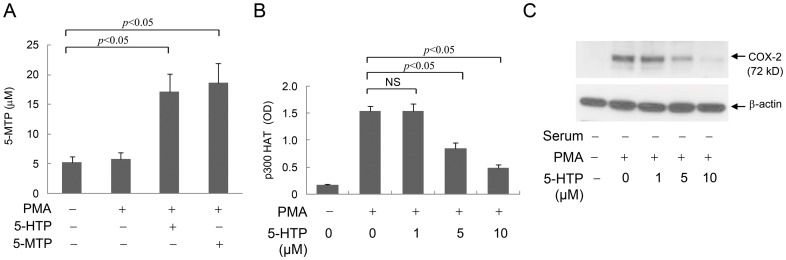
Quiescent fibroblasts possess unique genetic program and exhibit high metabolic activity distinct from proliferative fibroblasts. In response to inflammatory stimulation, quiescent fibroblasts are more active in expressing cyclooxygenase-2 and other proinflammatory genes than proliferative fibroblasts. The underlying transcriptional mechanism is unclear. Here we show that phorbol 12-myristate 13-acetate (PMA) and cytokines increased p300 histone acetyltransferase activity to a higher magnitude (> 2 fold) in quiescent fibroblasts than in proliferative fibroblasts. Binding of p300 to cyclooxygenase-2 promoter was reduced in proliferative fibroblasts. By ultrahigh-performance liquid chromatography coupled with a quadrupole time of flight mass spectrometer and enzyme-immunoassay, we found that production of 5-methoxytryptophan was 2-3 folds higher in proliferative fibroblasts than that in quiescent fibroblasts. Addition of 5-methoxytryptophan and its metabolic precursor, 5-hydroxytryptophan, to quiescent fibroblasts suppressed PMA-induced p300 histone acetyltransferase activity and cyclooxygenase-2 expression to the level of proliferative fibroblasts. Silencing of tryptophan hydroxylase-1 or hydroxyindole O-methyltransferase in proliferative fibroblasts with siRNA resulted in elevation of PMA-induced p300 histone acetyltransferase activity to the level of that in quiescent fibroblasts, which was rescued by addition of 5-hydroxytryptophan or 5-methoxytryptophan. Our findings indicate that robust inflammatory gene expression in quiescent fibroblasts vs. proliferative fibroblasts is attributed to uncontrolled p300 histone acetyltransferase activation due to deficiency of 5-methoxytryptophan production. 5-methoxytryptophan thus is a potential valuable lead compound for new anti-inflammatory drug development.
静止的成纤维细胞具有独特的基因程序,并表现出与增殖性成纤维细胞不同的高代谢活性。在炎症刺激下,静止的成纤维细胞在表达环氧化酶 - 2和其他促炎基因方面比增殖性成纤维细胞更活跃。其潜在的转录机制尚不清楚。在这里,我们表明,佛波醇12 - 肉豆蔻酸酯13 - 乙酸酯(PMA)和细胞因子在静止的成纤维细胞中比在增殖性成纤维细胞中更显著地增加p300组蛋白乙酰转移酶活性(> 2倍)。在增殖性成纤维细胞中,p300与环氧化酶 - 2启动子的结合减少。通过超高效液相色谱与四极杆飞行时间质谱仪联用以及酶免疫测定,我们发现增殖性成纤维细胞中5 - 甲氧基色氨酸的产生比静止的成纤维细胞高2 - 3倍。向静止的成纤维细胞中添加5 - 甲氧基色氨酸及其代谢前体5 - 羟基色氨酸可将PMA诱导的p300组蛋白乙酰转移酶活性和环氧化酶 - 2表达抑制到增殖性成纤维细胞的水平。用小干扰RNA(siRNA)沉默增殖性成纤维细胞中的色氨酸羟化酶 - 1或羟基吲哚O - 甲基转移酶会导致PMA诱导的p300组蛋白乙酰转移酶活性升高到静止的成纤维细胞的水平,而添加5 - 羟基色氨酸或5 - 甲氧基色氨酸可使其恢复。我们的研究结果表明,与增殖性成纤维细胞相比,静止的成纤维细胞中强大的炎症基因表达归因于由于5 - 甲氧基色氨酸产生不足导致的p300组蛋白乙酰转移酶的不受控制的激活。因此,5 - 甲氧基色氨酸是新型抗炎药物开发的潜在有价值的先导化合物。