Fetal Cardiology Unit, Department of Obstetrics, Federal University of São Paulo (UNIFESP), 05303-000 São Paulo, SP, Brazil.
Discipline of Neonatology, Department of Pediatrics, Federal University of São Paulo (UNIFESP), 05303-000 São Paulo, SP, Brazil.
Cardiol Res Pract. 2014;2014:175635. doi: 10.1155/2014/175635. Epub 2014 Jan 12.
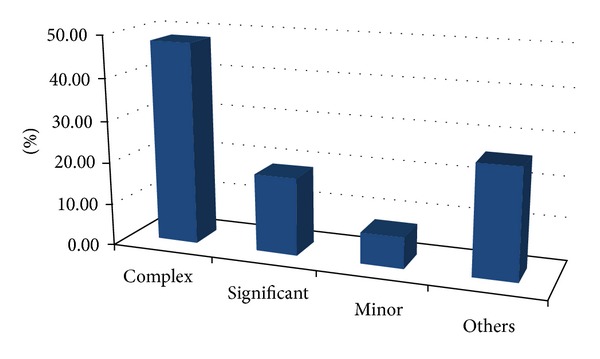
Objective. To describe the experience of a tertiary center in Brazil to which patients are referred whose fetuses are at increased risk for congenital heart diseases (CHDs). Methods. This was a cross-sectional observational study. The data was collected prospectively, during the year 2012, through a screening protocol of the fetal heart adapted from the International Society of Ultrasound in Obstetrics and Gynecology (ISUOG) guideline. We performed a fetal echocardiogram screening for all pregnant women who were referred to the fetal cardiology outpatient obstetrics clinic of a university hospital. The exams were classified as normal or abnormal. The cases considered abnormal were undergone to a postnatal echocardiogram. We categorized the abnormal fetal heart according to severity in "complex," "significant," "minor," and "others." Results. We performed 271 fetal heart screening. The incidence of abnormal screenings was 9.96% (27 fetuses). The structural CHD when categorized due to severity showed 48.1% (n = 13) of "complex" cases, 18.5% (n = 5) "significant" cases, and 7.4% (n = 2) "minor" cases. The most common referral reason was by maternal causes (67%) followed by fetal causes (33%). The main referral indication was maternal metabolic disease (30%), but there was just one fetus with CHD in such cases (1.2%). CHDs were found in 19/29 fetuses with suspicion of some cardiac abnormality by obstetrician (65.5%). Conclusion. We observed a high rate of CHD in our population. We also found that there was higher incidence of complex cases.
目的。描述巴西一家三级中心的经验,该中心接收胎儿患先天性心脏病(CHD)风险增加的患者。
方法。这是一项横断面观察性研究。数据是通过从国际妇产科超声学会(ISUOG)指南改编的胎儿心脏筛查方案前瞻性收集的,于 2012 年进行。我们对所有转诊到大学医院胎儿心脏病门诊妇产科的孕妇进行了胎儿超声心动图筛查。检查结果分为正常或异常。将被认为异常的病例进行了产后超声心动图检查。我们根据严重程度将异常胎儿心脏分为“复杂”、“显著”、“轻微”和“其他”。
结果。我们进行了 271 例胎儿心脏筛查。异常筛查的发生率为 9.96%(27 例)。根据严重程度对结构性 CHD 进行分类显示,“复杂”病例占 48.1%(n=13),“显著”病例占 18.5%(n=5),“轻微”病例占 7.4%(n=2)。最常见的转诊原因是母体原因(67%),其次是胎儿原因(33%)。主要转诊指征是母体代谢性疾病(30%),但在这些病例中只有 1 例胎儿患有 CHD(1.2%)。在妇产科医生怀疑存在某些心脏异常的 29 例胎儿中,发现了 19 例 CHD(65.5%)。
结论。我们观察到我们人群中的 CHD 发生率较高。我们还发现复杂病例的发生率较高。