Zhang ZiCheng, Xu Jin, Zhou Tao, Yi Yan, Li HongSheng, Sun HongFu, Huang Wei, Wang DongQing, Li BaoSheng, Ying GuoGuang
Tianjin Medical University Cancer Institute and Hospital, Tianjin, China.
Radiat Oncol. 2014 Feb 15;9:54. doi: 10.1186/1748-717X-9-54.
To analyze the clinical and dosimetric risk factors of acute esophagitis (AE) in non-small-cell lung cancer (NSCLC) patients treated with concomitant chemoradiotherapy.
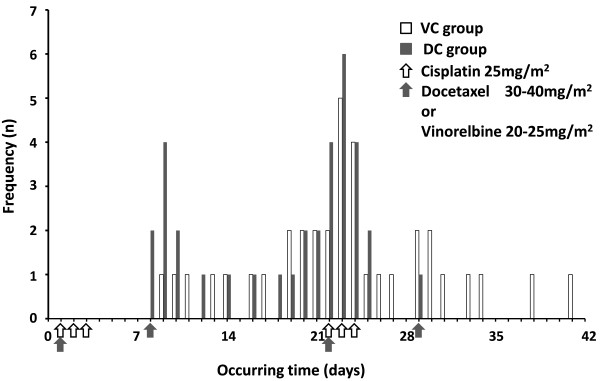
Seventy-six NSCLC patients treated with concomitant chemoradiotherapy were retrospectively analyzed. Forty-one patients received concomitant chemoradiotherapy with vinorelbine/cisplatin (VC), 35 with docetaxel/cisplatin (DC). AE was graded according to criteria of the Radiation Therapy Oncology Group (RTOG). The following clinical and dosimetric parameters were analyzed: gender, age, clinical stage, Karnofsky performance status (KPS), pretreatment weight loss, concomitant chemotherapy agents (CCA) (VC vs. DC), percentage of esophagus volume treated to ≥ 20 (V20), ≥ 30 (V30), ≥ 40 (V40), ≥ 50 (V50) and ≥ 60 Gy (V60), and the maximum (Dmax) and mean doses (Dmean) delivered to esophagus. Univariate and multivariate logistic regression analysis were used to test the association between the different factors and AE.
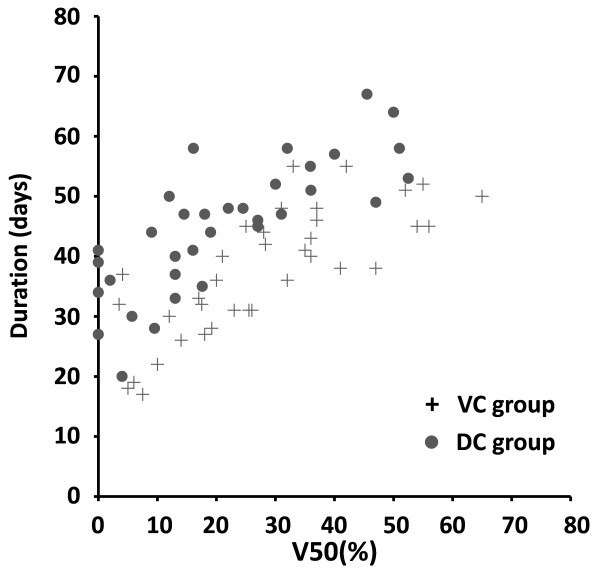
Seventy patients developed AE (Grade 1, 19 patients; Grade 2, 36 patients; and Grade 3, 15 patients). By multivariate logistic regression analysis, V40 was the only statistically significant factor associated with Grade ≥ 2 AE (p<0.001, OR = 1.159). A V40 of <23% had a 33.3% (10/30) risk of Grade ≥ 2 AE, which increased to 89.1% (41/46) with a V40 of ≥ 23% (p<0.001). CCA (p =0.01; OR = 9.686) and V50 (p<0.001; OR = 1.122) were most significantly correlated with grade 3 AE. A V50 of <26.5% had a 6.7% (3/45) risk of Grade 3 AE, which increased to 38.7% (12/31) with a V50 of ≥ 26.5% (p = 0.001). On the linear regression analysis, V50 and CCA were significant independent factors affecting AE duration. Patients who received concomitant chemotherapy with VC had a decreased risk of grade 3 AE and shorter duration compared with DC.
Concomitant chemotherapy agents have potential influence on AE. Concomitant chemotherapy with VC led to lower risk of AE compared with that using DC. V40 and V50 of esophagus can predict grade ≥ 2 and ≥ 3 AE, respectively.
分析接受同步放化疗的非小细胞肺癌(NSCLC)患者发生急性食管炎(AE)的临床和剂量学危险因素。
回顾性分析76例接受同步放化疗的NSCLC患者。41例患者接受长春瑞滨/顺铂(VC)同步放化疗,35例接受多西他赛/顺铂(DC)同步放化疗。根据放射肿瘤学组(RTOG)标准对AE进行分级。分析以下临床和剂量学参数:性别、年龄、临床分期、卡诺夫斯基体能状态(KPS)、治疗前体重减轻情况、同步化疗药物(CCA)(VC与DC)、接受≥20(V20)、≥30(V30)、≥40(V40)、≥50(V50)和≥60 Gy(V60)照射的食管体积百分比,以及食管接受的最大剂量(Dmax)和平均剂量(Dmean)。采用单因素和多因素逻辑回归分析来检验不同因素与AE之间的关联。
70例患者发生AE(1级,19例;2级,36例;3级,15例)。多因素逻辑回归分析显示,V40是与≥2级AE相关的唯一具有统计学意义的因素(p<0.001,OR = 1.159)。V40<23%时,≥2级AE的风险为33.3%(10/30),V40≥23%时,该风险增至89.1%(41/46)(p<0.001)。CCA(p = 0.01;OR = 9.686)和V50(p<0.001;OR = 1.122)与3级AE最显著相关。V50<26.5%时,3级AE的风险为6.7%(3/45),V50≥26.5%时,该风险增至38.7%(12/31)(p = 0.001)。线性回归分析显示,V50和CCA是影响AE持续时间的显著独立因素。与DC相比,接受VC同步化疗的患者3级AE风险降低且持续时间更短。
同步化疗药物对AE有潜在影响。与使用DC相比,VC同步化疗导致AE风险更低。食管的V40和V50可分别预测≥2级和≥3级AE。