Zhejiang Key Laboratory for Reactive Chemistry on Solid Surfaces, Institute of Physical Chemistry, Zhejiang Normal University, Jinhua, Zhejiang 321004, China.
Nanoscale Res Lett. 2014 Feb 17;9(1):77. doi: 10.1186/1556-276X-9-77.
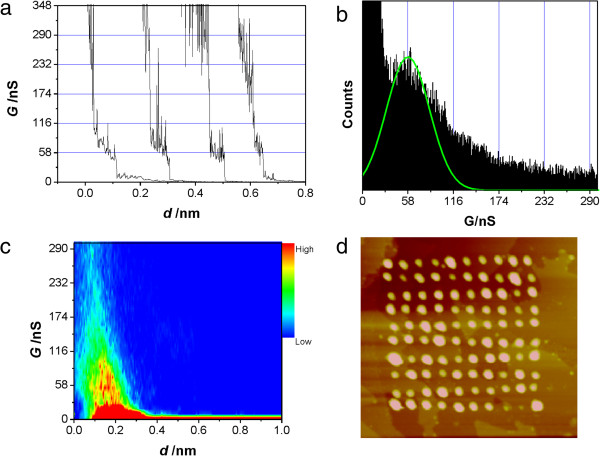
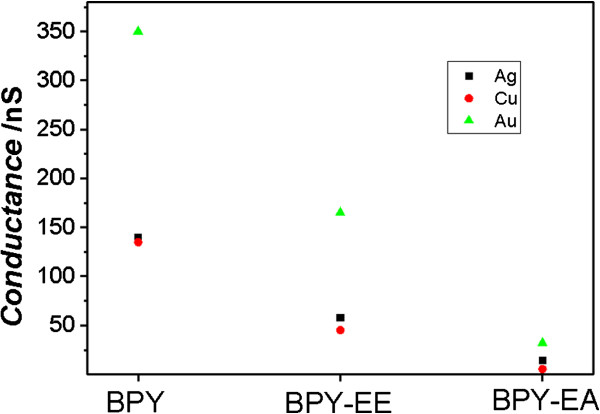
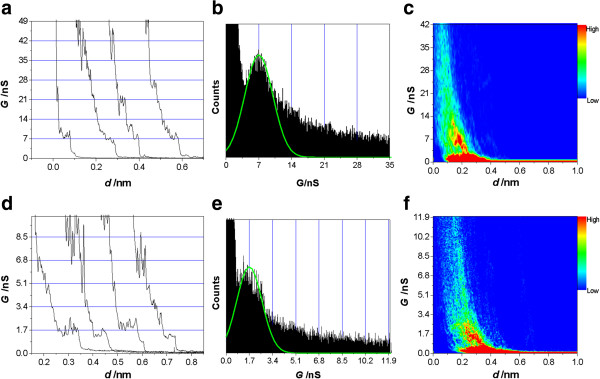
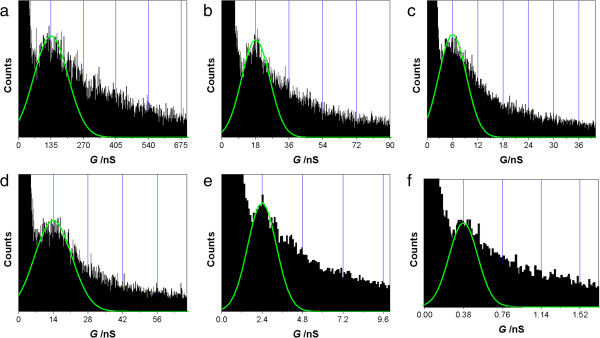
We have measured the conductance of three pyridyl-terminated molecules binding to Ag electrodes by using electrochemical jump-to-contact scanning tunneling microscopy break junction approach (ECSTM-BJ). Three molecules, including 4,4'-bipyridine (BPY), 1,2-di(pyridin-4-yl)ethene (BPY-EE), and 1,2-di(pyridin-4-yl)ethane (BPY-EA), contacting with Ag electrodes show three sets of conductance values, which follow the order of BPY > BPY-EE > BPY-EA. These values are smaller than those of molecules with Au electrodes, but larger than those of molecules with Cu electrodes. The difference may attribute to the different electronic coupling efficiencies between the molecules and electrodes. Moreover, the influence of the electrochemical potential on the Fermi level of electrodes is also discussed.
我们通过电化学跳跃接触扫描隧道显微镜断接(ECSTM-BJ)方法测量了三个吡啶末端分子与 Ag 电极结合的电导。三个分子,包括 4,4'-联吡啶(BPY)、1,2-二(吡啶-4-基)乙烯(BPY-EE)和 1,2-二(吡啶-4-基)乙烷(BPY-EA)与 Ag 电极接触显示出三组电导值,其顺序为 BPY>BPY-EE>BPY-EA。这些值小于与 Au 电极的分子的值,但大于与 Cu 电极的分子的值。这种差异可能归因于分子和电极之间不同的电子耦合效率。此外,还讨论了电化学势对电极费米能级的影响。