Laboratory of Cell and Developmental Genetics, Department of Medicine, VA Medical Center & Institute for Human Genetics, University of California, 4150 Clement Street, San Francisco, CA, USA.
Cell Biosci. 2014 Feb 17;4(1):9. doi: 10.1186/2045-3701-4-9.
The human TSPY is the putative gene for the gonadoblastoma locus on the Y chromosome (GBY). Various molecular, pathological and transgenic mouse studies suggest that TSPY is a Y-located proto-oncogene contributing to the initiation/progression in human cancers, including germ cell tumors and various somatic cancers, such as prostate and liver cancer, and melanoma. The TgTSPY9 transgenic mouse line harbors a 8.2-kb human TSPY structural gene, which is tandemly integrated in the mouse Y chromosome, and expressed in a similar pattern as that of the endogenous gene in the human genome. This mouse model of human TSPY gene offers an opportunity to examine its behavior and potential contribution in various mouse models of human diseases, such as human cancers. We had investigated the expression of such TSPY-transgene in the LADY mouse model of prostate cancer, harboring a SV40 T antigen gene directed by a rat probasin promoter; and compared the expression pattern with those of endogenous TSPY gene and biomarkers in human prostate cancer specimens.
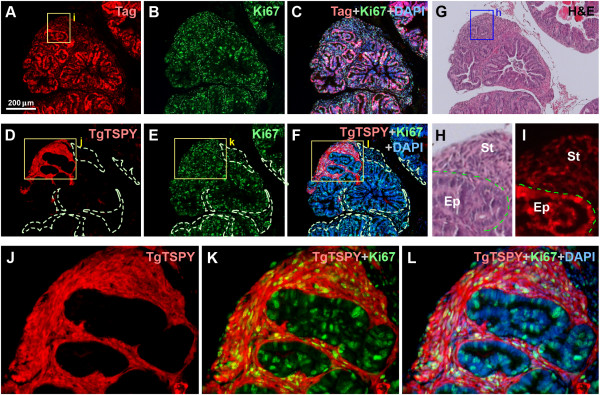
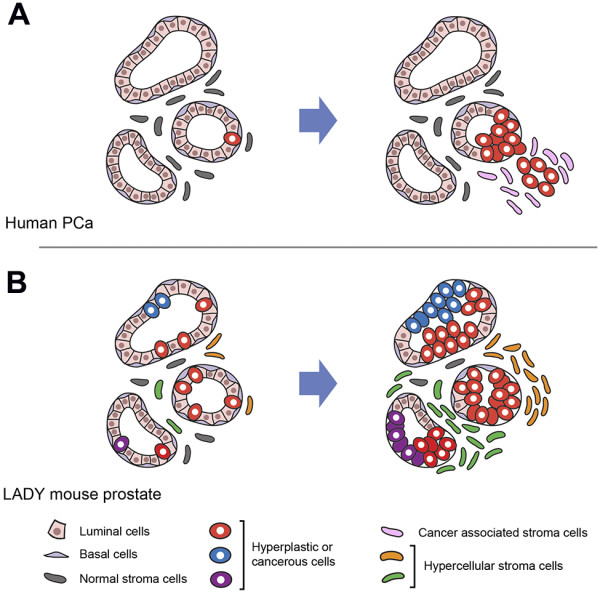
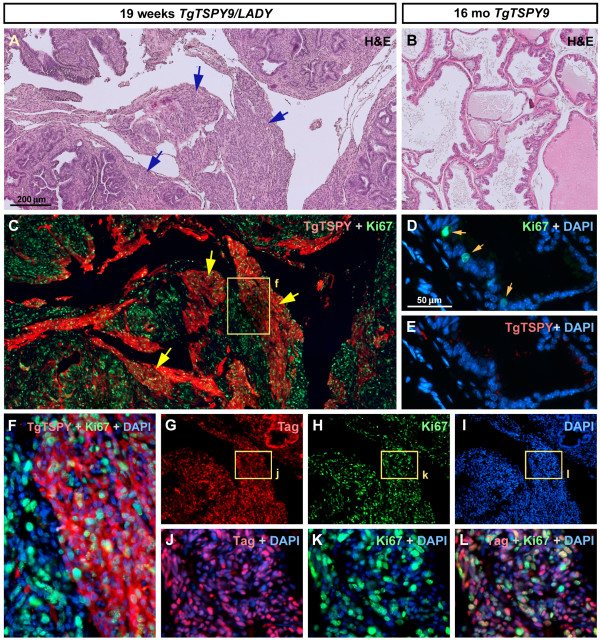
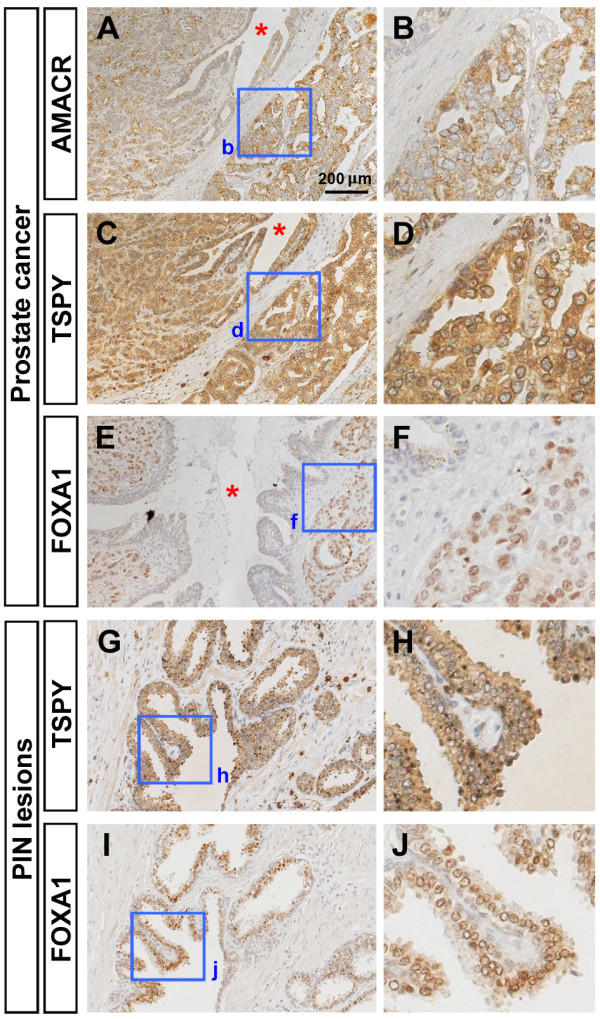
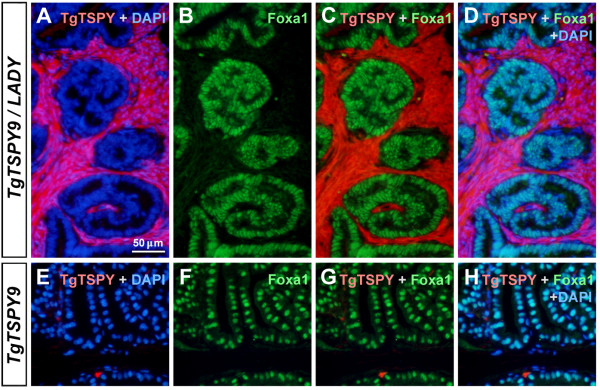
By introducing the Y-located TSPY-transgene to the LADY mice, we had examined the expression pattern of the human TSPY during prostatic oncogenesis in this mouse model of prostate cancer. Our results showed that the TSPY-transgene was activated in selected areas of the hypercellular stroma but not in the intraepithelial cells/neoplasia in the prostates of TgTSPY9/LADY mice. Using a specific biomarker, FOXA1, for epithelial cells, we demonstrated that TSPY-positive cells proliferated exclusively in the cancerous stroma in the LADY model at late stages of tumorigenesis. In contrast, in the human situation, TSPY was predominantly co-expressed with FOXA1 in the epithelial cells of PIN lesions and FOXA1 and another cancer biomarker, AMACR, in the adenocarcinoma cells in clinical prostate cancer samples of various degrees of malignancy.
Our data show that human TSPY could be abnormally activated during prostatic oncogenesis, and could possibly contribute to the heterogeneity of prostate cancer. The differential expression patterns of the human TSPY between the LADY mouse model and clinical prostate cancer suggest potential limitations of current mouse models for studies of either TSPY behavior in diseased conditions or prostate cancer development.
人类 TSPY 是 Y 染色体性腺母细胞瘤(GBY)位置的假定基因。各种分子、病理学和转基因小鼠研究表明,TSPY 是一种位于 Y 染色体上的原癌基因,有助于启动/进展人类癌症,包括生殖细胞瘤和各种体细胞癌,如前列腺癌和肝癌以及黑色素瘤。TgTSPY9 转基因小鼠品系携带一个 8.2kb 的人类 TSPY 结构基因,该基因串联整合在小鼠 Y 染色体上,并以与人类基因组中内源性基因相似的模式表达。这种人类 TSPY 基因的小鼠模型为研究其在各种人类疾病的小鼠模型中的行为和潜在贡献提供了机会,例如人类癌症。我们研究了携带 SV40 T 抗原基因的大鼠前列腺珠蛋白启动子指导的 LADY 前列腺癌小鼠模型中 TSPY 转基因的表达,并将其表达模式与人类前列腺癌标本中的内源性 TSPY 基因和生物标志物进行了比较。
通过将 Y 染色体上的 TSPY 转基因引入 LADY 小鼠,我们在这种前列腺癌的小鼠模型中研究了人类 TSPY 在前列腺癌发生过程中的表达模式。我们的结果表明,TSPY 转基因在增生的基质的选定区域被激活,但不在 TgTSPY9/LADY 小鼠前列腺的上皮细胞/肿瘤中被激活。使用上皮细胞的特异性生物标志物 FOXA1,我们证明 TSPY 阳性细胞仅在 LADY 模型肿瘤发生的晚期在癌性基质中增殖。相比之下,在人类中,TSPY 主要与 PIN 病变中的 FOXA1 和临床前列腺癌样本中不同恶性程度的腺癌细胞中的另一个癌症生物标志物 AMACR 共表达。
我们的数据表明,人类 TSPY 可能在前列腺癌发生过程中异常激活,并可能有助于前列腺癌的异质性。LADY 小鼠模型和临床前列腺癌之间人类 TSPY 的差异表达模式表明,当前的小鼠模型在研究 TSPY 在疾病状态下的行为或前列腺癌的发展方面存在潜在的局限性。