Long Yunling, Yu Hongyu, Zhuo Zhizheng, Zhang Ying, Wang Yang, Yang Xinjian, Li Haiyun
School of Biomedical Engineering, Capital Medical University, Beijing 100069, China.
Biomed Eng Online. 2014 Feb 17;13:17. doi: 10.1186/1475-925X-13-17.
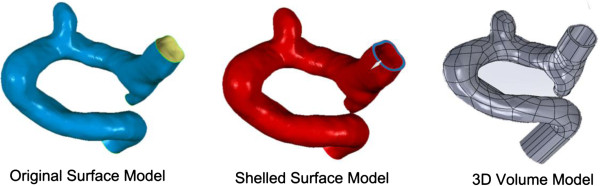
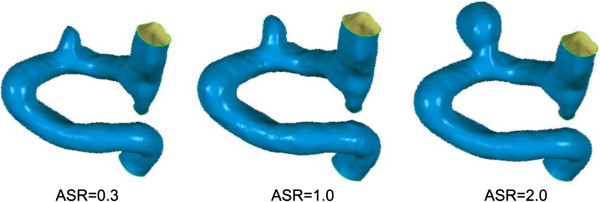
The intracranial aneurysm (IA) size has been proved to have impacts on the hemodynamics and can be applied for the prediction of IA rupture risk. Although the relationship between aspect ratio and hemodynamic parameters was investigated using real patients and virtual models, few studies focused on longitudinal experiments of IAs based on patient-specific aneurysm models. We attempted to do longitudinal simulation experiments of IAs by developing a series of scaled models.
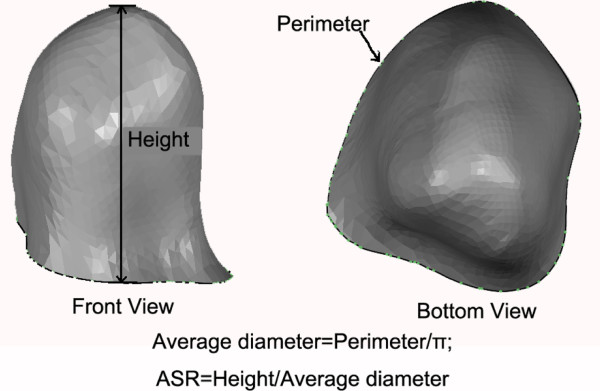
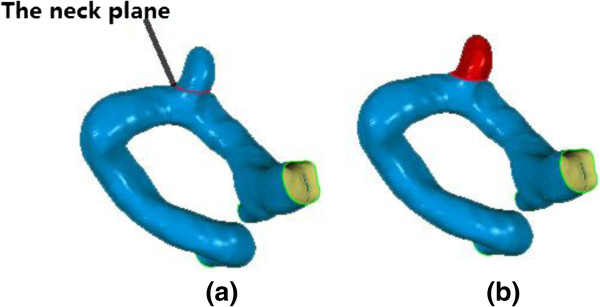
In this work, a novel scaling approach was proposed to create IA models with different aneurysm size ratios (ASRs) defined as IA height divided by average neck diameter from a patient-specific aneurysm model and the relationship between the ASR and hemodynamics was explored based on a simulated longitudinal experiment. Wall shear stress, flow patterns and vessel wall displacement were computed from these models. Pearson correlation analysis was performed to elucidate the relationship between the ASR and wall shear stress. The correlation of the ASR and flow velocity was also computed and analyzed.
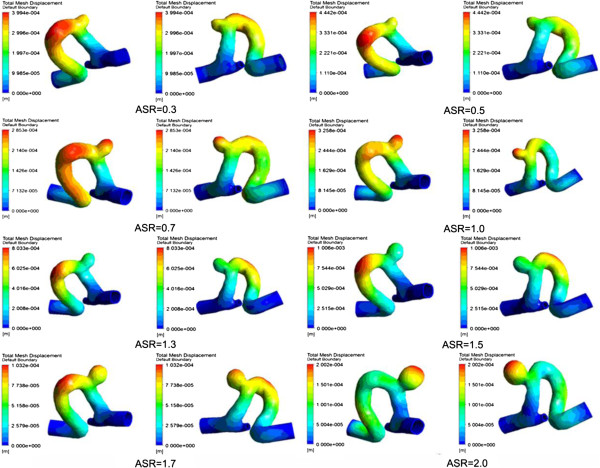
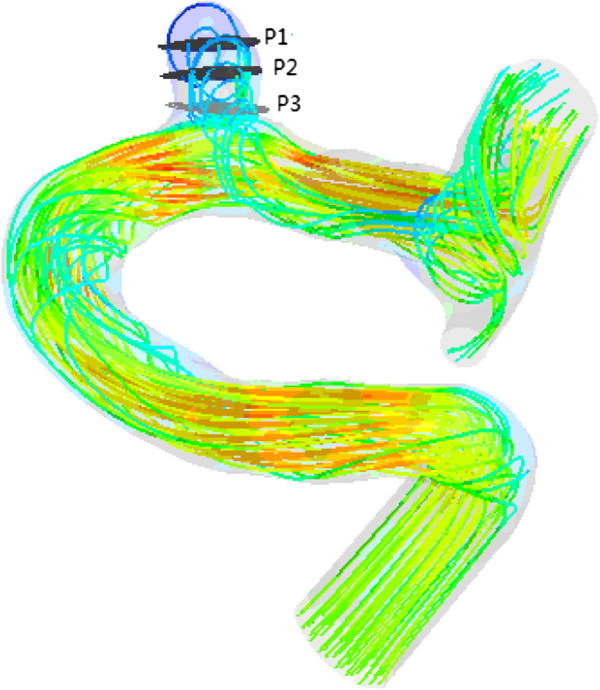
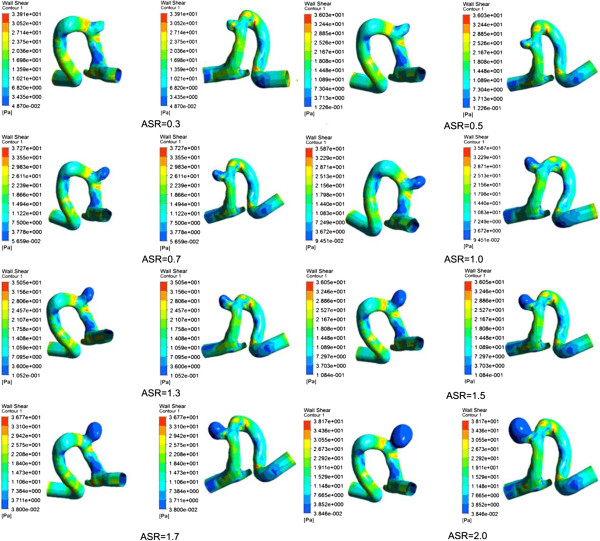
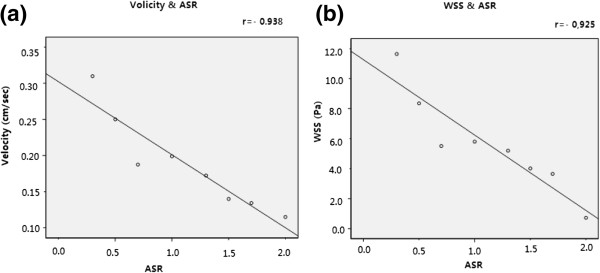
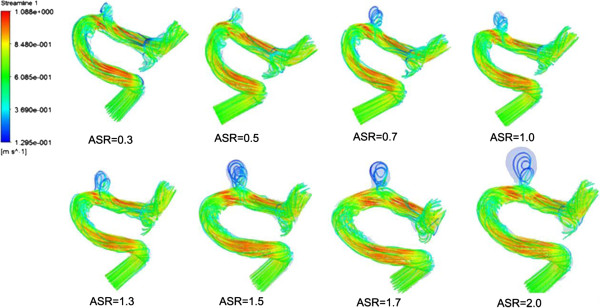
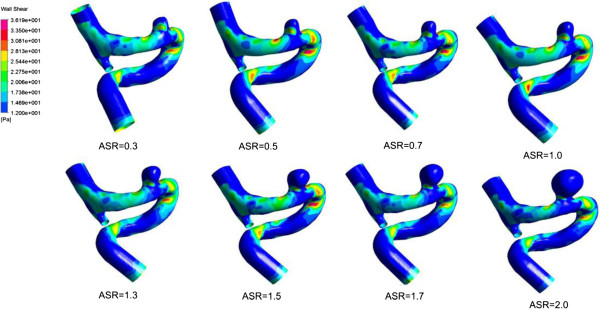
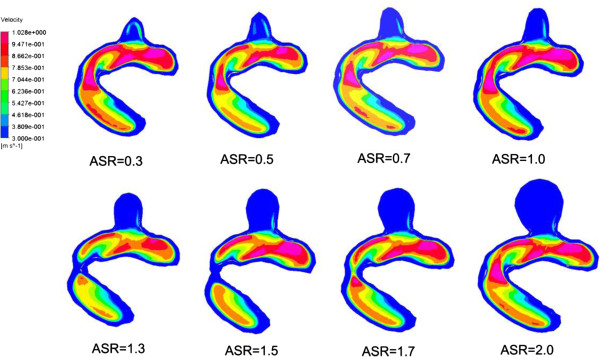
The experiment results showed that there was a significant increase in IA area exposed to low WSS once the ASR > 0.7, and the flow became slower and the blood was more difficult to flow into the aneurysm as the ASR increased. Meanwhile, the results also indicated that average blood flow velocity and WSS had strongly negative correlations with the ASR (r = -0.938 and -0.925, respectively). A narrower impingement region and a more concentrated inflow jet appeared as the ASR increased, and the large local deformation at aneurysm apex could be found as the ASR >1.7 or 0.7 < the ASR <1.0.
Hemodynamic characteristics varied with the ASR. Besides, it is helpful to further explore the relationship between morphologies and hemodynamics based on a longitudinal simulation by building a series of patient-specific aneurysm scaled models applying our proposed IA scaling algorithm.
颅内动脉瘤(IA)的大小已被证明对血流动力学有影响,可用于预测IA破裂风险。尽管使用真实患者和虚拟模型研究了纵横比与血流动力学参数之间的关系,但很少有研究关注基于患者特异性动脉瘤模型的IA纵向实验。我们试图通过开发一系列缩放模型来进行IA的纵向模拟实验。
在这项工作中,提出了一种新颖的缩放方法,以从患者特异性动脉瘤模型创建具有不同动脉瘤大小比(ASR)的IA模型,ASR定义为IA高度除以平均颈部直径,并基于模拟纵向实验探索ASR与血流动力学之间的关系。从这些模型中计算壁面剪应力、流动模式和血管壁位移。进行Pearson相关分析以阐明ASR与壁面剪应力之间的关系。还计算并分析了ASR与流速的相关性。
实验结果表明,一旦ASR>0.7,暴露于低壁面剪应力的IA面积显著增加,并且随着ASR的增加,血流变慢,血液流入动脉瘤更加困难。同时,结果还表明平均血流速度和壁面剪应力与ASR呈强负相关(分别为r = -0.938和-0.925)。随着ASR的增加,撞击区域变窄,流入射流更加集中,并且当ASR>1.7或0.7<ASR<1.0时,可在动脉瘤顶端发现较大的局部变形。
血流动力学特征随ASR而变化。此外,通过应用我们提出的IA缩放算法构建一系列患者特异性动脉瘤缩放模型,基于纵向模拟进一步探索形态学与血流动力学之间的关系是有帮助的。