Department of Anatomy and Neurobiology and Institute of Neurobiology, University of Puerto Rico, Medical Sciences Campus, San Juan 00936, Puerto Rico.
Department of Anatomy and Neurobiology and Institute of Neurobiology, University of Puerto Rico, Medical Sciences Campus, San Juan 00936, Puerto Rico.
Life Sci. 2014 Apr 17;101(1-2):1-9. doi: 10.1016/j.lfs.2014.01.083. Epub 2014 Feb 13.
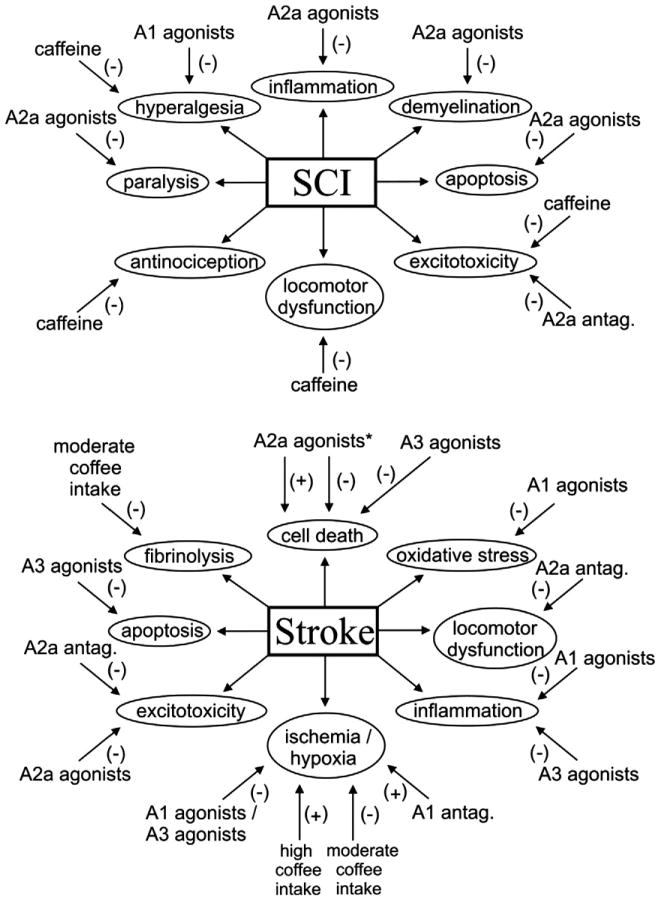
Caffeine is the most consumed pychostimulant in the world, and it is known to affect basic and fundamental human processes such as sleep, arousal, cognition and learning and memory. It works as a nonselective blocker of adenosine receptors (A1, A2a, A2b and A3) and has been related to the regulation of heart rate, the contraction/relaxation of cardiac and smooth muscles, and the neural signaling in the central nervous system (CNS). Since the late 1990s, studies using adenosine receptor antagonists, such as Caffeine, to block the A1 and A2a adenosine receptor subtypes have shown to reduce the physical, cellular and molecular damages caused by a spinal cord injury (SCI) or a stroke (cerebral infarction) and by other neurodegenerative diseases such as Parkinson's and Alzheimer's diseases. Interestingly, other studies using adenosine receptor agonists have also shown to provide a neuroprotective effect on various models of neurodegenerative diseases through the reduction of excitatory neurotransmitter release, apoptosis and inflammatory responses, among others. The seemingly paradoxical use of both adenosine receptor agonists and antagonists as neuroprotective agents has been attributed to differences in dosage levels, drug delivery method, extracellular concentration of excitatory neurotransmitters and stage of disease progression. We discuss and compare recent findings using both antagonists and agonists of adenosine receptors in animal models and patients that have suffered spinal cord injuries, brain strokes, and Parkinson's and Alzheimer's diseases. Additionally, we propose alternative interpretations on the seemingly paradoxical use of these drugs as potential pharmacological tools to treat these various types of neurodegenerative diseases.
咖啡因是世界上使用最广泛的精神兴奋剂,已知它会影响人类的基本过程,如睡眠、觉醒、认知和学习记忆。它作为一种非选择性的腺苷受体(A1、A2a、A2b 和 A3)阻断剂,与心率调节、心脏和平滑肌的收缩/松弛以及中枢神经系统(CNS)中的神经信号有关。自 20 世纪 90 年代末以来,使用腺苷受体拮抗剂(如咖啡因)阻断 A1 和 A2a 腺苷受体亚型的研究表明,它可以减轻脊髓损伤(SCI)或中风(脑梗死)以及其他神经退行性疾病(如帕金森病和阿尔茨海默病)引起的身体、细胞和分子损伤。有趣的是,其他使用腺苷受体激动剂的研究也表明,通过减少兴奋性神经递质的释放、细胞凋亡和炎症反应等,在各种神经退行性疾病模型中具有神经保护作用。作为神经保护剂,腺苷受体激动剂和拮抗剂的看似矛盾的使用,归因于剂量水平、药物输送方法、兴奋性神经递质的细胞外浓度和疾病进展阶段的差异。我们讨论并比较了最近在动物模型和患有脊髓损伤、中风、帕金森病和阿尔茨海默病的患者中使用腺苷受体拮抗剂和激动剂的研究结果。此外,我们对这些药物的看似矛盾的使用提出了替代解释,认为它们是治疗各种类型的神经退行性疾病的潜在药理学工具。