Yuan Xin, Xia Lu, Dong Xia, Hu Shenqiang, Zhang Yingying, Ding Fang, Liu Hehe, Li Liang, Wang Jiwen
Institute of Animal Genetics and Breeding, College of Animal Science and Technology, Sichuan Agricultural University, Sichuan 625014, P.R. China.
J Reprod Dev. 2014 Apr 24;60(2):83-91. doi: 10.1262/jrd.2013-080. Epub 2014 Feb 17.
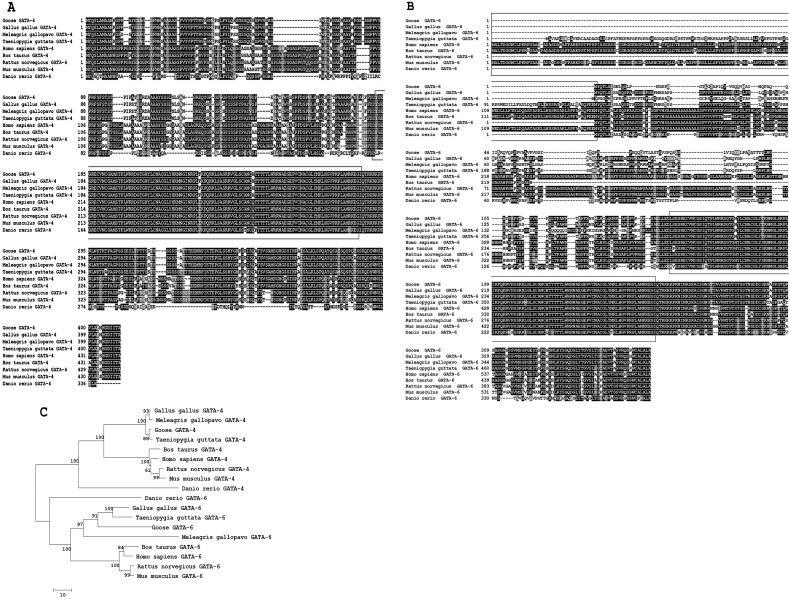
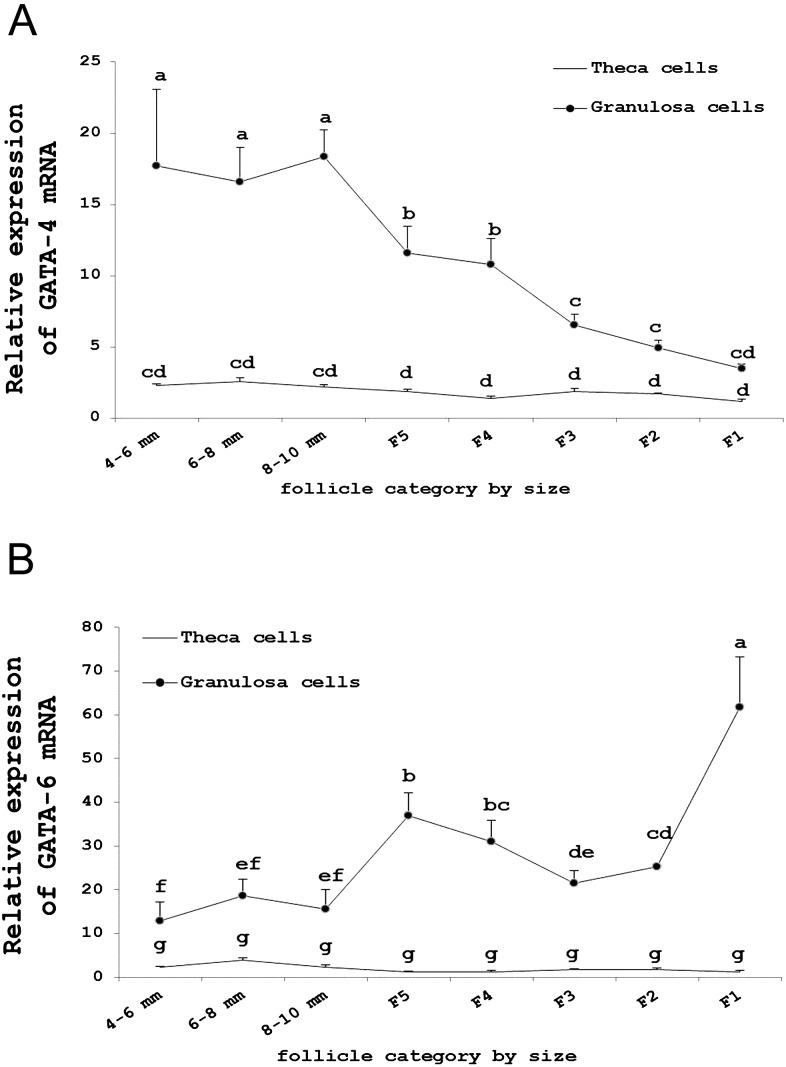
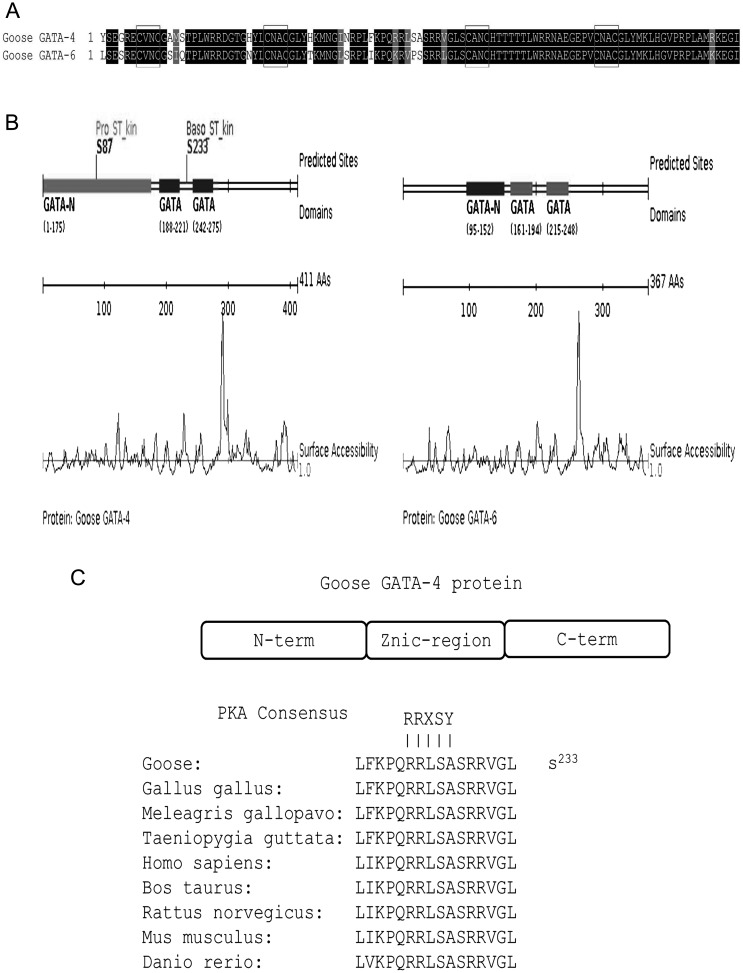
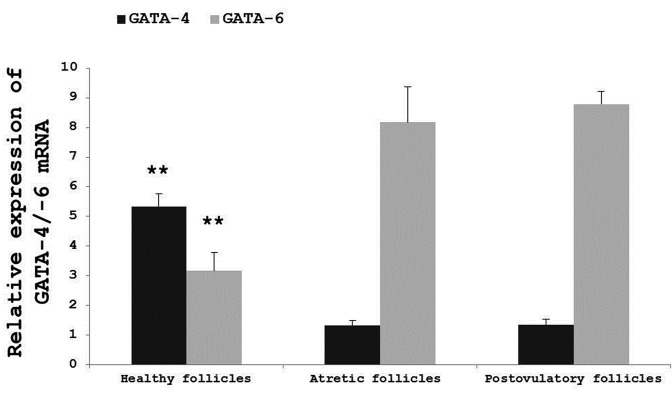
The transcription factors GATA-4 and GATA-6, members of the GATA family, play an important role in ovarian cell proliferation, differentiation and apoptosis. In this study, the full-length coding sequences of goose GATA-4 and GATA-6 were cloned and characterized. GATA-4 and GATA-6 consist of 1236 and 1104 nucleotides encoding proteins with 411 and 367 amino acids, respectively. The deduced amino acid sequences of both proteins include two adjacent zinc finger domains with the distinctive form (CVNC-X17-CNAC)-X29-(CANC-X17-CNAC) and share 84.76% identity within this domain. In silico prediction together with matching of the high affinity RRXS(T)Y motif revealed that the GATA-4 protein might be phosphorylated predominantly at S(233), but no phosphorylation site was found in the GATA-6 protein. Real-time quantitative PCR analysis showed that GATA-4 and GATA-6 mRNAs were co-expressed in goose follicles, moderately expressed in granulosa cells and weakly expressed in theca cells. The expression level of GATA-4 mRNA in healthy follicles was significantly higher than in atretic follicles or postovulatory follicles (P<0.01), and the expression level of GATA-6 mRNA in healthy follicles was significantly lower than in atretic follicles or postovulatory follicles (P<0.01). The expression level of GATA-4 mRNA in granulosa cells was downregulated during follicle development; the peak of expression occurred in the 8-10 mm follicles, and the lowest expression was in the F1 follicles. GATA-6 was upregulated and reached its peak expression in the F1 follicles. These results indicate that the molecular structural differences in goose GATA-4 and GATA-6 may be related to their different roles during follicle development.
转录因子GATA-4和GATA-6是GATA家族的成员,在卵巢细胞增殖、分化和凋亡中发挥重要作用。本研究克隆并鉴定了鹅GATA-4和GATA-6的全长编码序列。GATA-4和GATA-6分别由1236和1104个核苷酸组成,编码的蛋白质分别含有411和367个氨基酸。两种蛋白质推导的氨基酸序列均包含两个相邻的锌指结构域,其独特形式为(CVNC-X17-CNAC)-X29-(CANC-X17-CNAC),且该结构域内的序列一致性为84.76%。计算机模拟预测以及与高亲和力RRXS(T)Y基序的匹配显示,GATA-4蛋白可能主要在S(233)位点磷酸化,但在GATA-6蛋白中未发现磷酸化位点。实时定量PCR分析表明,GATA-4和GATA-6 mRNA在鹅卵泡中共同表达,在颗粒细胞中中度表达,在膜细胞中弱表达。健康卵泡中GATA-4 mRNA的表达水平显著高于闭锁卵泡或排卵后卵泡(P<0.01),而健康卵泡中GATA-6 mRNA的表达水平显著低于闭锁卵泡或排卵后卵泡(P<0.01)。颗粒细胞中GATA-4 mRNA的表达水平在卵泡发育过程中下调;表达峰值出现在8-10毫米的卵泡中,最低表达出现在F1卵泡中。GATA-6上调并在F1卵泡中达到表达峰值。这些结果表明,鹅GATA-4和GATA-6的分子结构差异可能与其在卵泡发育过程中的不同作用有关。