Ramey Andrew M, Fleskes Joseph P, Schmutz Joel A, Yabsley Michael J
US Geological Survey, Alaska Science Center, 4210 University Drive, Anchorage, AK 99508, USA ; Southeastern Cooperative Wildlife Disease Study, The University of Georgia, 589 D.W. Brooks Drive, Athens, GA 30602, USA.
US Geological Survey, Western Ecological Research Center, 800 Business Park Drive, Suite D, Dixon, CA 95620, USA.
Int J Parasitol Parasites Wildl. 2013 Mar 5;2:102-9. doi: 10.1016/j.ijppaw.2013.02.001. eCollection 2013 Dec.
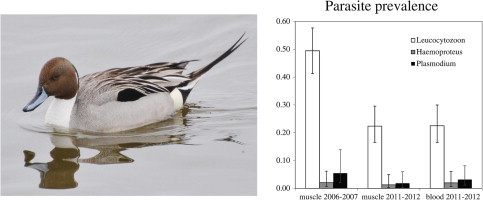
Information on the molecular detection of hematozoa from different tissue types and multiple years would be useful to inform sample collection efforts and interpret results of meta-analyses or investigations spanning multiple seasons. In this study, we tested blood and muscle tissue collected from northern pintails (Anas acuta) during autumn and winter of different years to evaluate prevalence and genetic diversity of Leucocytozoon, Haemoproteus, and Plasmodium infections in this abundant waterfowl species of the Central Valley of California. We first compared results for paired blood and wing muscle samples to assess the utility of different tissue types for molecular investigations of haemosporidian parasites. Second, we explored inter-annual variability of hematozoa infection in Central Valley northern pintails and investigated possible effects of age, sex, and sub-region of sample collection on estimated parasite detection probability and prevalence. We found limited evidence for differences between tissue types in detection probability and prevalence of Leucocytozoon, Haemoproteus, and Plasmodium parasites, which supports the utility of both sample types for obtaining information on hematozoan infections. However, we detected 11 haemosporidian mtDNA cyt b haplotypes in blood samples vs. six in wing muscle tissue collected during the same sample year suggesting an advantage to using blood samples for investigations of genetic diversity. Estimated prevalence of Leucocytozoon parasites was greater during 2006-2007 as compared to 2011-2012 and four unique haemosporidian mtDNA cyt b haplotypes were detected in the former sample year but not in the latter. Seven of 15 mtDNA cyt b haplotypes detected in northern pintails had 100% identity with previously reported hematozoa lineages detected in waterfowl (Haemoproteus and Leucocytozoon) or other avian taxa (Plasmodium) providing support for lack of host specificity for some parasite lineages.
来自不同组织类型和多年的血原虫分子检测信息,将有助于指导样本采集工作,并解释跨多个季节的荟萃分析或调查结果。在本研究中,我们检测了不同年份秋冬季节从尖尾鸭(Anas acuta)采集的血液和肌肉组织,以评估加利福尼亚中央谷地这种丰富水禽物种中白细胞原虫、血变虫和疟原虫感染的患病率和遗传多样性。我们首先比较了配对的血液和翼肌样本的结果,以评估不同组织类型在血孢子虫寄生虫分子研究中的效用。其次,我们探讨了中央谷地尖尾鸭血原虫感染的年际变异性,并研究了年龄、性别和样本采集子区域对估计的寄生虫检测概率和患病率的可能影响。我们发现,在白细胞原虫、血变虫和疟原虫寄生虫的检测概率和患病率方面,不同组织类型之间的差异证据有限,这支持了两种样本类型在获取血原虫感染信息方面的效用。然而,我们在血样中检测到11种血孢子虫线粒体细胞色素b单倍型,而在同一年采集的翼肌组织中检测到6种,这表明使用血样进行遗传多样性研究具有优势。与2011 - 2012年相比,2006 - 2007年白细胞原虫寄生虫的估计患病率更高,并且在前一个采样年份检测到四种独特的血孢子虫线粒体细胞色素b单倍型,而在后一个年份未检测到。在尖尾鸭中检测到的15种线粒体细胞色素b单倍型中有7种与先前在水禽(血变虫和白细胞原虫)或其他鸟类类群(疟原虫)中检测到的血原虫谱系具有100%的同一性,这为一些寄生虫谱系缺乏宿主特异性提供了支持。